. 2021 Sep 20:8:723396.
doi: 10.3389/fmed.2021.723396. eCollection 2021.

The Epidemiology of Lung Metastases

Affiliations

The Epidemiology of Lung Metastases

Hanbo Chen et al. Front Med (Lausanne). .

Abstract

Introduction: Lung metastasis is usually associated with poor outcomes in cancer patients. This study was performed to characterize and analyze the population of patients with de novo (synchronous) lung metastases using the Surveillance, Epidemiology and End Results (SEER) database. Materials and Methods: Baseline characteristics of lung metastasis patients were obtained from SEER case listings. Incidence rates and counts of synchronous lung metastasis were also obtained using the SEER*Stat software. Survival outcomes were analyzed using univariate and multivariable Cox regressions, controlling for confounders. An alpha threshold of 0.05 was used for statistical significance and p-values were subject to correction for multiple comparisons. Results: The age-adjusted incidence rate of synchronous lung metastasis was 17.92 per 100,000 between 2010 and 2015. Synchronous lung metastases most commonly arose from primary lung cancers, colorectal cancers, kidney cancers, pancreatic cancers and breast cancers. During this time period, 4% of all cancer cases presented with synchronous lung metastasis. The percentage of patients presenting with synchronous lung metastasis ranged from 0.5% of all prostate cancers to 13% of all primary lung cancers. The percentage of all cancer cases presenting with synchronous lung metastasis increased over time. De novo metastatic patients with lung metastases had worse overall survival [hazard ratio = 1.22 (1.21-1.23), p < 0.001] compared to those with only extrapulmonary metastases, controlling for potential confounders. Conclusions: Synchronous lung metastasis occurs frequently and is an independent predictors of poor patient outcomes. As treatment for lung metastases becomes more complicated, patients with synchronous lung metastasis represent a high-risk population.

Keywords: cancer; epidemiology; lung cancer; metastases; oncology.


Conflict of interest statement

NZ received personal fees from Springer Nature Inc. and Weatherby Healthcare, unrelated to the submitted work. DT reports clinical trial research support from Novocure, and publishing fees from Springer Nature Inc. for projects unrelated to the submitted work. AL has received honoraria from Varian Medical Systems Inc. and AstraZeneca, unrelated to the current work. The remaining authors declare that the research was conducted in the absence of any commercial or financial relationships that could be construed as a potential conflict of interest.

Figures
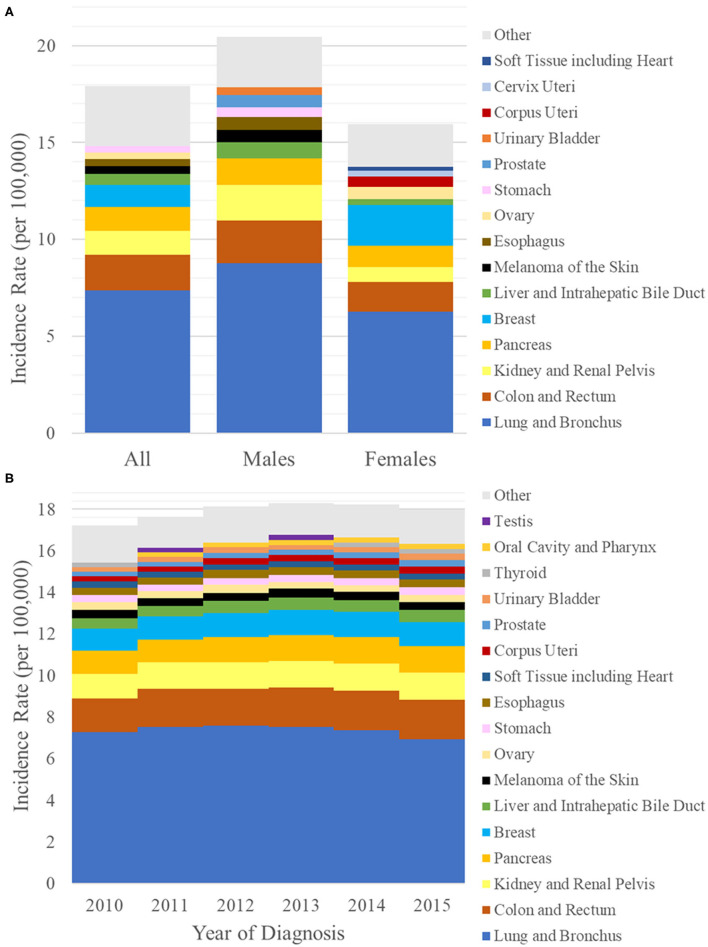
Figure 1
Figure 1
(A) Bar graph of the incidence rates per 100,000 of synchronous lung metastasis (y-axis) from 2010 to 2015 in the general population (left) and in either sex (males: middle, females: right). (B) Bar graph of the incidence rates per 100,000 of synchronous lung metastasis (y-axis) vs. year of diagnosis (x-axis) from 2010 to 2015. Each bar is broken down by primary sites of origin, which are indicated by different colors.
Figure 2
Figure 2
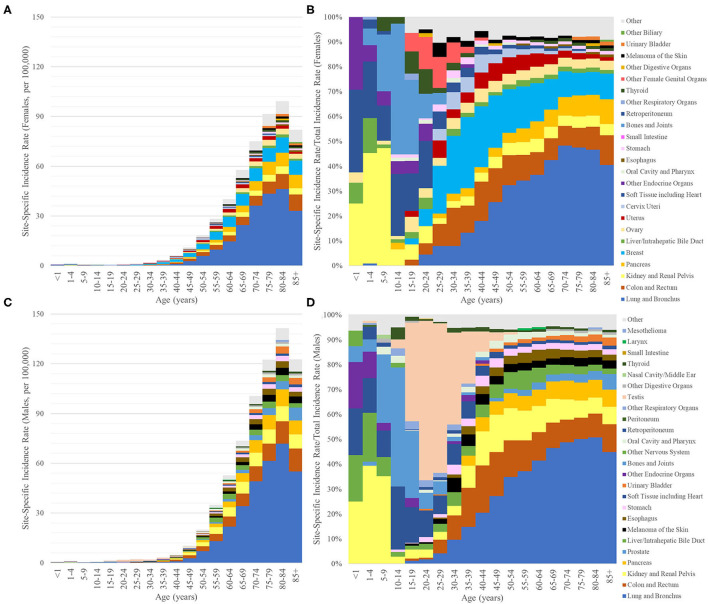
Bar graphs of the incidence rates per 100,000 of synchronous lung metastasis (y-axis) vs. age at diagnosis (x-axis, 5-year bins) broken down by primary sites of origin, which are indicated by different colors (only the top 10 for ages <15 and top 15 for ages >15). (A,B) Female. (C,D) Male. (A,C) y-axis values represent absolute incidence rates. (B,D) y-axis values represent the percentage of synchronous lung metastasis from one primary site relative to the overall incidence of synchronous lung metastasis from all primary sites for that age group.
Figure 3
Figure 3
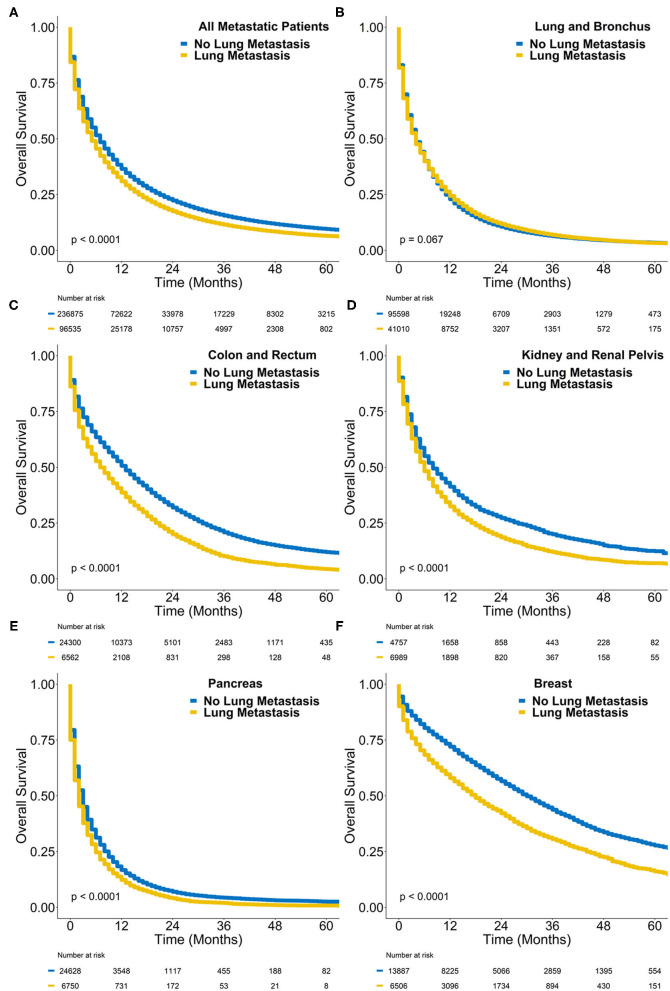
Kaplan-Meier survival plot of overall survival probability (y-axis) vs. time in months (x-axis) comparing de novo metastatic cases with synchronous lung metastasis (yellow) to those without (blue) in (A) all cases, (B) lung cancer cases, (C) colorectal cancer cases, (D) kidney cancer cases, (E) pancreatic cancer cases, and (F) breast cancer cases. The P-value represents the results of a log-rank test.
Figure 4
Figure 4
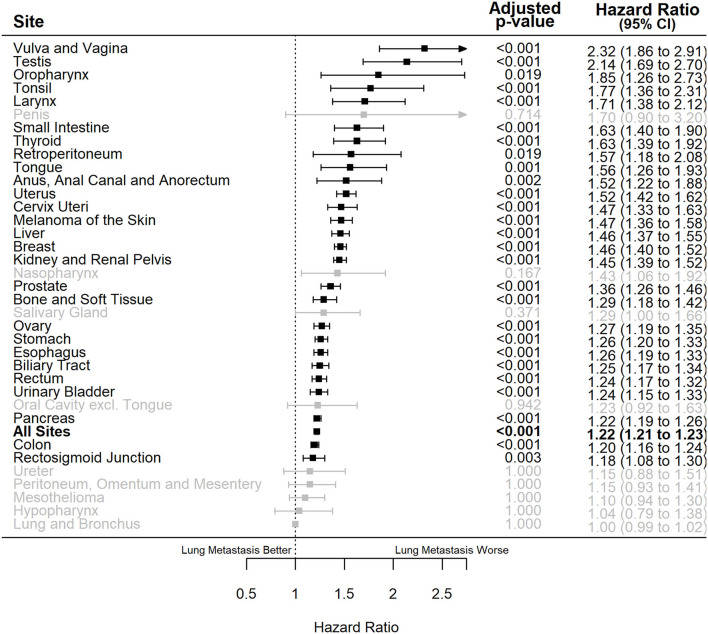
Forest plot of adjusted hazard ratios of death (x-axis) for de novo metastatic cases with lung metastasis vs. those with only extrapulmonary metastases for different primary sites of origin (y-axis). Bold: the overall effect estimate for all sites, black: statistically significant individual primary sites, gray: non-statistically significant individual primary sites. Adjusted P-values represent those corrected for multiple testing. CI, confidence interval.

References

    1. Vogelzang NJ. Prognostic factors in metastatic testicular cancer. Int J Androl. (1987) 10:225–37. 10.1111/j.1365-2605.1987.tb00188.x - DOI - PubMed
    1. Mitry E, Guiu B, Cosconea S, Jooste V, Faivre J, Bouvier AM. Epidemiology, management and prognosis of colorectal cancer with lung metastases: a 30-year population-based study. Gut. (2010) 59:1383–8. 10.1136/gut.2010.211557 - DOI - PubMed
    1. Riihimaki M, Hemminki A, Fallah M, Thomsen H, Sundquist K, Sundquist J, et al. Metastatic sites and survival in lung cancer. Lung Cancer. (2014) 86:78–84. 10.1016/j.lungcan.2014.07.020 - DOI - PubMed
    1. Riihimaki M, Hemminki A, Sundquist J, Hemminki K. Patterns of metastasis in colon and rectal cancer. Sci Rep. (2016) 6:29765. 10.1038/srep29765 - DOI - PMC - PubMed
    1. Riihimaki M, Hemminki A, Sundquist K, Sundquist J, Hemminki K. Metastatic spread in patients with gastric cancer. Oncotarget. (2016) 7:52307–16. 10.18632/oncotarget.10740 - DOI - PMC - PubMed