


Co-pathogens in Periodontitis and Inflammatory Bowel Disease
- PMID: 34616755
- PMCID: PMC8488124
- DOI: 10.3389/fmed.2021.723719
Co-pathogens in Periodontitis and Inflammatory Bowel Disease
Abstract
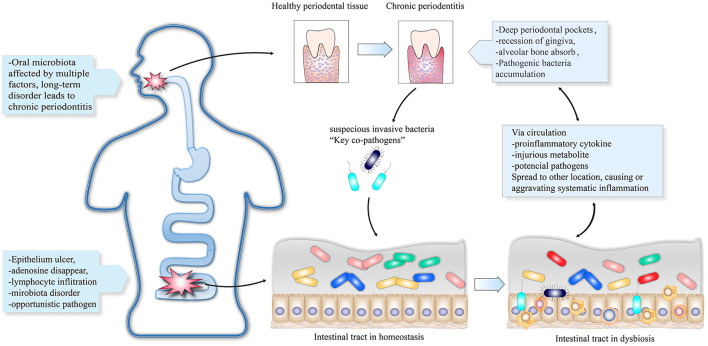
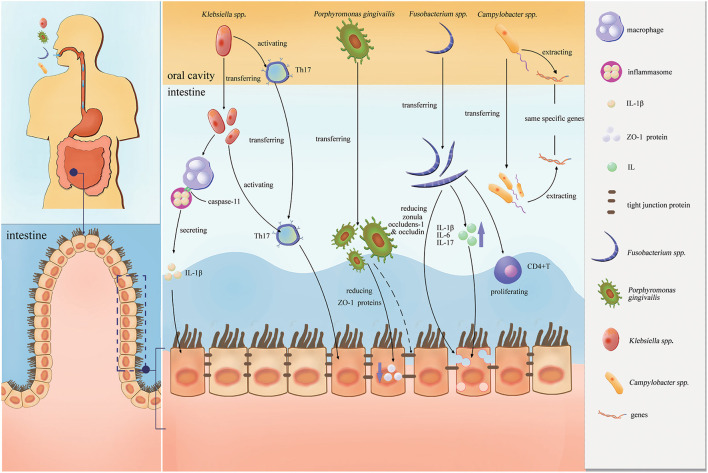
Localized inflammatory lesions in one area of the body may affect other distant organs through various modes of transmission thus initiating secondary inflammatory infections. Periodontal disease (PD) and inflammatory bowel disease (IBD) have been shown to coexist. Periodontitis is a multifactorial inflammatory disease, and dental plaque is considered to be the initial risk factor. Individuals with genetic susceptibility are more likely to develop periodontitis when exposed to external stimuli. IBD is affected by host genetics, immunoregulation, daily diet, and the gut microbiota, and its risk factors appear to be shared with those of PD. However, the key etiologies of both diseases remain unclear, thus hindering the exploration of possible links between IBD and PD. Recent studies and systematic reviews have focused on evidence-based statistics of the prevalence and clinical manifestations of both diseases, but discussions of the microbial etiological correlation between periodontitis and intestinal inflammation are scarce. Here, we summarize the potential common pathogenic microorganisms that may serve as bridges between the two diseases. Studies have shown that invasive microorganisms such as Porphyromonas gingivalis, Fusobacterium nucleatum, Klebsiella spp. and Campylobacter spp. play key roles in the comorbidity of PD and IBD.
Keywords: bacteria; inflammatory bowel disease; intestine; microbiota; periodontal disease; periodontitis.
Copyright © 2021 Cai, Zhu, Liu, Zhuang and Zhao.
Conflict of interest statement
The authors declare that the research was conducted in the absence of any commercial or financial relationships that could be construed as a potential conflict of interest.
Figures
References
-
- Chapple ILC, Mealey BL, Van Dyke TE, Bartold PM, Dommisch H, Eickholz P, et al. Periodontal health and gingival diseases and conditions on an intact and a reduced periodontium: consensus report of workgroup 1 of the 2017 World Workshop on the Classification of Periodontal and Peri-Implant Diseases and Conditions. J Clin Periodontol. (2018) 45(Suppl. 20):S68–77. 10.1002/JPER.17-0719 - DOI - PubMed
-
- Papapanou PN, Sanz M, Buduneli N, Dietrich T, Feres M, Fine DH, et al. Periodontitis: consensus report of workgroup 2 of the 2017 world workshop on the classification of periodontal and peri-implant diseases and conditions. J Periodontol. (2018) 89(Suppl. 1):S173–82. 10.1002/JPER.17-0721 - DOI - PubMed
Publication types
LinkOut - more resources
Full Text Sources
Miscellaneous
