


Understanding antibiotic use: practices, structures and networks
- PMID: 34617017
- PMCID: PMC8488471
- DOI: 10.1093/jacamr/dlab150
Understanding antibiotic use: practices, structures and networks
Abstract
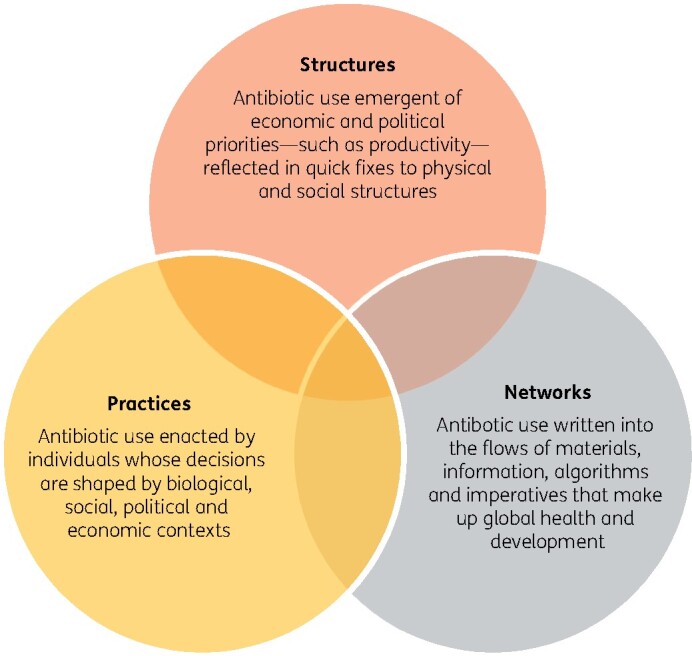
In this article, we consider how social sciences can help us to understand the rising use of antibiotics globally. Drawing on ethnography as a way to research how we are in the world, we explore scholarship that situates antibiotic use in relation to interactions of pathogens, humans, animals and the environment in the context of globalization, changes in agriculture and urbanization. We group this research into three areas: practices, structures and networks. Much of the public health and related social research concerning antimicrobial resistance has focused on antibiotic use as a practice, with research characterizing how antibiotics are used by patients, farmers, fishermen, drug sellers, clinicians and others. Researchers have also positioned antibiotic use as emergent of political-economic structures, shedding light on how working and living conditions, quality of care, hygiene and sanitation foster reliance on antibiotics. A growing body of research sees antibiotics as embedded in networks that, in addition to social and institutional networks, comprise physical, technical and historical connections such as guidelines, supply chains and reporting systems. Taken together, this research emphasizes the multiple ways that antibiotics have become built into daily life. Wider issues, which may be invisible without explication through ethnographic approaches, need to be considered when addressing antibiotic use. Adopting the complementary vantage points of practices, networks and structures can support the diversification of our responses to AMR.
© The Author(s) 2021. Published by Oxford University Press on behalf of the British Society for Antimicrobial Chemotherapy.
Figures
References
-
- So A. Tracking Antimicrobial Resistance in the Sustainable Development Goals. International Institute for Sustainable Development. http://sdg.iisd.org/commentary/guest-articles/tracking-antimicrobial-res....
-
- Holmes A, Moore LS, Sundsfjord A. et al. Understanding the mechanisms and drivers of antimicrobial resistance. Lancet 2016; 387: 176–87. - PubMed
-
- Lambert H.Social Scientists Needed to Solve the Problem of Antibiotic Overuse. University of Bristol. http://www.bristol.ac.uk/population-health-sciences/projects/amr-champio.... - PubMed
-
- Smith R.Antimicrobial resistance is a social problem requiring a social solution. BMJ 2015; 350: h2682. - PubMed
Publication types
LinkOut - more resources
Full Text Sources