


Preparing Patients with Early Stage Prostate Cancer to Participate in Clinical Appointments Using a Shared Decision Making Training Video
- PMID: 34617827
- PMCID: PMC8918874
- DOI: 10.1177/0272989X211028563
Preparing Patients with Early Stage Prostate Cancer to Participate in Clinical Appointments Using a Shared Decision Making Training Video
Abstract
Background: Rates of shared decision making (SDM) are relatively low in early stage prostate cancer decisions, as patients' values are not well integrated into a preference-sensitive treatment decision. The study objectives were to develop a SDM training video, measure usability and satisfaction, and determine the effect of the intervention on preparing patients to participate in clinical appointments.
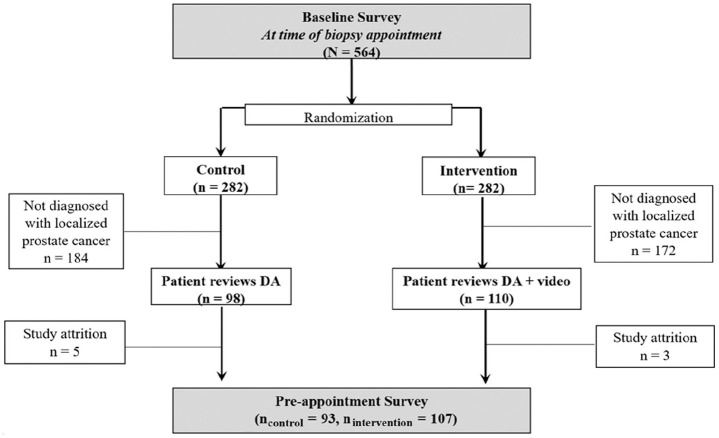
Methods: A randomized controlled trial was conducted to compare a plain-language decision aid (DA) to the DA plus a patient SDM training video. Patients with early stage prostate cancer completed survey measures at baseline and after reviewing the intervention materials. Survey items assessed patients' knowledge, beliefs related to SDM, and perceived readiness/intention to participate in their upcoming clinical appointment.
Results: Of those randomized to the DA + SDM video group, most participants (91%) watched the video and 93% would recommend the video to others. Participants in the DA + SDM video group, compared to the DA-only group, reported an increased desire to participate in the decision (mean = 3.65 v. 3.39, P < 0.001), less decision urgency (mean = 2.82 v. 3.39, P < 0.001), and improved self-efficacy for communicating with physicians (mean = 4.69 v. 4.50, P = 0.05). These participants also reported increased intentions to seek a referral from a radiation oncologist (73% v. 51%, P = 0.004), to take notes (mean = 3.23 v. 2.86, P = 0.004), and to record their upcoming appointments (mean = 1.79 v. 1.43, P = 0.008).
Conclusions: A novel SDM training video was accepted by patients and changed several measures associated with SDM. This may be a scalable, cost-effective way to prepare patients with early stage prostate cancer to participate in their clinical appointments.[Box: see text].
Keywords: communication skills; decision aid; patient engagement; prostate cancer; shared decision making.
Conflict of interest statement
The author(s) declared no potential conflicts of interest with respect to the research, authorship, and/or publication of this article.
Figures
References
-
- Thompson I, Thrasher JB, Aus G, et al. Guideline for the management of clinically localized prostate cancer: 2007 update. J Urol. 2007;177(6):2106–31. - PubMed
-
- Charles C, Gafni A, Whelan T. Shared decision-making in the medical encounter: what does it mean? (or it takes at least two to tango). Soc Sci Med. 1997;44(5):681–92. - PubMed
-
- Pieterse AH, Henselmans I, de Haes HCJM, Koning CCE, Geijsen ED, Smets EMA. Shared decision making: Pprostate cancer patients’ appraisal of treatment alternatives and oncologists’ eliciting and responding behavior, an explorative study. Patient Educ Couns. 2011;85(3):e251–e9. - PubMed
Publication types
MeSH terms
Grants and funding
LinkOut - more resources
Full Text Sources
Medical
