Review
. 2021 Nov;105(21-22):8195-8226.
doi: 10.1007/s00253-021-11615-1. Epub 2021 Oct 7.

Solutions against emerging infectious and noninfectious human diseases through the application of baculovirus technologies

Affiliations
Review

Solutions against emerging infectious and noninfectious human diseases through the application of baculovirus technologies

Alexandra Marisa Targovnik et al. Appl Microbiol Biotechnol. 2021 Nov.

Abstract

Baculoviruses are insect pathogens widely used as biotechnological tools in different fields of life sciences and technologies. The particular biology of these entities (biosafety viruses 1; large circular double-stranded DNA genomes, infective per se; generally of narrow host range on insect larvae; many of the latter being pests in agriculture) and the availability of molecular-biology procedures (e.g., genetic engineering to edit their genomes) and cellular resources (availability of cell lines that grow under in vitro culture conditions) have enabled the application of baculoviruses as active ingredients in pest control, as systems for the expression of recombinant proteins (Baculovirus Expression Vector Systems-BEVS) and as viral vectors for gene delivery in mammals or to display antigenic proteins (Baculoviruses applied on mammals-BacMam). Accordingly, BEVS and BacMam technologies have been introduced in academia because of their availability as commercial systems and ease of use and have also reached the human pharmaceutical industry, as incomparable tools in the development of biological products such as diagnostic kits, vaccines, protein therapies, and-though still in the conceptual stage involving animal models-gene therapies. Among all the baculovirus species, the Autographa californica multiple nucleopolyhedrovirus has been the most highly exploited in the above utilities for the human-biotechnology field. This review highlights the main achievements (in their different stages of development) of the use of BEVS and BacMam technologies for the generation of products for infectious and noninfectious human diseases. KEY POINTS: • Baculoviruses can assist as biotechnological tools in human health problems. • Vaccines and diagnosis reagents produced in the baculovirus platform are described. • The use of recombinant baculovirus for gene therapy-based treatment is reviewed.

Keywords: AcMNPV; BEVS; BacMam; Baculovirus; Human diseases.


Conflict of interest statement

The authors declare no competing interests.

Figures
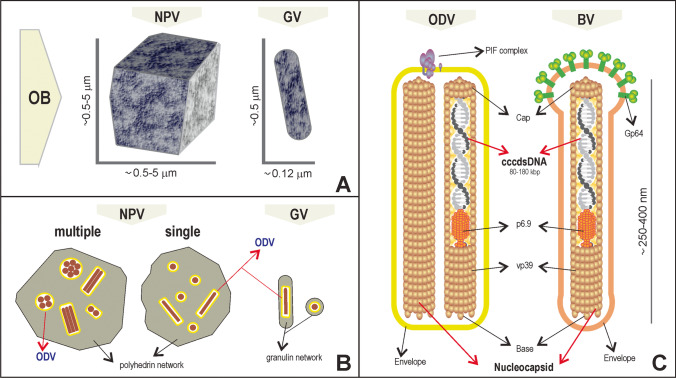
Fig. 1
Fig. 1
Baculovirus virions. Illustrations describing the main characteristics of baculovirus morphologies. A Representation of typical shapes and dimensions of the occlusion bodies (OBs) of nucleopolyhedroviruses (NPV) and granuloviruses (GVs). B Representation of cross-sections on the OBs, revealing the occlusion-derived viruses (ODVs) present in multiple nucleopolyhedroviruses (MNPVs), single nucleopolyhedroviruses (SNPVs), and GVs. The latter illustrate two different cuts for each particle. C Comparative illustration between ODVs and budded viruses (BVs). The nucleocapsids are the same, but the envelopes are different (that of ODV is derived from the nuclear membrane of the infected cell, whereas that of BV is derived from the plasma membrane). Ncs are polar structures manifesting a different composition and differing forms in the extreme ends and are composed of mainly the VP39 protein. The covalently closed circular double-stranded DNA (cccdsDNA) is associated with a basic protein called p6.9. The per-os–infectivity (PIF) complex is composed of various proteins and is present in only the ODV envelope. The fusogenic GP64 protein is present only in the BV envelope of Group I-alphabaculoviruses (e.g., in AcMNPV), while in the remaining clades this role is performed by the F protein
Fig. 2
Fig. 2
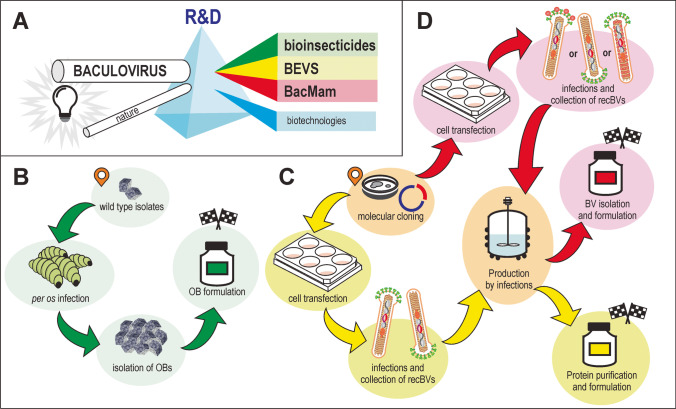
Applications of baculoviruses. Illustrations indicating the main uses of baculoviruses. A Because of the research and development carried out on the biology of baculoviruses, 3 main applications have been generated: bioinsecticides, baculovirus expression vector systems (BEVS), and baculoviruses applied to mammals (BacMam). B Main procedures for the generation of bioinsecticide products based on occlusion bodies (OBs). C Main procedures for the generation of protein products based on recombinant budded viruses (recBVs) infecting insect cells and subsequent downstream processes. D. Main procedures for the generation of virion products based on recBVs infecting insect cells and subsequent downstream processes. Only 3 alternatives of recBVs are illustrated: virions that display proteins in the envelope; virions that carry transgenes for the expression in mammal cells; virions that display proteins in the nucleocapsid
Fig. 3
Fig. 3
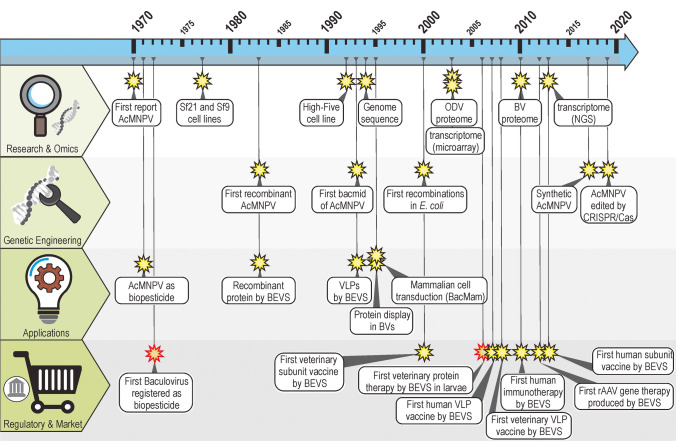
Milestones in baculovirus research and development. The scheme is a timeline of the last 50 years where some ground-breaking discoveries and developments involving baculoviruses are cited, with a particular focus on AcMNPV, the most widely studied and applied species of Baculoviridae. These achievements are classified according to 4 categories: basic research and applications of omic technologies in AcMNPV, plus the development of cell lines to multiply the vector; the use of genetic-engineering tools on the AcMNPV genome; biotechnological applications of AcMNPV virions; and regulatory approvals of some AcMNPV-based products (or baculovirus based products). Only in the example of the first registered biopesticide (Elcar®) and the first veterinary therapy based on recombinant protein produced in Bombyx mori larvae (Virbagen® Omega) are mentioned products generated using other baculoviral species (Helicoverpa zea NPV and Bombyx mori NPV, respectively; milestones indicated with orange stars). All the references that support these milestones are included in the main text

References

    1. Abe T, Takahashi H, Hamazaki H, Miyano-Kurosaki N, Matsuura Y, Takaku H. Baculovirus induces an innate immune response and confers protection from lethal influenza virus infection in mice. J Immunol. 2003;171:1133–1139. doi: 10.4049/jimmunol.171.3.1133. - DOI - PubMed
    1. Abe T, Hemmi H, Miyamoto H, Moriishi K, Tamura S, Takaku H, Akira S, Matsuura Y. Involvement of the toll-like receptor 9 signaling pathway in the induction of innate immunity by baculovirus. J Virol. 2005;79:2847–2858. doi: 10.1128/jvi.79.5.2847-2858.2005. - DOI - PMC - PubMed
    1. Abe T, Kaname Y, Wen X, Tani H, Moriishi K, Uematsu S, Takeuchi O, Ishii KJ, Kawai T, Akira S, Matsuura Y. Baculovirus induces type i interferon production through toll-like receptor-dependent and -independent pathways in a cell-type-specific manner. J Virol. 2009;83:7629–7640. doi: 10.1128/jvi.00679-09. - DOI - PMC - PubMed
    1. Airenne KJ, Makkonen KE, Mähönen AJ, Ylä-Herttuala S. Baculoviruses mediate efficient gene expression in a wide range of vertebrate cells. Methods Mol Biol. 2011;737:279–301. doi: 10.1007/978-1-61779-095-9_12. - DOI - PubMed
    1. Airenne KJ, Hu YC, Kost TA, Smith RH, Kotin RM, Ono C, Matsuura Y, Wang S, Ylä-Herttuala S. Baculovirus: an insect-derived vector for diverse gene transfer applications. Mol Ther. 2013;21:739–749. doi: 10.1038/mt.2012.286. - DOI - PMC - PubMed

Substances

LinkOut - more resources