doi: 10.1371/journal.pmed.1003799.
eCollection 2021 Oct.
The global burden of Plasmodium vivax malaria is obscure and insidious
Affiliations
- PMID: 34618814
- PMCID: PMC8496786
- DOI: 10.1371/journal.pmed.1003799
Item in Clipboard
The global burden of Plasmodium vivax malaria is obscure and insidious
PLoS Med.
.
Abstract
J. Kevin Baird and colleagues, examine and discuss the estimated global burden of vivax malaria and it's biological, clinical, and public health complexity.
Conflict of interest statement
The authors have declared that no competing interests exist.
Figures
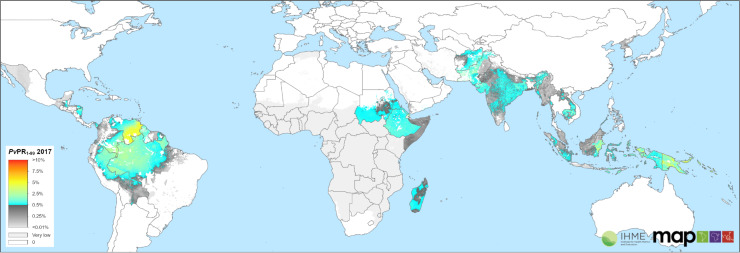
The mean predicted parasite rate of P. vivax is in people 1 to 99 years of age based on the analysis from Battle and colleagues is shown on a scale of low prevalence (blue) to high (red) with very low prevalence in light grey and nonendemic regions in white [3]. Global national shapefile obtained from the Malaria Atlas Project (MAP; https://malariaatlas.org/ ) and available for download through the malariaAtlas R package [109].

Relative burdens of risk (A) and estimated illness (B) due to P. vivax malaria among the WHO regions: WPRO is Western Pacific; SEARO is Southeast Asia; EMRO is Eastern Mediterranean; AFRO is Sub-Saharan Africa; and PAHO is the Americas.

The mean estimated clinical burdens of P. vivax malaria are shown on a scale of blue (very low burden) to red (high clinical burden) [3]. Global national shapefile obtained from the Malaria Atlas Project (MAP; https://malariaatlas.org/ ) and available for download through the malariaAtlas R package [109].

Global and region trends of P. vivax clinical incidence rate (A) and case counts (B) from 2000 to 2017 [3]. WPRO is Western Pacific; SEARO is Southeast Asia; EMRO is Eastern Mediterranean; AFRO is Sub-Saharan Africa; and PAHO is the Americas.
References
-
- Institute for Health Metrics and Evaluation. Findings from the Global Burden of Disease Study 2017 [Internet]. Seattle, WA; 2018 [cited 2020 Oct 18]. Available from: www.healthdata.org.
-
- World Health Organization. World Malaria Report 2015. Geneva; 2015. Available from: https://www.who.int/malaria/publications/world-malaria-report-2015/repor....
MeSH terms
LinkOut - more resources
Full Text Sources