


Machine learning to predict individual patient-reported outcomes at 2-year follow-up for women undergoing cancer-related mastectomy and breast reconstruction (INSPiRED-001)
- PMID: 34619573
- PMCID: PMC8551470
- DOI: 10.1016/j.breast.2021.09.009
Machine learning to predict individual patient-reported outcomes at 2-year follow-up for women undergoing cancer-related mastectomy and breast reconstruction (INSPiRED-001)
Abstract
Background: Women undergoing cancer-related mastectomy and reconstruction are facing multiple treatment choices where post-surgical satisfaction with breasts is a key outcome. We developed and validated machine learning algorithms to predict patient-reported satisfaction with breasts at 2-year follow-up to better inform the decision-making process for women with breast cancer.
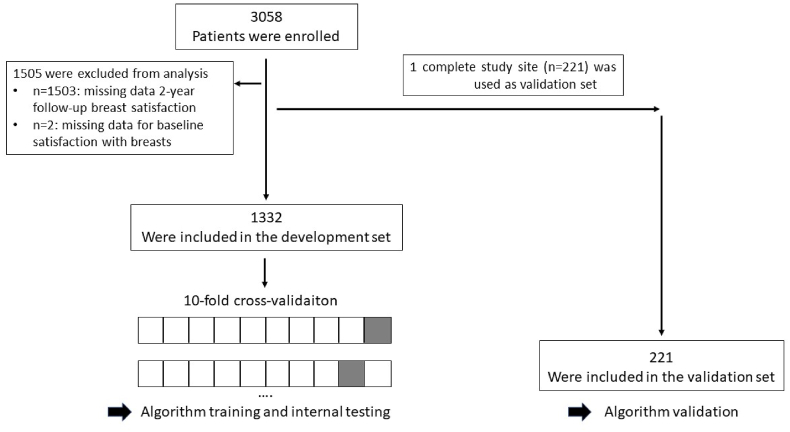
Methods: We trained, tested, and validated three machine learning algorithms (logistic regression (LR) with elastic net penalty, Extreme Gradient Boosting (XGBoost) tree, and neural network) to predict clinically important differences in satisfaction with breasts at 2-year follow-up using the validated BREAST-Q. We used data from 1553 women undergoing cancer-related mastectomy and reconstruction who were followed-up for two years at eleven study sites in North America from 2011 to 2016. 10-fold cross-validation was used to train and test the algorithms on data from 10 of the 11 sites which were further validated using the additional site's data. Area-under-the-receiver-operating-characteristics-curve (AUC) was the primary outcome measure.
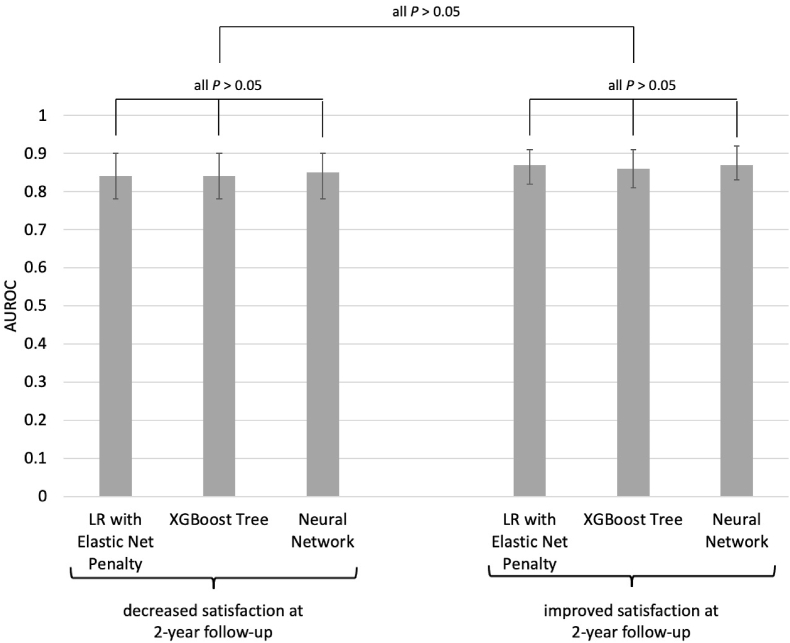
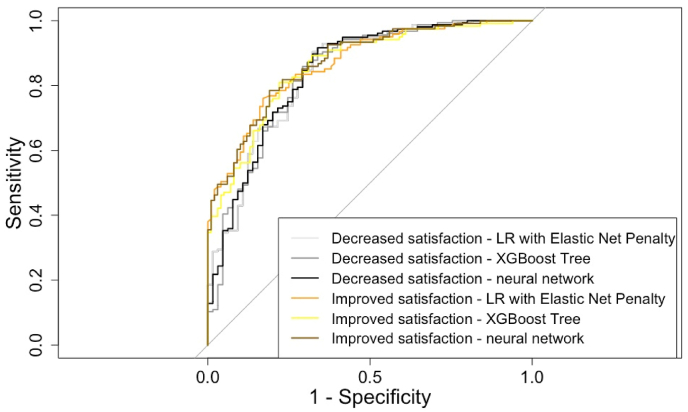
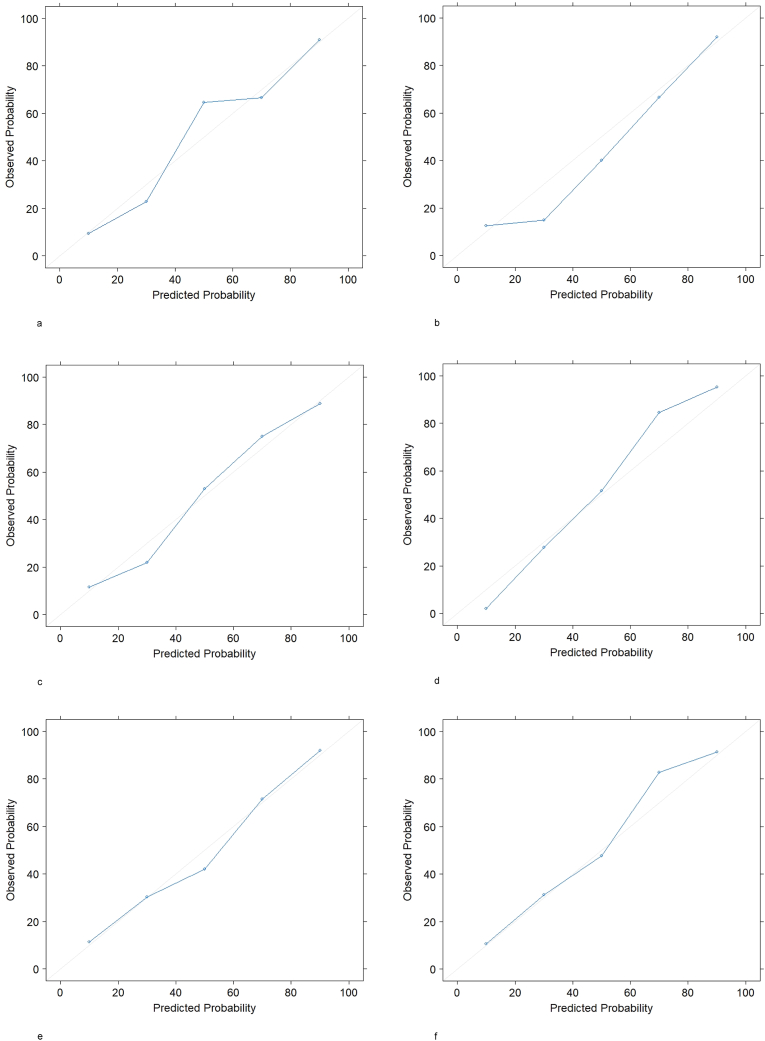
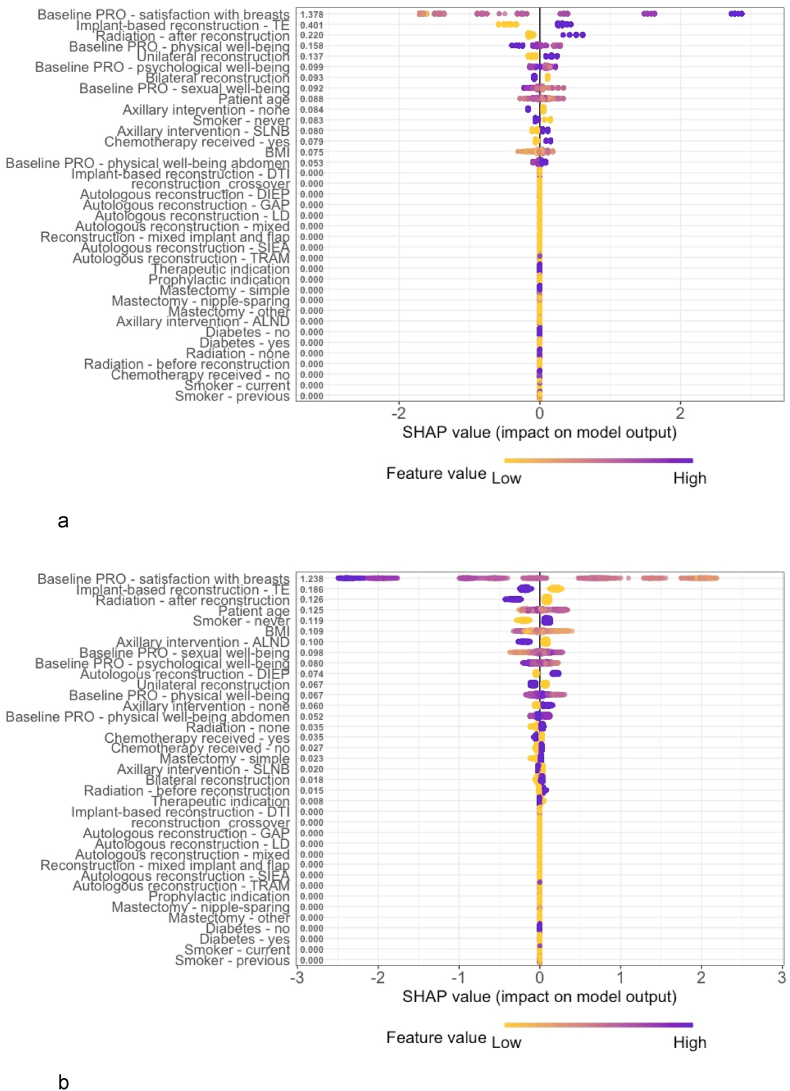
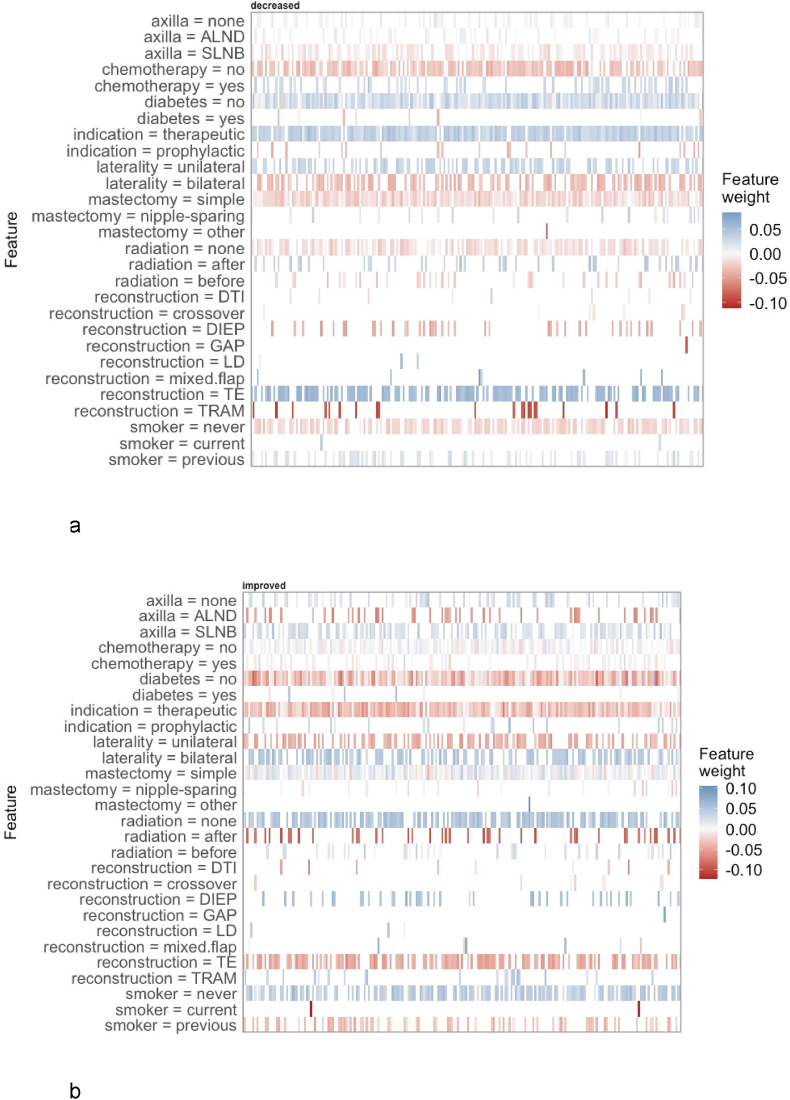
Results: Of 1553 women, 702 (45.2%) experienced an improved satisfaction with breasts and 422 (27.2%) a decreased satisfaction. In the validation set (n = 221), the algorithms showed equally high performance to predict improved or decreased satisfaction with breasts (all P > 0.05): For improved satisfaction AUCs were 0.86-0.87 and for decreased satisfaction AUCs were 0.84-0.85.
Conclusion: Long-term, individual patient-reported outcomes for women undergoing mastectomy and breast reconstruction can be accurately predicted using machine learning algorithms. Our algorithms may be used to better inform clinical treatment decisions for these patients by providing accurate estimates of expected quality of life.
Keywords: Breast reconstruction; Breast surgery; Decision-making; INSPiRED; Individualized treatment; Machine learning.
Copyright © 2021 The Authors. Published by Elsevier Ltd.. All rights reserved.
Conflict of interest statement
Declaration of competing interest André Pfob No relationship to disclose. Babak J. Mehrara No relationship to disclose. Jonas A. Nelson No relationship to disclose. Edwin G. Wilkins No relationship to disclose. Andrea L. Pusic Patents, Royalties, Other Intellectual Property: I am co-developer of BREAST-Q and receive royalty payments when it is used in industry-sponsored trials. Chris Sidey-Gibbons No relationship to disclose.
Figures
References
-
- Heil J., Kuerer H.M., Pfob A. Eliminating the breast cancer surgery paradigm after neoadjuvant systemic therapy: current evidence and future challenges. Ann Oncol. 2020;31:61–71. - PubMed
-
- Kummerow K.L., Du L., Penson D.F., Shyr Y., Hooks M.A. Nationwide trends in mastectomy for early-stage breast cancer. JAMA Surg. 2015;150:9–16. - PubMed
-
- Frost M.H., Hoskin T.L., Hartmann L.C., Degnim A.C., Johnson J.L., Boughey J.C. Contralateral prophylactic mastectomy: long-term consistency of satisfaction and adverse effects and the significance of informed decision-making, quality of life, and personality traits. Ann Surg Oncol. 2011;18:3110–3116. - PMC - PubMed
MeSH terms
Grants and funding
LinkOut - more resources
Full Text Sources
Medical
