


Granulocytic Myeloid-Derived Suppressor Cells in Cystic Fibrosis
- PMID: 34621276
- PMCID: PMC8490623
- DOI: 10.3389/fimmu.2021.745326
Granulocytic Myeloid-Derived Suppressor Cells in Cystic Fibrosis
Abstract
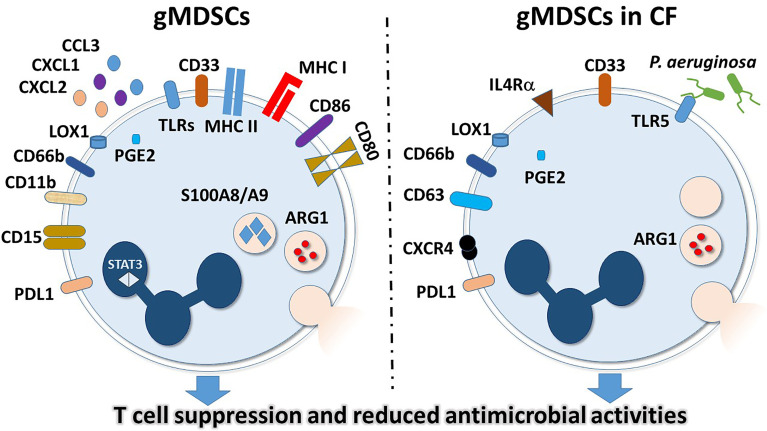
Cystic Fibrosis (CF) is a genetic disease that causes chronic and severe lung inflammation and infection associated with high rates of mortality. In CF, disrupted ion exchange in the epithelium results in excessive mucus production and reduced mucociliary clearance, leading to immune system exacerbation and chronic infections with pathogens such as P. aeruginosa and S. aureus. Constant immune stimulation leads to altered immune responses including T cell impairment and neutrophil dysfunction. Specifically, CF is considered a Th17-mediated disease, and it has been proposed that both P. aeruginosa and a subset of neutrophils known as granulocytic myeloid suppressor cells (gMDSCs) play a role in T cell suppression. The exact mechanisms behind these interactions are yet to be determined, but recent works demonstrate a role for arginase-1. It is also believed that P. aeruginosa drives gMDSC function as a means of immune evasion, leading to chronic infection. Herein, we review the current literature regarding immune suppression in CF by gMDSCs with an emphasis on T cell impairment and the role of P. aeruginosa in this dynamic interaction.
Keywords: cystic fibrosis; gMDSC; immunosuppression; myeloid-derived suppressor cell; neutrophil.
Copyright © 2021 Tucker, Sarr and Rada.
Conflict of interest statement
The authors declare that the research was conducted in the absence of any commercial or financial relationships that could be construed as a potential conflict of interest.
Figures
References
-
- Trapnell BC, Chu CS, Paakko PK, Banks TC, Yoshimura K, Ferrans VJ, et al. . Expression of the Cystic Fibrosis Transmembrane Conductance Regulator Gene in the Respiratory Tract of Normal Individuals and Individuals With Cystic Fibrosis. Proc Natl Acad Sci USA (1991) 88(15):6565–9. doi: 10.1073/pnas.88.15.6565 - DOI - PMC - PubMed
Publication types
MeSH terms
Substances
Grants and funding
LinkOut - more resources
Full Text Sources
Medical
Research Materials
Miscellaneous
