


Case Reports
doi: 10.1016/j.ekir.2021.07.001.
eCollection 2021 Oct.
Eculizumab and Complement Activation in Anti-glomerular Basement Membrane Disease
Affiliations
- PMID: 34622110
- PMCID: PMC8484114
- DOI: 10.1016/j.ekir.2021.07.001
Item in Clipboard
Case Reports
Eculizumab and Complement Activation in Anti-glomerular Basement Membrane Disease
Kidney Int Rep.
.
No abstract available
Figures

Clinical course of patients treated with eculizumab. (a) In case 1, the patient is treated with plasmapheresis (gold bars), 2 induction doses of rituximab 1000 mg i.v. (red bars), a 6-month terminal prednisone taper (brown horizontal arrow), and oral cyclophosphamide dosed at 2.5 mg/kg per day for 1 week, then 1.5 mg/kg per day for 7 weeks, with doses adjusted for renal function (received a cumulative dose of 3.8 g) (blue horizontal arrow). Three doses of eculizumab at 300 mg, 600 mg, and 900 mg, were given following the fifth, sixth, and tenth plasmapheresis sessions, respectively (light blue vertical arrow). The patient’s serum creatinine reached a zenith of 3.9 mg/dl, and following treatment his SCr improved to 1.9 mg/dl. (b) In case 2, the patient underwent plasmapheresis (gold bars) followed by additional sessions for a rising anti-GBM titer, 2 induction doses of rituximab 1000 mg i.v. (red bars), a 6-month terminal prednisone taper (brown horizontal bar), and oral cyclophosphamide dosed at 2.5 mg/kg per day for 1 week, then 1.5 mg/kg per day for 7 weeks, with doses adjusted for renal function (received a cumulative dose of 3.15 g) (blue horizontal bar). One dose of eculizumab 900 mg i.v. was given (light blue vertical arrow) following the 12th plasmapheresis session. The patient’s SCr reached a zenith 6.9 mg/dl before initiating hemodialysis (black horizontal bar). At 4 months following hospital discharge, hemodialysis was discontinued, and her SCr improved to 2.6 mg/dl.
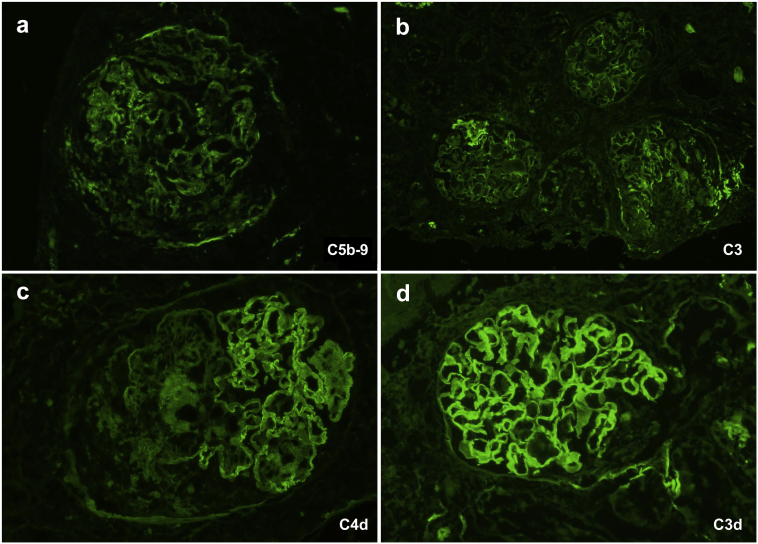
Kidney biopsy findings of case 2 patient: immunofluorescent photomicrograph of glomeruli. (a) Granular C5b-9 (membrane attack complex) deposition is detected along the glomerular capillary wall. There was also detection of (b) C3, (c) C4d, and (d) C3d along the glomerular capillary loops. b, Original magnification ×20; a, c, and d, original magnification ×40.
References
-
- Fischer E.G., Lager D.J. Anti–glomerular basement membrane glomerulonephritis: a morphologic study of 80 Cases. Am J Clin Pathol. 2006;125:445–450. - PubMed
-
- Groggel G.C., Salant D.J., Darby C. Role of terminal complement pathway in the heterologous phase of antiglomerular basement membrane nephritis. Kidney Int. 1985;27:643–651. - PubMed
-
- Ma R., Cui Z., Liao Y-h. Complement activation contributes to the injury and outcome of kidney in human anti-glomerular basement membrane disease. J Clin Immunol. 2013;33:172–178. - PubMed
Publication types
LinkOut - more resources
Full Text Sources
