


Examining SARS-CoV-2 Interventions in Residential Colleges Using an Empirical Network
- PMID: 34624516
- PMCID: PMC8492892
- DOI: 10.1016/j.ijid.2021.10.008
Examining SARS-CoV-2 Interventions in Residential Colleges Using an Empirical Network
Abstract
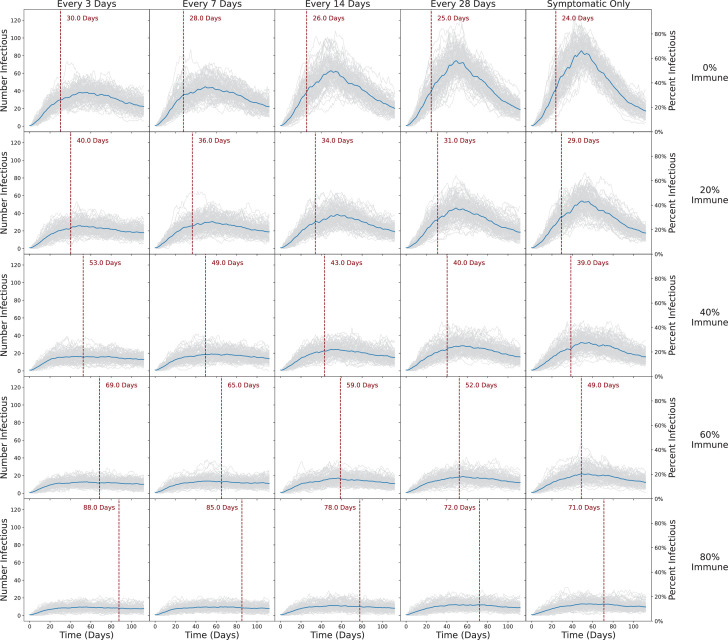
Objectives Universities have turned to SARS-CoV-2 models to examine campus reopening strategies. While these studies have explored a variety of modeling techniques, none have used empirical data. Methods In this study, we use an empirical proximity network of college freshmen obtained using smartphone Bluetooth to simulate the spread of the virus. We investigate the role of immunization, testing, isolation, mask wearing, and social distancing in the presence of implementation challenges and imperfect compliance. Results We show that frequent testing could drastically reduce the spread of the virus if levels of immunity are low, but its effects are limited if immunity is more ubiquitous. Furthermore, moderate levels of mask wearing and social distancing could lead to additional reductions in cumulative incidence, but their benefit decreases rapidly as immunity and testing frequency increase. However, if immunity from vaccination is imperfect or declines over time, scenarios not studied here, frequent testing and other interventions may play more central roles. Conclusions Our findings suggest that although regular testing and isolation are powerful tools, they have limited benefit if immunity is high or other interventions are widely adopted. If universities can attain even moderate levels of vaccination, masking, and social distancing, they may be able to relax the frequency of testing to once every four weeks.
Keywords: Bluetooth; COVID-19; Copenhagen Network Study; Proximity network; Repeat testing; SARS-CoV-2.
Published by Elsevier Ltd.
Conflict of interest statement
Declaration of Competing Interest The authors declare that they have no known competing financial interests or personal relationships that could have appeared to influence the work reported in this paper.
Figures

Update of
-
Examining SARS-CoV-2 Interventions in Residential Colleges Using an Empirical Network.medRxiv [Preprint]. 2021 Apr 10:2021.03.09.21253198. doi: 10.1101/2021.03.09.21253198. medRxiv. 2021. Update in: Int J Infect Dis. 2021 Dec;113:325-330. doi: 10.1016/j.ijid.2021.10.008. PMID: 33758870 Free PMC article. Updated. Preprint.
References
-
- Bradley E.H., An M.W., Fox E. Reopening colleges during the coronavirus disease 2019 (COVID-19) pandemic-one size does not fit all. JAMA Network Open. 2020;3:e2017838. - PubMed
MeSH terms
Grants and funding
LinkOut - more resources
Full Text Sources
Medical
Miscellaneous
