. 2021 Oct 9;25(1):31.
doi: 10.1186/s40824-021-00234-6.

To control floating drug delivery system in a simulated gastric environment by adjusting the Shell layer formulation

Affiliations

To control floating drug delivery system in a simulated gastric environment by adjusting the Shell layer formulation

Yu-Tung Hsu et al. Biomater Res. .

Abstract

Background: Gastroretentive drug delivery system (GDDS) are novel systems that have been recently developed for treating stomach diseases. The key function of all GDDS systems is to control the retention time in the stomach. However, research into the bulk density or entanglement of polymers, especially regarding their effects on drug float and release times, is scarce.

Methods: In this research, we prepared the floating core-shell beads carrying tetracycline. The ratio of chitosan and xanthan gum in the shell layer was changed to modify polymer compactness. Tetracycline was encapsulated in the alginate core.

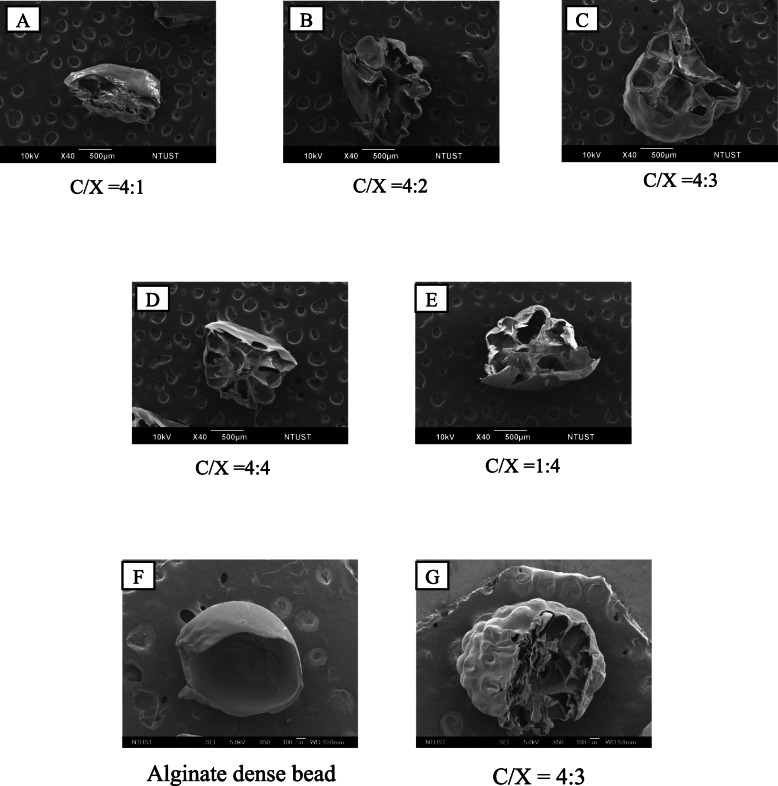
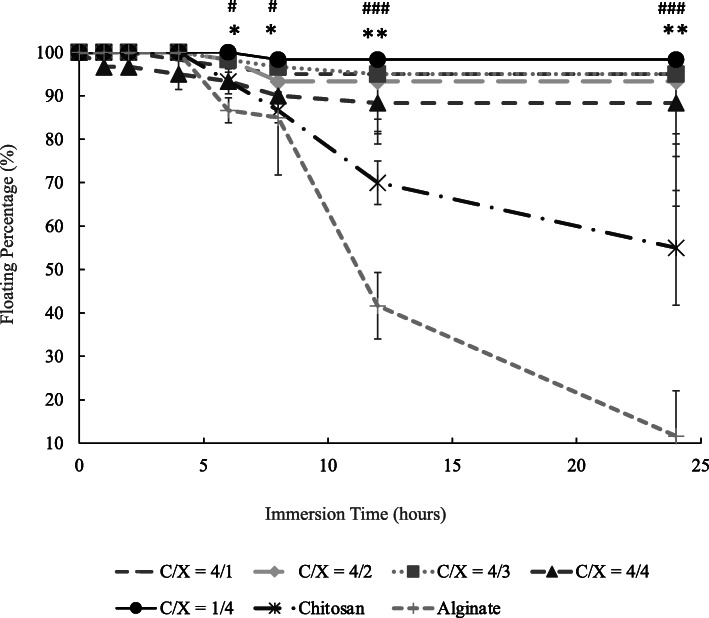
Results: Using scanning electron microscopy (SEM) techniques, we observed that the shell formulation did not change the bead morphology. The cross-sectional images showed that the beads were highly porous. The interaction between anionic xanthan gum and cationic chitosan made the shell layer dense, resisting to the mass transfer in the shell layer. Due to the high mass transfer resistance to water penetration, the longer float and delivery time were caused by the dense surface of the beads. The cell culture demonstrated that floating core-shell beads were biocompatible. Importantly, the beads with tetracycline showed a significant prolonged anti-bacterial effect.

Conclusion: Research results proved that the floating and releasing progress of core-shell beads can be well controlled by adjusting the shell layer formulation that could promote the function of gastroretentive drugs.

Keywords: Anti-bacterial effect; Chitosan; Core-shell particles; Floating beads; Gastroretentive drug delivery; Xanthan gum.


Conflict of interest statement

The authors declare that they have no competing interests.

Figures
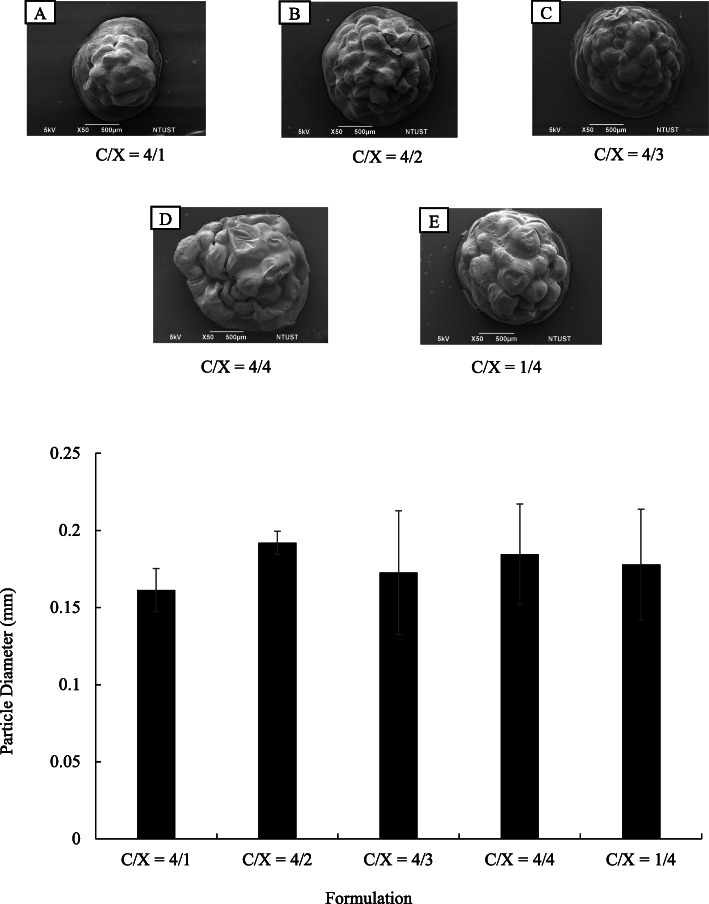
Fig. 1
Fig. 1
Morphologies of core-shell floating beads with various formulation in chitosan/xanthan-gum shell layer (n = 20). (a) SEM images of floating beads. The C/X ratios are 4:1 (A), 4:2 (B), 4:3 (C), 4:4. (D) and 1:4 (E). (b) Diameters of beads with various formulations in chitosan/xanthan-gum (C/X) shell layer (p > 0.1 form ANOVA test, n ≥ 10)
Fig. 2
Fig. 2
The cross-sectional SEM images of floating beads with various formulation in chitosan and xanthan gum shell layer. The C/X ratios are 4:1 (A), 4:2 (B), 4:3 (C), 4:4 (D) and 1:4 (E). The magnified images of alginate dense bead (F) and floating beads with C/X = 4:3 (G) were presented to identify the dense and porous structures in beads
Fig. 3
Fig. 3
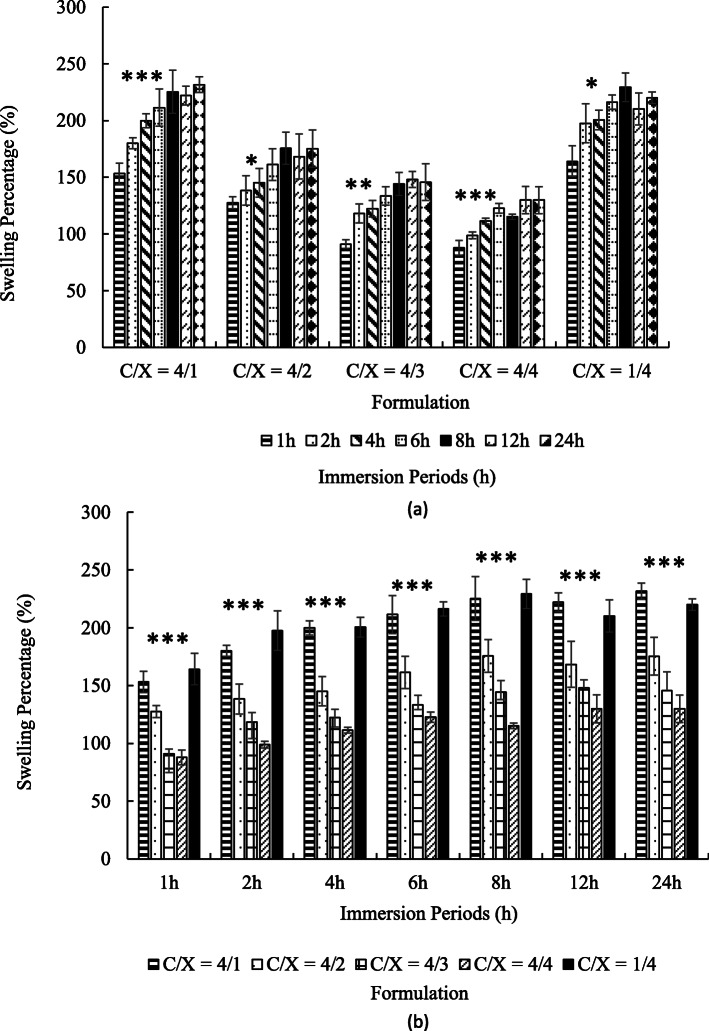
The swelling ratios of core-shell beads with various in chitosan/xanthan-gum (C/X) formulation in pH = 2 buffer (n ≥ 4). The times for immersion were 1, 2, 4, 6, 8, 12 and 24 h. The results were pooled in accordance with formulation (a) and with immersion period (b). In (a), the significance from ANOVA test from 1 h to 6 h with fixed formulation was marked by * (p < 0.05), ** (p < 0.01) and *** (p < 0.005) for indicated groups. In (b), the significance from ANOVA test for C/X ratio with fixed immersion time was marked by *** (p < 0.005)
Fig. 4
Fig. 4
The floating percentage of core-shell beads with various chitosan/xanthan gum ratios, chitosan beads and alginate beads (n ≥ 3). The significant difference between core-shell beads with all the formulations and dense chitosan beads was indicated by * (p < 0.05) and ** (p < 0.01) from t-test at the same immersion time. The significant difference between core-shell beads with all the formulations and dense alginate beads was indicated by # (p < 0.05), ## (p < 0.01) and ### (p < 0.005) from t-test at the same immersion time (n ≥ 3). Chitosan and alginate beads were dense particles without core-shell structure. There is not significant differences between floating beads with different C/X (p > 0.15) from ANOVA test
Fig. 5
Fig. 5
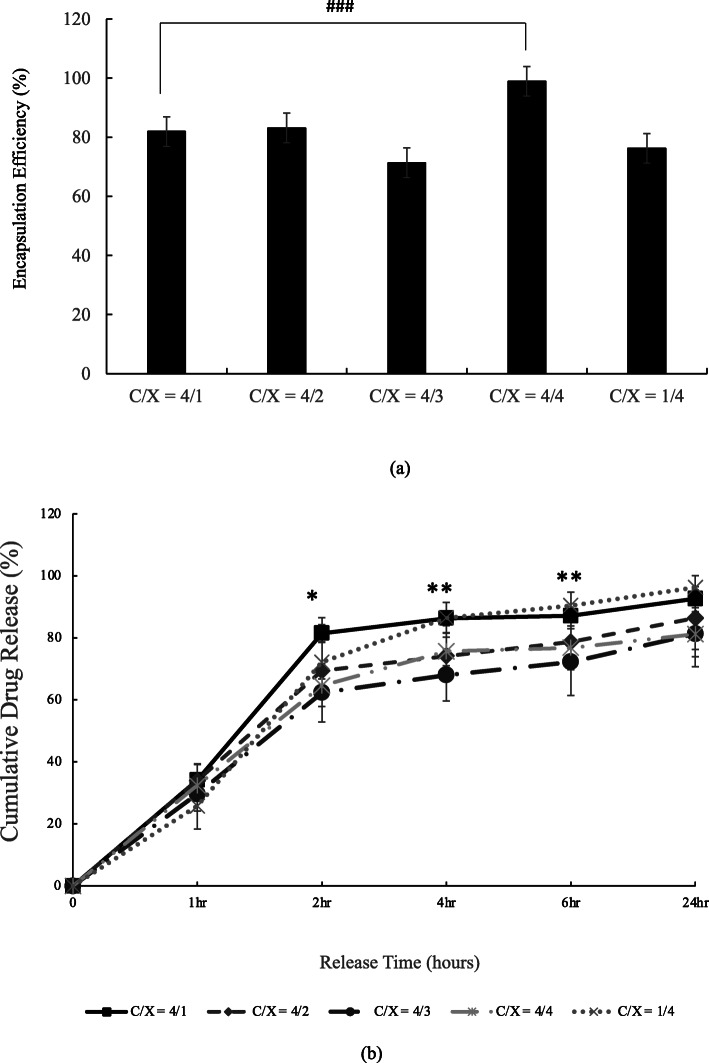
Encapsulation efficiency (a) and releasing profile (b) of tetracycline-alginate floating beads in pH = 2 buffer. In (a), the significant differences were indicated by ### (p < 0.005) from t-test (n ≥ 3). In (b), the significant differences were indicated by * (p < 0.1) and ** (p < 0.05) from ANOVA test with the same release time (n ≥ 4)
Fig. 6
Fig. 6
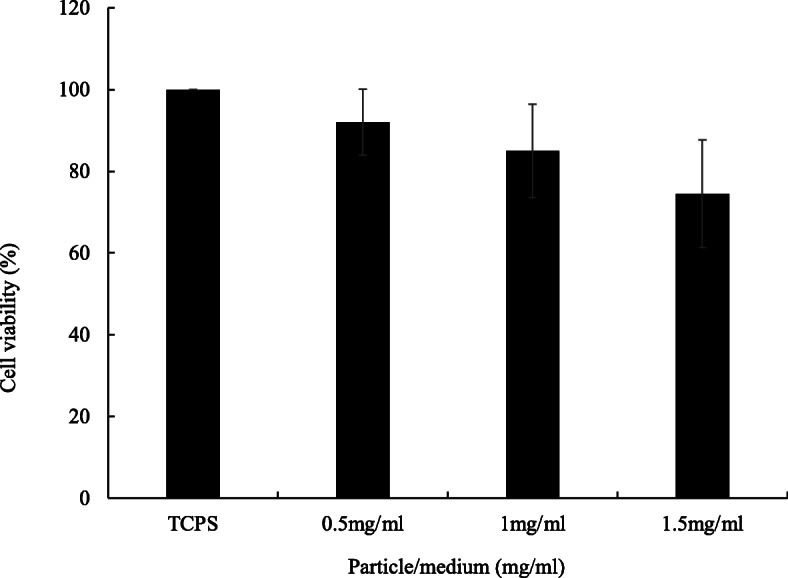
Biocompatibility of floating beads. The bead amounts in culture medium were 0.5, 1 and 1.5 mg/ml, respectively. Floating beads are core-shell beads with C/X = 4/3. TCPS was tissue culture polystyrene which was used as the controlled group. The culture period was 24 h. From ANOVA test, there was no statistical difference (p > 0.05 and n ≥ 4). From t test, all the core-shell bead groups were not significantly different from TCPS (p > 0.05 and n ≥ 4)
Fig. 7
Fig. 7
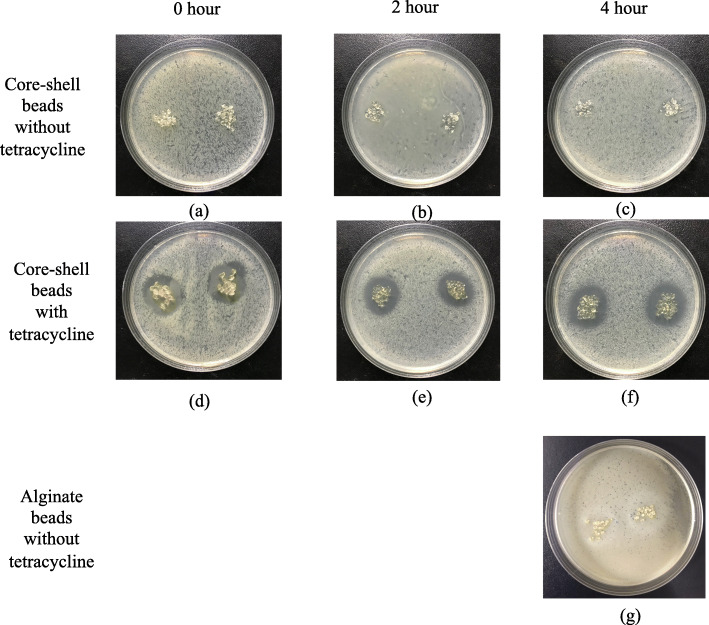
Antibacterial effects of floating beads with/without tetracycline for different immersion periods. (a), (b) and (c) are core-shell beads (C/X=4/3) without tetracycline, and (d), (e) and (f) are core-shell beads (C/X=4/3) with tetracycline. (g) is non-core-shell alginate beads without tetracycline. The immersion time before antibacterial test is 0 hour for (a) (d), 2 hours for (b) (e), and 4 hours for (c) (f) and (g). The beads in (d), (e) and (f) encapsulate 69.9 μg tetracycline in total

References

    1. Patel SS, Ray S, Thakur RS. Formualtion and evaluation of floating drug delivery system containing clarithromycin for helicobacter pylori. Acta Pol Pharm. 2006;63:53–61. - PubMed
    1. Nayak RMAK, Biswarup D. Gastroretentive drug delivery systems: a review. Asian J Pharm Clin Res. 2010;3:2–10.
    1. Arora S, Ali J, Ahuja A, Khar RK, Baboota S. Floating drug delivery systems: a review. AAPS Pharm Sci Tech. 2005;6:E372–E390. doi: 10.1208/pt060347. - DOI - PMC - PubMed
    1. Shah S, Qaqish R, Patel V, Amiji M. Evaluation of the factors influencing stomach-specific delivery of antibacterial agents for helicobacter pylori infection. J Pharm Pharmacol. 1999;51:667–672. doi: 10.1211/0022357991772952. - DOI - PubMed
    1. Yokel RA, Dickey KM, Goldberg AH. Selective adherence of a sucralfate-tetracycline complex to gastric ulcers: implications for the treatment of Helicobacter pylori. Biopharm Drug Dispos. 1005;16:475–479. doi: 10.1002/bdd.2510160605. - DOI - PubMed