


Complementary use of stable isotopes and fatty acids for quantitative diet estimation of sympatric predators, the Antarctic pack-ice seals
- PMID: 34626270
- PMCID: PMC8585811
- DOI: 10.1007/s00442-021-05045-z
Complementary use of stable isotopes and fatty acids for quantitative diet estimation of sympatric predators, the Antarctic pack-ice seals
Abstract
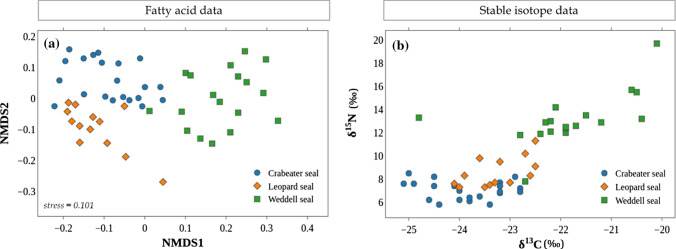
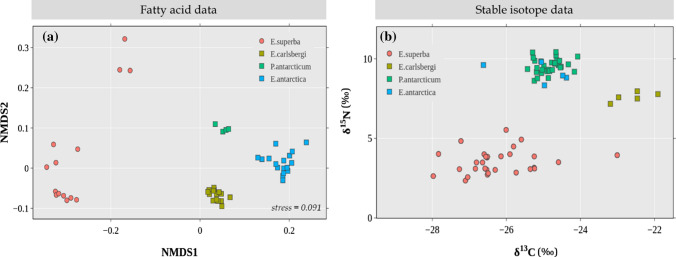
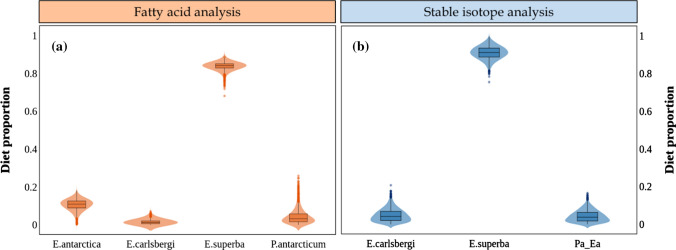
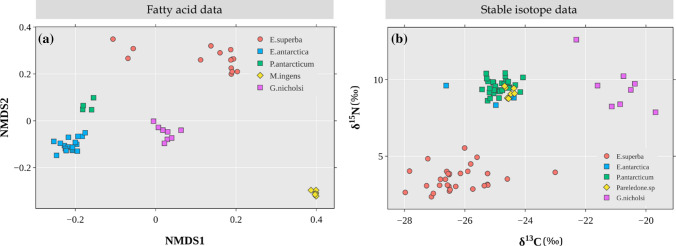
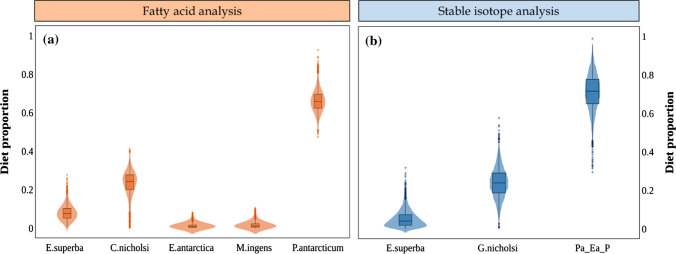
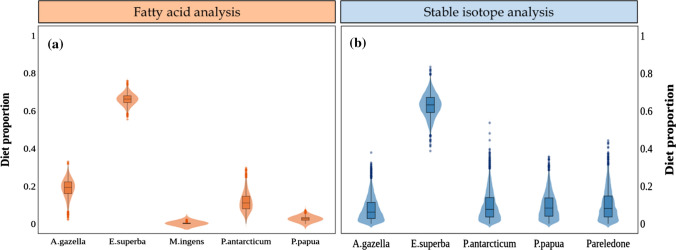
The quantitative use of stable isotopes (SIs) for trophic studies has seen a rapid growth whereas fatty acid (FA) studies remain mostly qualitative. We apply the Bayesian tool MixSIAR to both SI and FA data to estimate the diet of three sympatric predators: the crabeater (Lobodon carcinophaga), Weddell (Leptonychotes weddellii) and leopard seal (Hydrurga leptonyx). We used SI data of their vibrissae and FA data of their outer blubber to produce comparable diet estimates for the same individuals. Both SI and FA models predicted the same main diet components, although the predicted proportions differed. For the crabeater seal, both methods identified krill, Euphausia superba, as the main, and almost exclusive, food item, although the FA model estimated a slightly lower proportion, potentially due to the low lipid content of krill compared to the fish species used in the model. For the Weddell seal the FA model identified the fish Pleuragramma antarcticum as the most important prey, whereas the SI model was not able to distinguish among prey species, identifying a 'fish-squid' group as the main diet component. For the leopard seal, both models identified krill as the main contributor; however, the predicted proportions for the secondary sources differed. Although vibrissae and outer blubber may not represent the same timeframe, the use of MixSIAR with FA data provides diet estimates comparable to those obtained with SI data, thus, both approaches were complimentary. The use of both biotracers offers a feasible option to study diets of wild animals in a quantitative manner.
Keywords: Biochemical tracer; Blubber; Marine mammal; Pinniped; Trophic marker.
© 2021. The Author(s).
Conflict of interest statement
Authors declare no conflicts of interest.
Figures
References
-
- Acevedo J, Carreño E, Torres D, et al. Cephalopod remains in scats of Weddell seals (Leptonychotes weddellii) at Cape Shirreff, South Shetland Islands, Antarctica. Polar Biol. 2015;5:10. doi: 10.1007/s00300-015-1713-0. - DOI
-
- Alonzo F, Virtue P, Nicol S, Nichols PD. Lipids as trophic markers in Antarctic krill. II. Lipid composition of the body and digestive gland of Euphausia superba in controlled conditions. Mar Ecol Prog Ser. 2005 doi: 10.3354/meps296065. - DOI
-
- Beck CA, Rea LD, Iverson SJ, et al. Blubber fatty acid profiles reveal regional, seasonal, age-class and sex differences in the diet of young Steller sea lions in Alaska. Mar Ecol Prog Ser. 2007;338:269–280. doi: 10.3354/meps338269. - DOI
-
- Beltran RS, Sadou MC, Condit R, et al. Fine-scale whisker growth measurements can reveal temporal foraging patterns from stable isotope signatures. Mar Ecol Prog Ser. 2015;523:243–253. doi: 10.3354/meps11176. - DOI
-
- Botta S, Secchi ER, Rogers TL, et al. Isotopic niche overlap and partition among three Antarctic seals from the Western Antarctic Peninsula. Deep Res Part II Top Stud Oceanogr. 2018 doi: 10.1016/j.dsr2.2017.11.005. - DOI
MeSH terms
Substances
Grants and funding
LinkOut - more resources
Full Text Sources
