


Restoration of Immune Privilege in Human Dermal Papillae Controlling Epithelial-Mesenchymal Interactions in Hair Formation
- PMID: 34626334
- PMCID: PMC8782965
- DOI: 10.1007/s13770-021-00392-7
Restoration of Immune Privilege in Human Dermal Papillae Controlling Epithelial-Mesenchymal Interactions in Hair Formation
Abstract
Background: Hair follicles are among a handful of organs that exhibit immune privilege. Dysfunction of the hair follicle immune system underlies the development of inflammatory diseases, such as alopecia areata.
Methods: Quantitative reverse transcription PCR and immunostaining was used to confirm the expression of major histocompatibility complex class I in human dermal papilla cells. Through transcriptomic analyses of human keratinocyte stem cells, major histocompatibility complex class I was identified as differentially expressed genes. Organ culture and patch assay were performed to assess the ability of WNT3a conditioned media to rescue immune privilege. Lastly, CD8+ T cells were detected near the hair bulb in alopecia areata patients through immunohistochemistry.
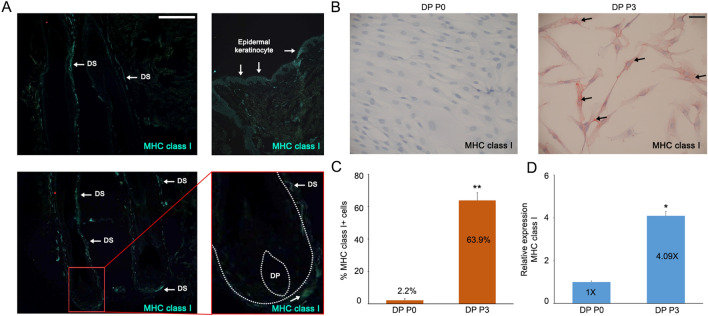
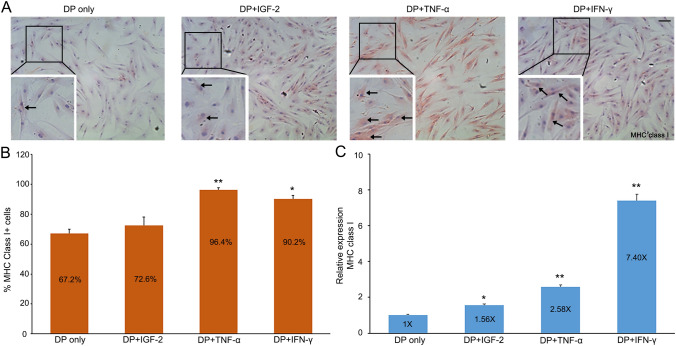
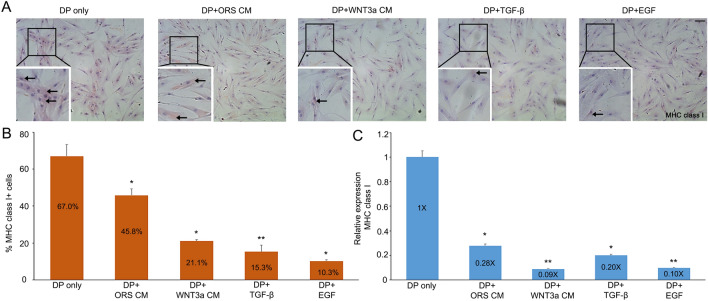
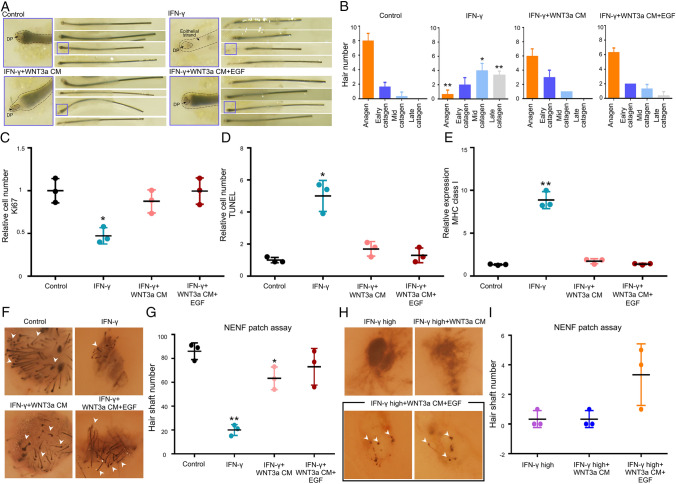
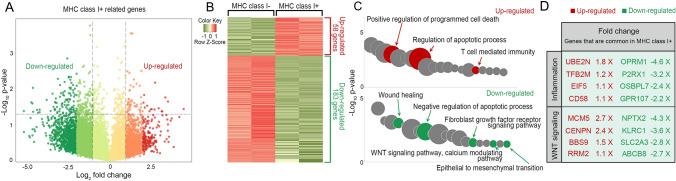
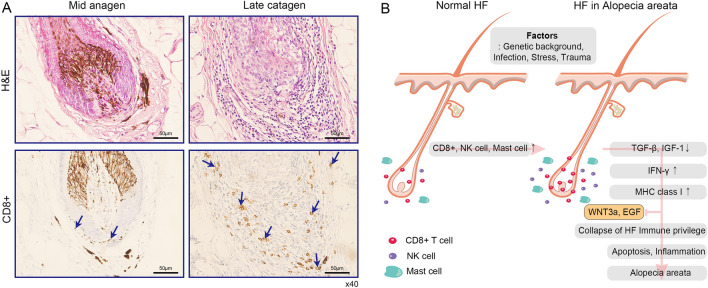
Results: Inflammatory factors such as tumor necrosis factor alpha and interferon gamma were verified to induce the expression of major histocompatibility complex class I proteins in dermal papilla cells. Additionally, loss of immune privilege of hair follicles was rescued following treatment with conditioned media from outer root sheath cells. Transcriptomic analyses found 58 up-regulated genes and 183 down-regulated genes related in MHC class I+ cells. Using newborn hair patch assay, we demonstrated that WNT3a conditioned media with epidermal growth factor can restore hair growth. In alopecia areata patients, CD8+ T cells were increased during the transition from mid-anagen to late catagen.
Conclusion: Identification of mechanisms governing epithelial and mesenchymal interactions of the hair follicle facilitates an improved understanding of the regulation of hair follicle immune privilege.
Keywords: Epithelial-mesenchymal interaction; Hair follicle; Immune privilege; MHC molecule.
© 2021. The Korean Tissue Engineering and Regenerative Medicine Society.
Conflict of interest statement
The authors declare that they have no conflict of interest.
Figures
References
-
- Reynolds AJ, Jahoda CA. Cultured dermal papilla cells induce follicle formation and hair growth by transdifferentiation of an adult epidermis. Development. 1992;115:587–593. - PubMed
-
- Jahoda CA, Reynolds AJ, Oliver RF. Induction of hair growth in ear wounds by cultured dermal papilla cells. J Invest Dermatol. 1993;101:584–590. - PubMed
-
- Millar SE. Molecular mechanisms regulating hair follicle development. J Invest Dermatol. 2002;118:216–225. - PubMed
Publication types
MeSH terms
Substances
LinkOut - more resources
Full Text Sources
Research Materials