


Review
doi: 10.1016/j.immuni.2021.09.019.
Epub 2021 Sep 24.
Transition to endemicity: Understanding COVID-19
Affiliations
- PMID: 34626549
- PMCID: PMC8461290
- DOI: 10.1016/j.immuni.2021.09.019
Item in Clipboard
Review
Transition to endemicity: Understanding COVID-19
Immunity.
.
Abstract
The emergence of severe acute respiratory syndrome coronavirus 2 (SARS-CoV-2) and its associated disease, coronavirus disease 2019 (COVID-19), has caused a devastating pandemic worldwide. Here, we explain basic concepts underlying the transition from an epidemic to an endemic state, where a pathogen is stably maintained in a population. We discuss how the number of infections and the severity of disease change in the transition from the epidemic to the endemic phase and consider the implications of this transition in the context of COVID-19.
Copyright © 2021 Elsevier Inc. All rights reserved.
Figures
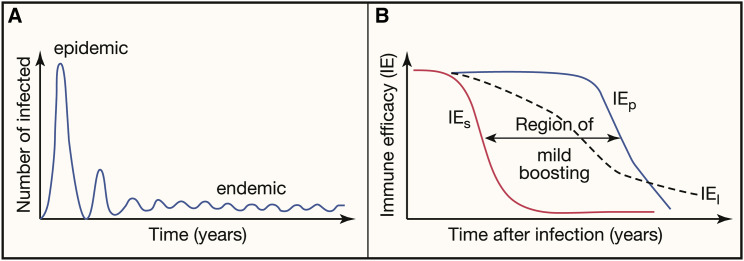
Prevalence of infection and impact of immune efficacy in endemicity (A) Changes in number of infections during the transition between epidemic and endemic phase in the absence of interventions or virus evolution. The number of infected individuals peaks during the epidemic phase. If the epidemic does not fade out, then the virus can reach an endemic phase with a much lower number of infections. (B) Different measures of immune efficacy (IE) are expected to decrease over time. IES, IEP, and IEI describe how immunity reduces susceptibility to infection, pathology, and infectiousness of infected individuals, respectively. In the region of mild boosting, individuals can become reinfected (because IES has waned), but these reinfections will be mild (because IEP is still high).
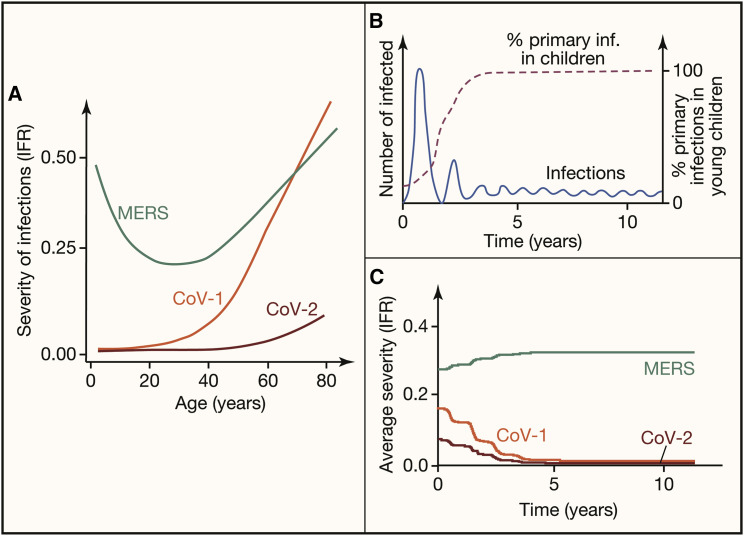
Different patterns for the severity of primary infections (IFR) of emerging coronaviruses might be expected to affect the prevalence of infections and disease severity if these viruses were to become endemic For all three infections (SARS-CoV-1, SARS-CoV-2, and MERS), we assume that primary infections provide protection from severe disease following reinfection. (A) The age-dependent severity of primary infections with emerging coronaviruses as measured by their IFR. Both SARS-CoV-1 and SARS-CoV-2 are mild in children, and disease severity increases with age. In contrast, the IFR for MERS is lowest at intermediate ages. (B) The transition from initial large epidemic to lower prevalence in the endemic phase (blue line) is associated with a change in the age distribution of primary infections. During the initial epidemic phase, infections occur in all age groups, while during the endemic phase, primary infections occur predominantly in children (dashed line). (C) Changes in the IFR as we go from the epidemic to the endemic phase. We illustrate how we might expect the severity of SARS-CoV-2, SARS-CoV-1, and MERS might change if they were to become endemic in the human population. The average severity of disease during the endemic stage depends principally on the severity of primary infections of children.
References
-
- Cliff A., Haggett P. Island epidemics. Sci. Am. 1984;250:138–147. - PubMed
Publication types
MeSH terms
Grants and funding
LinkOut - more resources
Full Text Sources
Medical
Miscellaneous
