Characteristics and Risk Factors Associated With Mortality in a Multicenter Spanish Cohort of Patients With COVID-19 Pneumonia
- PMID: 34629641
- PMCID: PMC7939995
- DOI: 10.1016/j.arbres.2021.02.021
Characteristics and Risk Factors Associated With Mortality in a Multicenter Spanish Cohort of Patients With COVID-19 Pneumonia
Abstract
Introduction: Spain is one of the countries with the highest number of COVID-19 patients. Unfortunately, few data for regions are available.
Objectives: This study aimed to describe the characteristics and independent risk factors associated with COVID-19 mortality in Castilla-La Mancha, Spain.
Methods: Cohort and multicenter study in all 14 public hospitals of the Castilla-La Mancha Health Service. Baseline characteristics, preexisting comorbidities, symptoms, clinical features and treatments were included. Multivariable logistic regression was used to evaluate factors associated with death and Kaplan-Meier test to examine survival probability. Statistical significance was considered with p < 0.05 (95% CI). SPSS (version 24.0 for Windows) and R 4.0.2 (R Statistics) software were used.
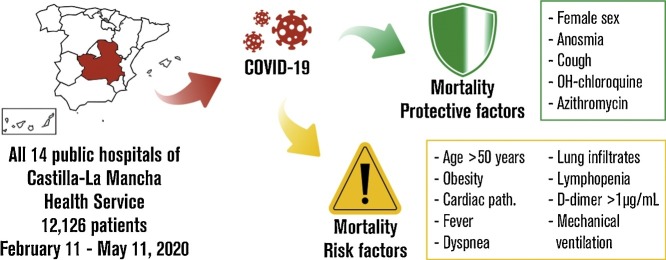
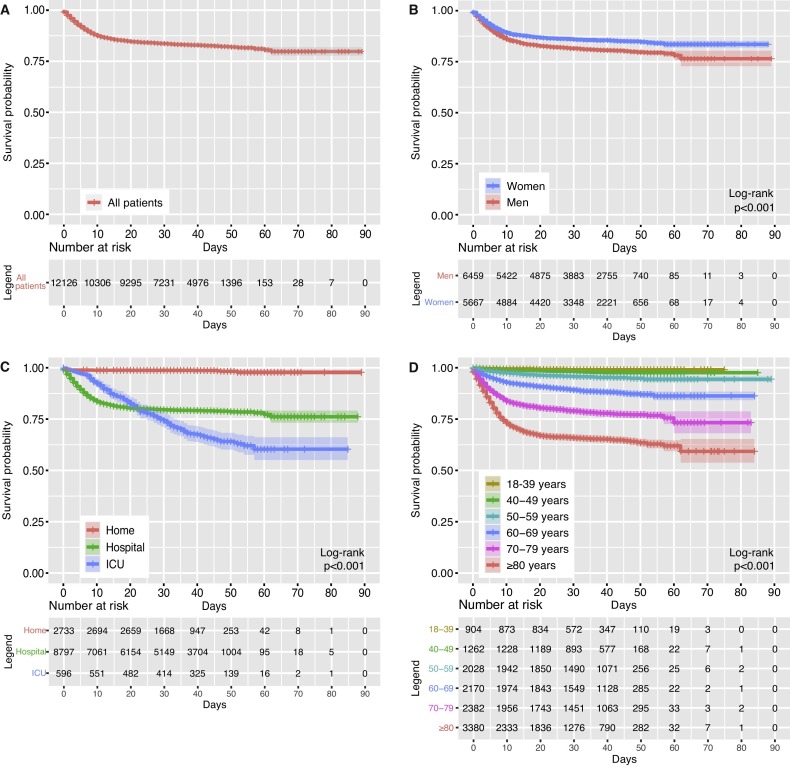
Results: The cohort comprised 12,126 patients sequentially attended between February 11 and May 11, 2020. The mean age of patients was 66.4 years; 5667 (46.7%) were women. Six protective factors against exitus were defined: female sex, anosmia, cough, chloroquine and azithromycin. The risk factors were: age over 50, obesity, cardiac pathology, fever, dyspnea, lung infiltrates, lymphopenia, D-dimer above 1000 ng/mL, and mechanical ventilation requirement. Survival analysis showed higher survival rate in women (75.7%) than men (72.1%). Cumulative survival was 87.5% for non-hospitalized patients, 70.2% for patients admitted to hospital and 61.2% in ICU patients. Additionally, survival probability decreased with increasing age range.
Conclusion: Determination of protective or death-promoting factors could be useful to stratify patients by severity criteria and to improve COVID-19 care management.
Introducción: España es uno de los países con mayor número de pacientes con COVID-19. Desafortunadamente, se dispone de pocos datos por regiones.
Objetivos: Describir las características y los factores de riesgo independientes asociados a mortalidad por COVID-19 en Castilla-La Mancha, España.
Métodos: Estudio de cohorte, multicéntrico de los 14 hospitales públicos de Castilla-La Mancha. Se evaluaron las características clínicas, comorbilidades preexistentes, síntomas y tratamientos. Se utilizó una regresión logística multivariable para evaluar los factores asociados a muerte y Kaplan-Meier para medir supervivencia. Se consideró significación estadística con p < 0,05 (IC 95%). Se utilizaron los programas SPSS (versión 24.0 para Windows) y R 4.0.2 (R Statistics).
Resultados: Se estudiaron 12.126 pacientes atendidos secuencialmente entre el 11 de febrero y el 11 de mayo de 2020. La edad media fue de 66,4 años; 5.667 (46,7%) fueron mujeres. Se definieron seis factores protectores contra el exitus: sexo femenino, anosmia, tos, cloroquina y azitromicina. Los factores de riesgo fueron: edad superior a 50, obesidad, patología cardíaca, fiebre, disnea, infiltrados pulmonares, linfopenia, dímero-D > 1.000 ng/mL y necesidad de ventilación mecánica. Se observó mayor tasa de supervivencia en mujeres (75,7%) que en hombres (72,1%). La supervivencia acumulada fue del 87,5% para pacientes no hospitalizados, 70,2% para admitidos en planta hospitalaria y 61,2% en la Unidad de Cuidados Intensivos (UCI). Además, la probabilidad de supervivencia disminuyó con el aumento del rango de edad.
Conclusión: La determinación de los factores protectores o favorecedores de muerte podría ser útil para estratificar pacientes por criterios de gravedad y mejorar la atención frente a la COVID-19.
Keywords: Covid-19; Mortality; Pandemic; Pneumonia; Risk factors.
© 2021 SEPAR. Published by Elsevier España, S.L.U. All rights reserved.
Figures


References
-
- Casas Rojo J.M., Antón Santos J.M., Núñez-Cortés J.M., Bermejo C.L., Rincón J.M.R., Roy-Vallejo E., et al. Clinical characteristics of patients hospitalized with COVID-19 in Spain: results from the SEMI-COVID-19 Registry. Rev Clin Esp. 2020;220:480–494. doi: 10.1016/j.rce.2020.07.003. - DOI - PMC - PubMed
LinkOut - more resources
Full Text Sources