Review
. 2021 Sep 27;12(5):87-103.
doi: 10.4331/wjbc.v12.i5.87.

Alcoholic liver disease: Current insights into cellular mechanisms

Affiliations
Review

Alcoholic liver disease: Current insights into cellular mechanisms

Lucy Petagine et al. World J Biol Chem. .

Abstract

Alcoholic liver disease (ALD) due to chronic alcohol consumption is a significant global disease burden and a leading cause of mortality. Alcohol abuse induces a myriad of aberrant changes in hepatocytes at both the cellular and molecular level. Although the disease spectrum of ALD is widely recognized, the precise triggers for disease progression are still to be fully elucidated. Oxidative stress, mitochondrial dysfunction, gut dysbiosis and altered immune system response plays an important role in disease pathogenesis, triggering the activation of inflammatory pathways and apoptosis. Despite many recent clinical studies treatment options for ALD are limited, especially at the alcoholic hepatitis stage. We have therefore reviewed some of the key pathways involved in the pathogenesis of ALD and highlighted current trials for treating patients.

Keywords: Alcohol; Gut microbiome; Inflammation; Liver; Mitochondria; Oxidative stress.


Conflict of interest statement

Conflict-of-interest statement: There is no conflict of interest.

Figures
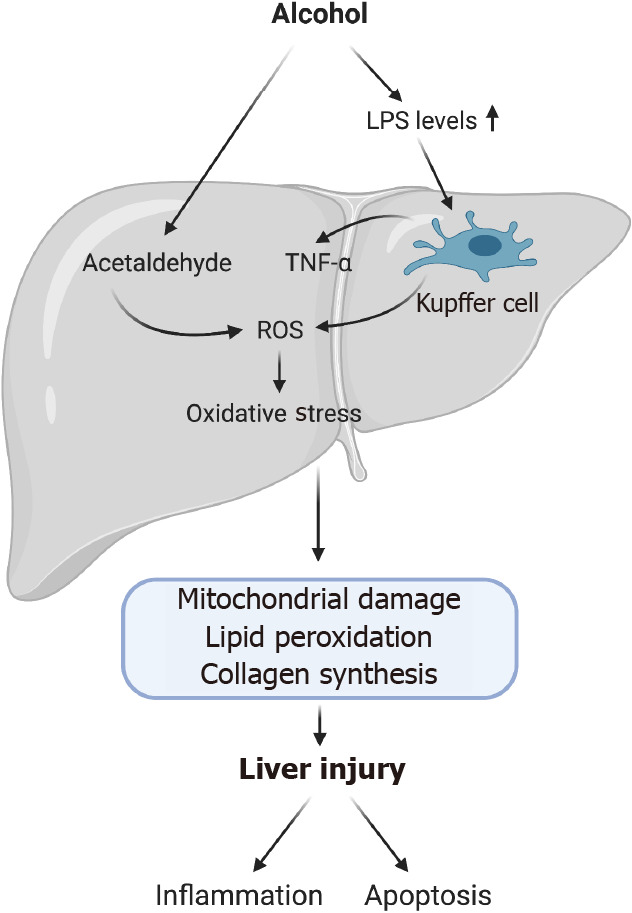
Figure 1
Figure 1
Alcohol-related induction of oxidative stress and liver injury. Alcohol misuse leads to loss of tight junctions in the gut increasing its permeability. This causes translocation of lipopolysaccharide into the liver activating toll-like receptor 4 on Kupffer cells (KCs). Activation of KCs can cause reactive oxygen species (ROS) production and pro-inflammatory cytokines such as tumor necrosis factor-α. ROS production also occurs due to the metabolism of alcohol. ROS production and inflammatory cytokines leads to inflammation and recruitment of inflammatory cells as well as activation of apoptotic pathways. (Figure created with BioRender.com). LPS: Lipopolysaccharide; ROS: Reactive oxygen species; TNF-α: Tumor necrosis factor-α.
Figure 2
Figure 2
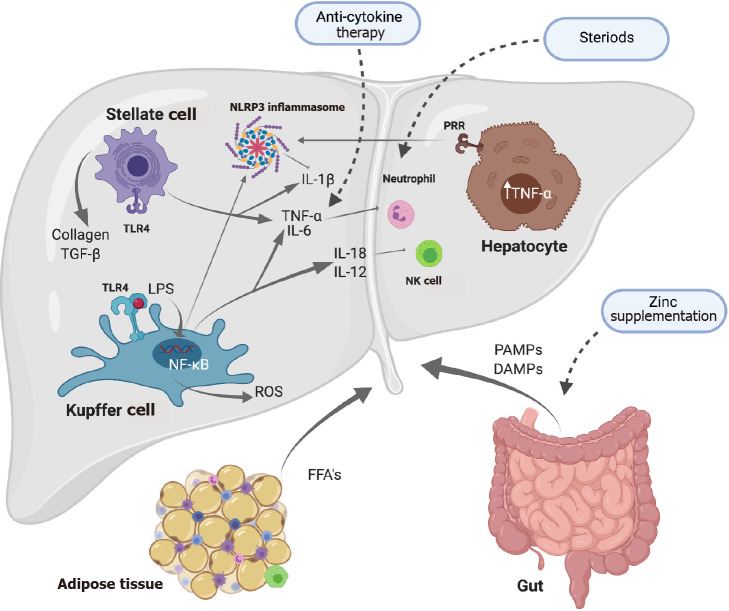
The inflammatory response during alcoholic liver disease. Excessive consumption of alcohol causes lipopolysaccharide release from the gut activating toll-like receptor 4 on Kupffer cells (KCs). Pattern recognition receptors become activated by pathogen-associated molecular patterns/damage-associated molecular patterns which induces inflammation via release of proinflammatory cytokines and inflammasome activation. Interleukin (IL)-18 production from KCs causes activation of natural killer cells. Toll-like receptor stimulation in hepatic stellate cells results in the expression of IL-6, transforming growth factor-β1 and tumor necrosis factor-α. (Figure created with BioRender.com). DAMPs: Damage-associated molecular patterns; FFA: Free fatty acids; PAMPs: Pathogen-associated molecular patterns; IL: Interleukin; LPS: Lipopolysaccharide; NF-κB: Nuclear factor-κB; NK: Natural killer; NLRP3: NOD-, LRR- and pyrin domain-containing protein 3; PRR: Pattern recognition receptor; ROS: Reactive oxygen species; TGF-β: Transforming growth factor β; TLR4: Toll-like receptor 4; TNF-α: Tumor necrosis factor-α.
Figure 3
Figure 3
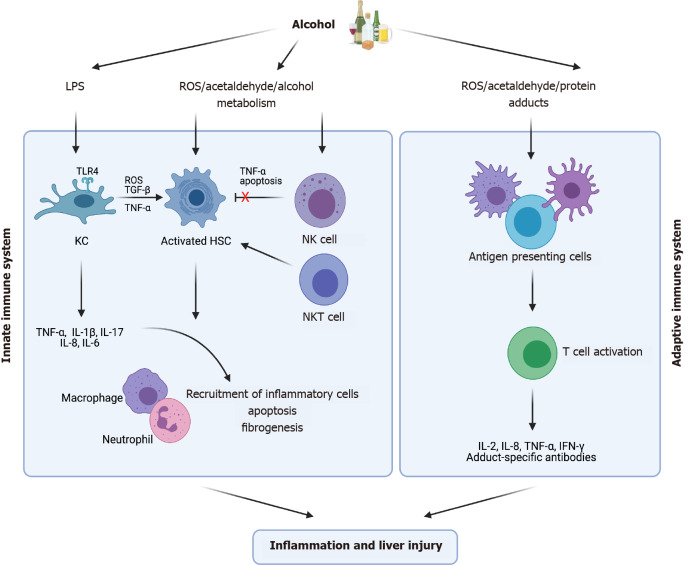
Innate and adaptive immune response to alcohol exposure. Kupffer cells, hepatic stellate cells and natural killer cells are components of the innate immune system which becomes activated following chronic alcohol consumption. This leads to the release of inflammatory cytokines, causing further recruitment of inflammatory cells. The adaptive immune system also becomes activated releasing inflammatory mediators as well as antibody generation to protein and Malondialdehyde-acetaldehyde adducts. Both immune response mechanisms eventually become dysregulated over time with alcohol consumption. (Figure created with BioRender.com). HSC: Hepatic stellate cell; IFN-γ: Interferon-γ; IL: Interleukin; KC: Kupffer cell; LPS: Lipopolysaccharide; NK: Natural killer; NKT: Natural killer T; ROS: Reactive oxygen species; TGF-β: Transforming growth factor β; TLR4: Toll-like receptor 4; TNF-α: Tumor necrosis factor-α.

References

    1. Fleming KA, McGee JO. Alcohol induced liver disease. J Clin Pathol. 1984;37:721–733. - PMC - PubMed
    1. Frazier TH, Stocker AM, Kershner NA, Marsano LS, McClain CJ. Treatment of alcoholic liver disease. Therap Adv Gastroenterol. 2011;4:63–81. - PMC - PubMed
    1. Kong LZ, Chandimali N, Han YH, Lee DH, Kim JS, Kim SU, Kim TD, Jeong DK, Sun HN, Lee DS, Kwon T. Pathogenesis, Early Diagnosis, and Therapeutic Management of Alcoholic Liver Disease. Int J Mol Sci. 2019;20 - PMC - PubMed
    1. Nagy LE. The Role of Innate Immunity in Alcoholic Liver Disease. Alcohol Res. 2015;37:237–250. - PMC - PubMed
    1. WHO Global status report on alcohol and health 2018. [cited 10 March 2021]. Available from: https://apps.who.int/iris/bitstream/handle/10665/274603/9789241565639-en... .