. 2020;10(5):2513-2518.
doi: 10.1039/C9RA10091A. Epub 2020 Jan 14.

Rigor and reproducibility in polymer nanoparticle synthesis and characterization

Affiliations

Rigor and reproducibility in polymer nanoparticle synthesis and characterization

Kenneth R Sims Jr et al. RSC Adv. 2020.

Abstract

Standardized process improvement methods and tools were used to enhance the rigor and reproducibility of diblock copolymer nanoparticle (NP) synthesis and characterization. Models linking design parameters with NP characteristics boosted process control for NP synthesis, which may improve translation and commercialization of NP research.


Conflict of interest statement

Conflicts of interest There are no conflicts to declare.

Figures
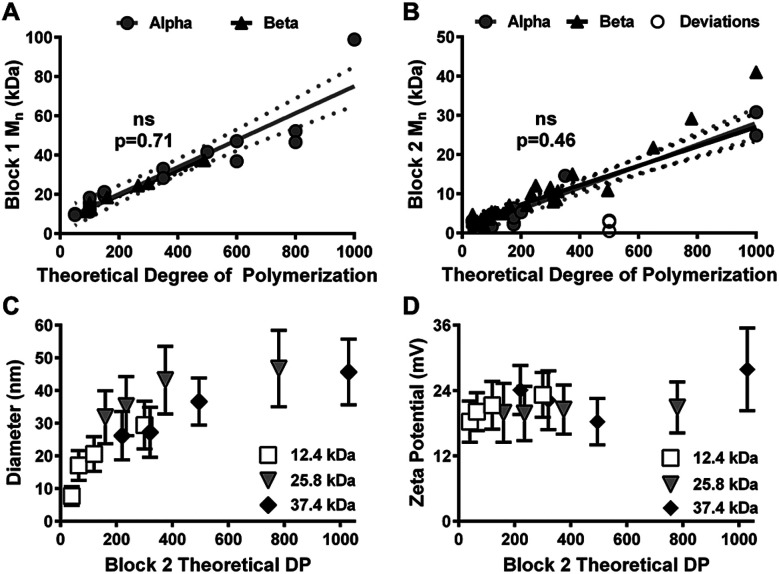
Fig. 1
Fig. 1. Polymer and nanoparticle (NP) characterization as a function of theoretical Degree of Polymerization (DP). Scatterplots of Block 1 (A) and Block 2 (B) number average molecular weight (Mn) as a function of theoretical DP for Alpha (grey circles) and Beta (black triangles) syntheses. White circles represent polymers with process deviations. Data are shown as individual Mn values and linear regressions for each group. ns = no significant difference between the regression slopes per analysis of covariance testing. Dotted lines represent 95% confidence intervals for linear regression lines. Scatterplots of NP diameter (C) and zeta potential (D) versus Block 2 theoretical DP for copolymers synthesized using different Block 1s (12.4 kDa, white squares; 25.8 kDa, grey triangles; 37.4 kDa, black diamonds). Data are shown as mean ± standard deviation from n = 3 independent size measurements (C) and n = 5 independent zeta potential measurements (D).
Fig. 2
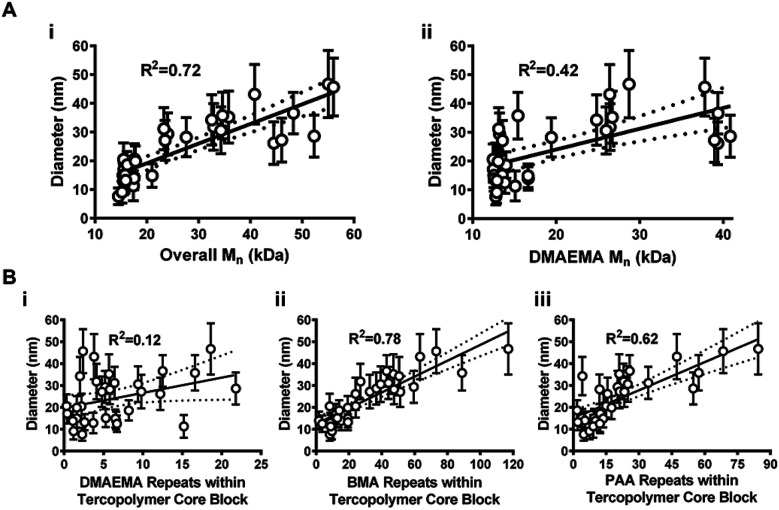
Fig. 2. NP size as a function of copolymer Mn and monomer incorporation within hydrophobic cores. (A) Scatterplots of measured NP diameter versus (i) overall copolymer Mn and (ii) DMAEMA Mn. (B) Scatterplots of NP diameter versus monomer repeats within NP hydrophobic cores for (i) DMAEMA, (ii) BMA, and (iii) PAA. Data shown as mean ± standard deviation from n = 3 independent measurements. Dotted lines indicate 95% confidence intervals.
Fig. 3
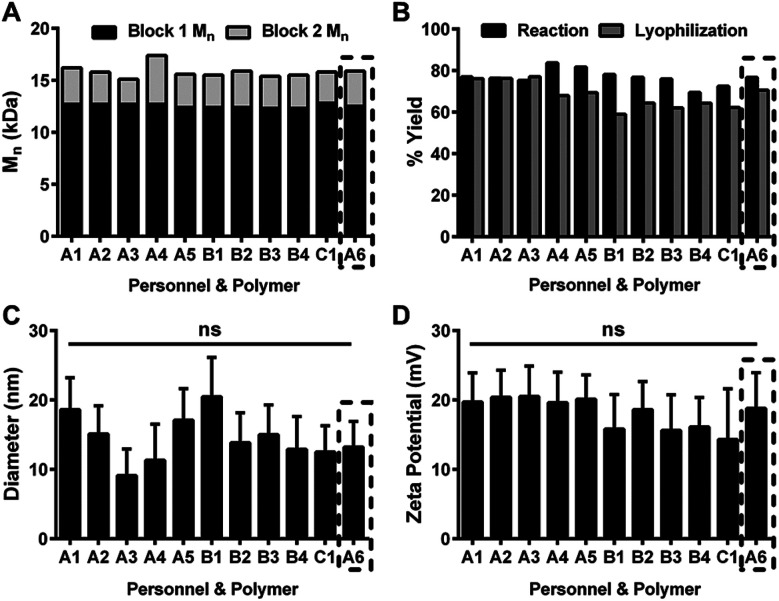
Fig. 3. Reproducibility of diblock copolymer NP synthesis. (A) Block 1 and Block 2 Mn data for eleven NP batches synthesized by different personnel (e.g., A, B and C). (B) Reaction and lyophilization yields for each NP batch. NP size (C) and zeta potential (D) data shown as the mean ± standard deviation from n = 3 (C) or n = 5 (D) measurements. ns = no significant difference from One-way ANOVA with Tukey's multiple comparisons test. Black dashed-line box indicates 10× scale-up pilot batch showing similar results to the other batches.
Fig. 4
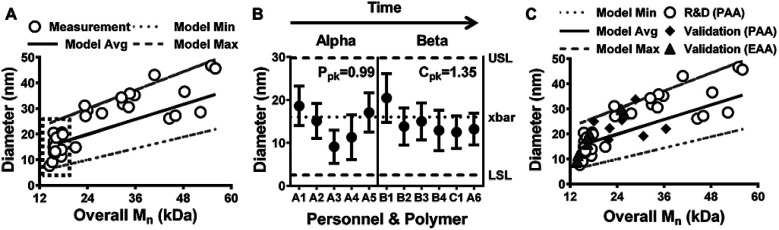
Fig. 4. Predictive model and process capability analysis demonstrate statistical process control for NP production. (A) Model results show theoretical NP diameters, observed slope, and 95% confidence interval from Fig. 2A. White circles represent data means and the black, dashed box highlights batches from Fig. 3. (B) Process performance analysis of five Alpha batches and process capability analysis of seven Beta batches from Fig. 3 showing initial process performance (Ppk = 0.99) and the modified process capability (Cpk = 1.35) for diblock copolymer NP synthesis. Statistical process control (Ppk values ≥ 1.67 and Cpk values ≥ 1.33) was achieved only after application of insights from the model shown in Fig. 1. (C) Validation results comparing theoretical model data from (A), termed “R&D (PAA)” (white circles) with measurements for prospectively synthesized diblock copolymers containing either propyl acrylic acid (“Validation (PAA)”, black diamonds) or ethyl acrylic acid (“Validation (EAA)”, grey triangles) in the hydrophobic core. 6 out of 7 Validation (PAA) batches and all 8 Validation (EAA) batches were within model limits.

References

    1. Cabral H. Miyata K. Osada K. Kataoka K. Chem. Rev. 2018;118:6844–6892. doi: 10.1021/acs.chemrev.8b00199. - DOI - PubMed
    1. Ventola C. L. Pharm. Therapeut. 2017;42:742–755. - PMC - PubMed
    1. Bobo D. Robinson K. J. Islam J. Thurecht K. J. Corrie S. R. Pharm. Res. 2016;33:2373–2387. doi: 10.1007/s11095-016-1958-5. - DOI - PubMed
    1. Truong N. P. Gu W. Prasadam I. Jia Z. Crawford R. Xiao Y. Monteiro M. J. Nat. Commun. 2013;4:1902. doi: 10.1038/ncomms2905. - DOI - PubMed
    1. Ramírez-García P. D. Retamal J. S. Shenoy P. Imlach W. Sykes M. Truong N. Constandil L. Pelissier T. Nowell C. J. Khor S. Y. Layani L. M. Lumb C. Poole D. P. Lieu T. Stewart G. D. Mai Q. N. Jensen D. D. Latorre R. Scheff N. N. Schmidt B. L. Quinn J. F. Whittaker M. R. Veldhuis N. A. Davis T. P. Bunnett N. W. Nat. Nanotechnol. 2019;14:1150–1159. doi: 10.1038/s41565-019-0568-x. - DOI - PMC - PubMed