. 2021 Aug 26:23:98-107.
doi: 10.1016/j.omtm.2021.08.001. eCollection 2021 Dec 10.

Coagulation factor IX gene transfer to non-human primates using engineered AAV3 capsid and hepatic optimized expression cassette

Affiliations

Coagulation factor IX gene transfer to non-human primates using engineered AAV3 capsid and hepatic optimized expression cassette

Sandeep R P Kumar et al. Mol Ther Methods Clin Dev. .

Abstract

Hepatic gene transfer with adeno-associated viral (AAV) vectors shows much promise for the treatment of the X-linked bleeding disorder hemophilia B in multiple clinical trials. In an effort to further innovate this approach and to introduce alternative vector designs with potentially superior features into clinical development, we recently built a vector platform based on AAV serotype 3 because of its superior tropism for human hepatocytes. A vector genome with serotype-matched inverted terminal repeats expressing hyperactive human coagulation factor IX (FIX)-Padua was designed for clinical use that is optimized for translation using hepatocyte-specific codon-usage bias and is depleted of immune stimulatory CpG motifs. Here, this vector genome was packaged into AAV3 (T492V + S663V) capsid for hepatic gene transfer in non-human primates. FIX activity within or near the normal range was obtained at a low vector dose of 5 × 10¹¹ vector genomes/kg. Pre-existing neutralizing antibodies, however, completely or partially blocked hepatic gene transfer at that dose. No CD8+ T cell response against capsid was observed. Antibodies against the human FIX transgene product formed at a 10-fold higher vector dose, albeit hepatic gene transfer was remarkably consistent, and sustained FIX activity in the normal range was nonetheless achieved in two of three animals for the 3-month duration of the study. These results support the use of this vector at low vector doses for gene therapy of hemophilia B in humans.

Keywords: AAV; adeno-associated virus; antibodies; capsid; factor IX; hemophilia; immune response; liver; non-human primate.


Conflict of interest statement

G.G. is a scientific co-founder of Voyager Therapeutic, Adrenas Therapeutics, and Aspa Therapeutics and holds equity in these companies. G.G. is an inventor on patents with potential royalties licensed to Voyager Therapeutics, Aspa Therapeutics, and other biopharmaceutical companies. Arun Srivastava is a co-founder of, and holds equity in, Lacerta Therapeutics. Arun Srivastava, G.G., and R.W.H. are inventors on several issued patents on recombinant AAV vectors that have been licensed to various gene therapy companies. C.B.D. and H.T.S. are co-founders of Expression Therapeutics and own equity in the company. Expression Therapeutics owns the intellectual property associated with the LCO-FIX transgene. H.C.B. is an inventor of the technology and an employee of Expression Therapeutics. The terms of this arrangement have been reviewed and approved by Emory University in accordance with its conflict-of-interest policies. The remaining authors declare no competing interests.

Figures

None
Graphical abstract
Figure 1
Figure 1
Experimental scheme to evaluate hFIX expression in non-human primates after AAV gene transfer (A) Vector genome design. HSh4/TTR, liver-specific enhancer/transthyretin promoter; MVM intron, intron derived from minute virus of mice; PA, polyadenylation signal; TR3, wild-type AAV3 inverted terminal repeat; mTR3, mutated AAV3 inverted terminal repeat (terminal resolution site deleted). (B) AAV capsid. (C) Animal groups, vector doses, and administration route. (D) Evaluation of hFIX expression, activity, immune responses, blood chemistry, and other factors at different time points.
Figure 2
Figure 2
Dose-dependent expression of hFIX in plasma samples from two cohorts (n = 3) of non-human primates injected intravenously with AAV3-hFIX vector (A and B) Expression levels of hFIX in animals injected with (A) 5 × 1011 vg/kg and (B) 5 × 1012 vg/kg AAV3-hFIX. Each line represents an individual animal.
Figure 3
Figure 3
hFIX activity in plasma samples from non-human primates collected at different time points after AAV3-hFIX administration (A and B) Vector doses were (A) 5 × 1011 vg/kg and (B) 5 × 1012 vg/kg. Values are baseline corrected to eliminate endogenous FIX activity. Each line represents an individual animal.
Figure 4
Figure 4
Anti-hFIX IgG and Bethesda titers in plasma samples from non-human primates after AAV3-hFIX administration (A and B) Anti-hFIX IgG antibodies level in (A) 5 × 1011 vg/kg cohort and (B) 5 × 1012 vg/kg cohort. (C) Inhibitory antibodies against hFIX as detected by Bethesda assay. Each line represents an individual animal. (D) Frequency of B cells secreting antibodies to hFIX in splenocytes of each non-human primate as determined by B cell ELISpot assay. Data are presented as spots per million splenocytes. (E) Representative wells from B cell ELISpot assay performed on the splenocytes of each non-human primate collected at the end of experiment.
Figure 5
Figure 5
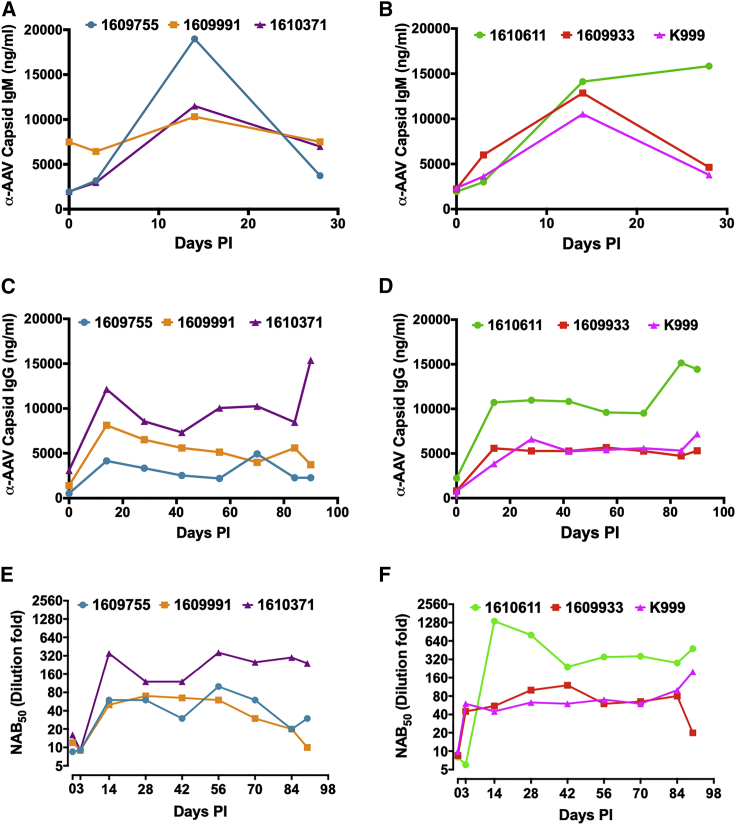
Antibody response to AAV capsid (A and B) Anti-AAV3 capsid-specific IgM antibodies levels in (A) 5 × 1011 vg/kg and (B) 5 × 1012 vg/kg cohort. (C and D) Anti-AAV3 capsid-specific IgG antibodies levels in (C) 5 × 1011 vg/kg and (D) 5 × 1012 vg/kg cohort. (E and F) AAV3 neutralizing antibody (NAb) profiles in the serum from animals before and after administration of AAV3-hFIX in (E) 5 × 1011 vg/kg and (F) 5 × 1012 vg/kg cohort. Each line represents an individual animal.
Figure 6
Figure 6
Quantification of hepatic gene transfer and transgene expression (A–C) Quantification of (A) AAV genome, (B) hFIX mRNA transcript normalized to actin mRNA, and (C) hFIX protein levels (ng/mg liver tissue) in different liver lobes of individual animal from both cohorts. Each dot represents an individual lobe, and each bar represents an individual animal. Error bar indicate standard deviation.

References

    1. Butterfield J.S.S., Hege K.M., Herzog R.W., Kaczmarek R. A molecular revolution in the treatment of hemophilia. Mol. Ther. 2020;28:997–1015. - PMC - PubMed
    1. Nathwani A.C. Gene therapy for hemophilia. Hematology (Am. Soc. Hematol. Educ. Program) 2019;2019:1–8. - PMC - PubMed
    1. Perrin G.Q., Herzog R.W., Markusic D.M. Update on clinical gene therapy for hemophilia. Blood. 2019;133:407–414. - PMC - PubMed
    1. George L.A., Sullivan S.K., Giermasz A., Rasko J.E.J., Samelson-Jones B.J., Ducore J., Cuker A., Sullivan L.M., Majumdar S., Teitel J. Hemophilia B gene therapy with a high-specific-activity factor IX variant. N. Engl. J. Med. 2017;377:2215–2227. - PMC - PubMed
    1. Pierce G.F. Gene therapy for hemophilia: Are expectations matching reality? Mol. Ther. 2020;28:2097–2098. - PMC - PubMed