


Aspirin for cardiovascular disease prevention among adults in the United States: Trends, prevalence, and participant characteristics associated with use
- PMID: 34632437
- PMCID: PMC8488247
- DOI: 10.1016/j.ajpc.2021.100256
Aspirin for cardiovascular disease prevention among adults in the United States: Trends, prevalence, and participant characteristics associated with use
Abstract
Objective: : Aspirin has been widely utilized over several decades for atherosclerotic cardiovascular disease (ASCVD) prevention among adults in the United States. We examined trends in aspirin use among adults aged ≥40 years from 1998 to 2019 and assessed factors associated with its use for primary and secondary ASCVD prevention.
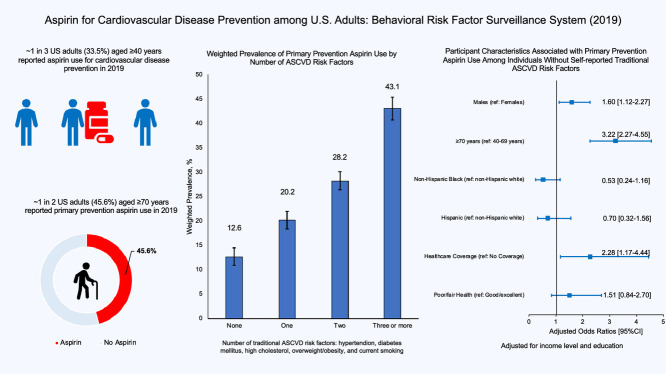
Methods: : Using 1998-2019 Behavioral Risk Factor Surveillance System data, we obtained weighted prevalence of aspirin use among adults aged ≥40 years for each year and examined trends in use over this period. Using multivariable logistic regression and utilizing data from 54,388 respondents aged ≥40 years in the 2019 data, we assessed factors associated with aspirin use for secondary prevention and for primary prevention stratified by the number of traditional ASCVD risk factors reported (hypertension, diabetes mellitus, high cholesterol, overweight/obesity, and cigarette smoking).
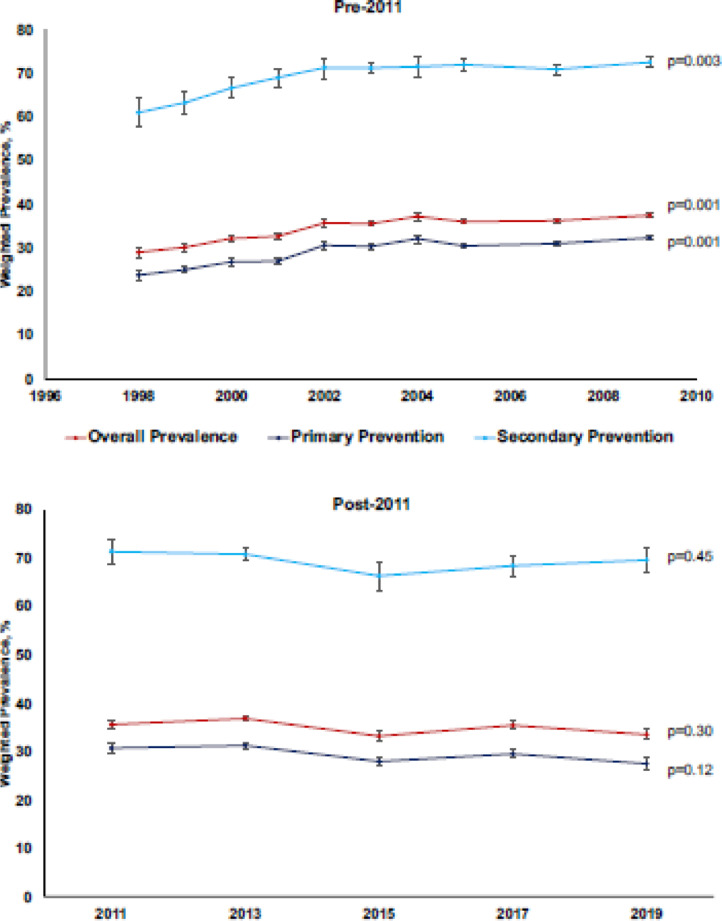
Results: : Aspirin use prevalence increased from 29.0%(95%CI, 27.9%-30.2%) in 1998 to 37.5%(36.9%-38.0%) in 2009. However, use has slightly declined over the last decade: 35.6%(34.6%-36.6%) in 2011 to 33.5%(32.5%-34.6%) in 2019. In 2019, among respondents without cardiovascular disease (CVD), 27.5%(26.4%-28.6%) reported primary prevention aspirin use while 69.7%(67.0%-72.2%) of respondents with CVD reported secondary prevention aspirin use. Of concern, 45.6%(43.5%-47.7%) of adults aged ≥70 years without CVD reported primary prevention aspirin use. Additionally, among individuals without any self-reported traditional ASCVD risk factor, males (adjusted odds ratio(aOR):1.60, 95%CI:1.12-2.27), persons aged ≥70 years (aOR:3.22, 95%CI:2.27-4.55), and individuals with healthcare coverage (aOR:2.28, 95%CI:1.17-4.44) had higher odds of primary prevention aspirin use compared to females, persons aged 40-69 years, and individuals without healthcare coverage, respectively. Females were less likely than males to report secondary prevention aspirin use (aOR:0.64, 95%CI:0.50-0.82).
Conclusion: : Aspirin use has slightly declined over the last decade. A significant proportion of adults aged ≥70 years reported primary prevention aspirin use in 2019. Since current guidelines do not recommend primary prevention aspirin use among adults aged ≥70 years, such use should be discouraged.
Keywords: Aspirin; Primary prevention; Secondary prevention; Trends.
© 2021 The Authors.
Conflict of interest statement
The authors declare that they have no known competing financial interests or personal relationships that could have appeared to influence the work reported in this paper.
Figures
References
-
- Edney P., Jackson P., Burrell B. Antiplatelet treatment reduces the risk of non-fatal vascular events and, to a lesser extent, vascular death. Br Med J. 1988;296(6618):320–331. doi: 10.1136/bmj.296.6618.320. - DOI
LinkOut - more resources
Full Text Sources
Medical
