


Primary care is the frontline for help-seeking insomnia patients
- PMID: 34633282
- PMCID: PMC8510604
- DOI: 10.1080/13814788.2021.1960308
Primary care is the frontline for help-seeking insomnia patients
Abstract
Background: Although insomnia is a very common disorder, few people seek medical help.
Objectives: To determine the proportion of people who consult a healthcare professional about insomnia and examine reasons for help seeking.
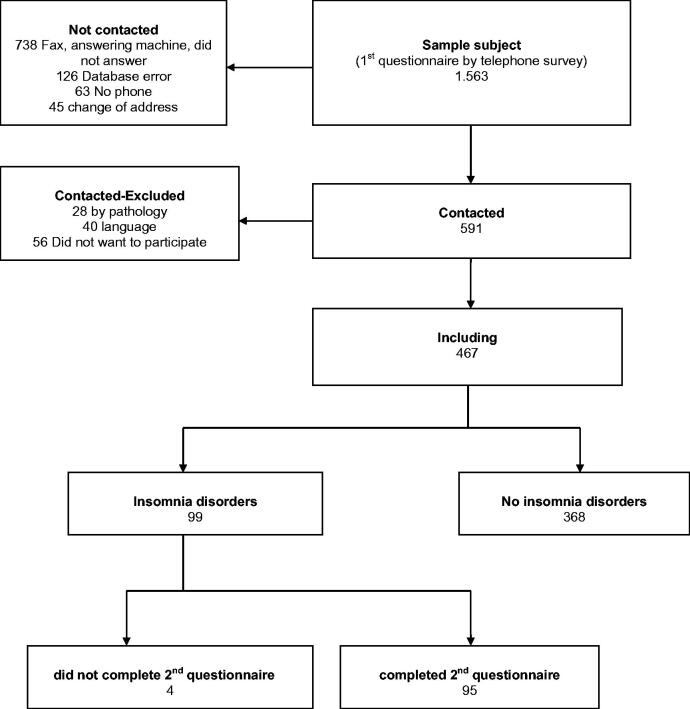
Methods: Descriptive study of 99 patients diagnosed with insomnia following a telephone survey of 466 adults assigned to a primary healthcare unit in Majorca (Spain). Data were obtained from interviews and subsequent review of electronic medical records.
Results: Thirty-nine patients (39.8%) consulted at least once with one health care professional; 36(92.2%) consulted a general practitioner. Only 12.2% had an insomnia diagnosis registered in their medical record. Insomnia consultation was not associated with any sociodemographic variables analysed, anxiety, depression or comorbidities. Also, there was no association with sleep quality, duration, and sleep efficiency. Patients with clinical insomnia (OR, 2.48; 95% CI, 1.03-5.94), those who were more worried (OR, 2.93; 95% CI 1.08-7.95) or felt that others noticed the impact of insomnia on their quality of life (OR, 2.48; 95% CI, 1.02-19.08) are more likely to seek medical help. Patients taking sleep medication were 21.54 (95% CI, 7.34-63.20) times more likely to have asked for medical assistance.
Conclusion: Insomnia is an under-reported problem for both patients and doctors. When patients decide to consult for insomnia problems, they first go to the GP, and the vast majority take medications for their sleep problem. Those who consult most are people with more severe insomnia and those who are more worried.
Keywords: Insomnia; general practitioner; health care; help seek; nursing; primary care.
Conflict of interest statement
The authors report no conflicts of interest. The authors alone are responsible for the content and writing of the paper.
Figures
References
-
- Ohayon MM. Epidemiology of insomnia: what we know and what we still need to learn. Sleep Med Rev. 2002;6(2):97–111. - PubMed
-
- Ohayon MM, Sagales T.. Prevalence of insomnia and sleep characteristics in the general population of Spain. Sleep Med. 2010;11(10):1010–1018. - PubMed
-
- Léger D, Partinen M, Hirshkowitz M, EQUINOX (Evaluation of daytime QUality Impairment by Nocturnal awakenings in Outpatient's eXperience) Survey Investigators, et al. Characteristics of insomnia in a primary care setting: EQUINOX survey of 5293 insomniacs from 10 countries. Sleep Med. 2010;11(10):987–998. - PubMed
-
- Cañellas Dols F, Ochogavia Cánaves J, Llobera Cánaves J, et al. ITC. Trastornos del sueño y consumo de hipnóticos en la isla de Mallorca [sleep disorders and the consumption of hypnotics on the island of Mallorca]. Rev Clin Esp. 1998;198:719–725. - PubMed
-
- Vela-Bueno A, de Iceta M, Fernández C.. Prevalencia de los trastornos del sueño en la ciudad de Madrid [prevalence of sleep disorders in Madrid, Spain]. Gac Sanit. 1999;13(6):441–448. - PubMed
MeSH terms
LinkOut - more resources
Full Text Sources
Medical
