


COVID-19 and antimicrobial resistance: A cross-study
- PMID: 34634340
- PMCID: PMC8500695
- DOI: 10.1016/j.scitotenv.2021.150873
COVID-19 and antimicrobial resistance: A cross-study
Abstract
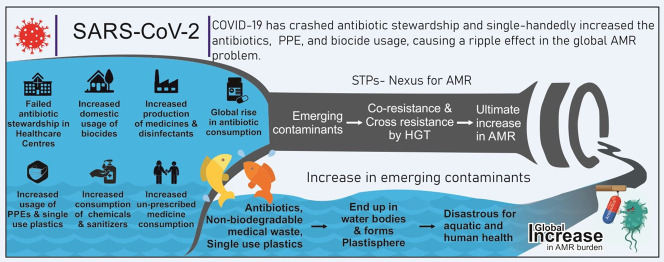
Antimicrobial resistance (AMR) is emerging as a severe concern due to the escalating instances of resistant human pathogens encountered by health workers. Consequently, there is a shortage of antibiotics to treat Multidrug Resistance (MDR) and Extensively Drug Resistance (XDR) patients. The primary cause of AMR is the vast array of anthropogenic disturbances in natural microfauna brought about by the extensive use of antibiotics. Coronavirus Disease of 2019 (COVID-19) has crashed antibiotic stewardship and single-handedly increased the global usage of antibiotics, Personal Protective Equipment (PPE), and biocide, causing a ripple effect in the existing global AMR problem. This surge in antibiotic usage has escalated the residual antibiotics reaching Wastewater Treatment Plants (WWTPs) from pharmaceutical companies, health care centers, and domestic settings. Ultimately the natural water bodies receiving their effluents will have higher concentrations of emerging contaminants as the WWTPs cannot remove the Pharmaceuticals and Personal Care Products (PPCPs) completely. Furthermore, increased biocides usage will increase AMR by co-resistance, and increasing plastics will turn into microplastics and get converted to plastisphere, which will further enhance its propagation. Therefore, it is crucial to curb antibiotic usage, implement antibiotic stewardship dynamically; and, ameliorate the present condition of WWTPs to remove residual PPCPs efficiently. The need of the hour is to address the grave threat of AMR, which is loitering silently; if not the mankind will endure more affliction hereafter.
Keywords: Antibiotic resistance; Emerging contaminants; Health risk; Pandemic; Pharmaceuticals and Personal Care Products.
Copyright © 2021. Published by Elsevier B.V.
Conflict of interest statement
Declaration of competing interest The authors declare that they have no known competing financial interests or personal relationships that could have appeared to influence the work reported in this paper.
Figures
References
-
- Ameta et al., n.d.Ameta C. Suresh, Ameta Rakshit, n.d. Advanced Oxidation Processes for Wastewater Treatment [WWW Document]. URL https://books.google.co.in/books?hl=en&lr=&id=hyk0DwAAQBAJ&o... (accessed 5.8.21).
-
- Amoxil (Amoxicillin): Uses, Dosage, Side Effects, Interactions, Warning [WWW Document], n.d.Amoxil (Amoxicillin): Uses, Dosage, Side Effects, Interactions, Warning [WWW Document], n.d. URL https://www.rxlist.com/amoxicillin-drug.htm#clinpharm (accessed 2.15.21).
Publication types
MeSH terms
Substances
LinkOut - more resources
Full Text Sources
Medical
