


Clinical Implications of the Amyloidogenic V122I Transthyretin Variant in the General Population
- PMID: 34634447
- PMCID: PMC8923911
- DOI: 10.1016/j.cardfail.2021.09.015
Clinical Implications of the Amyloidogenic V122I Transthyretin Variant in the General Population
Abstract
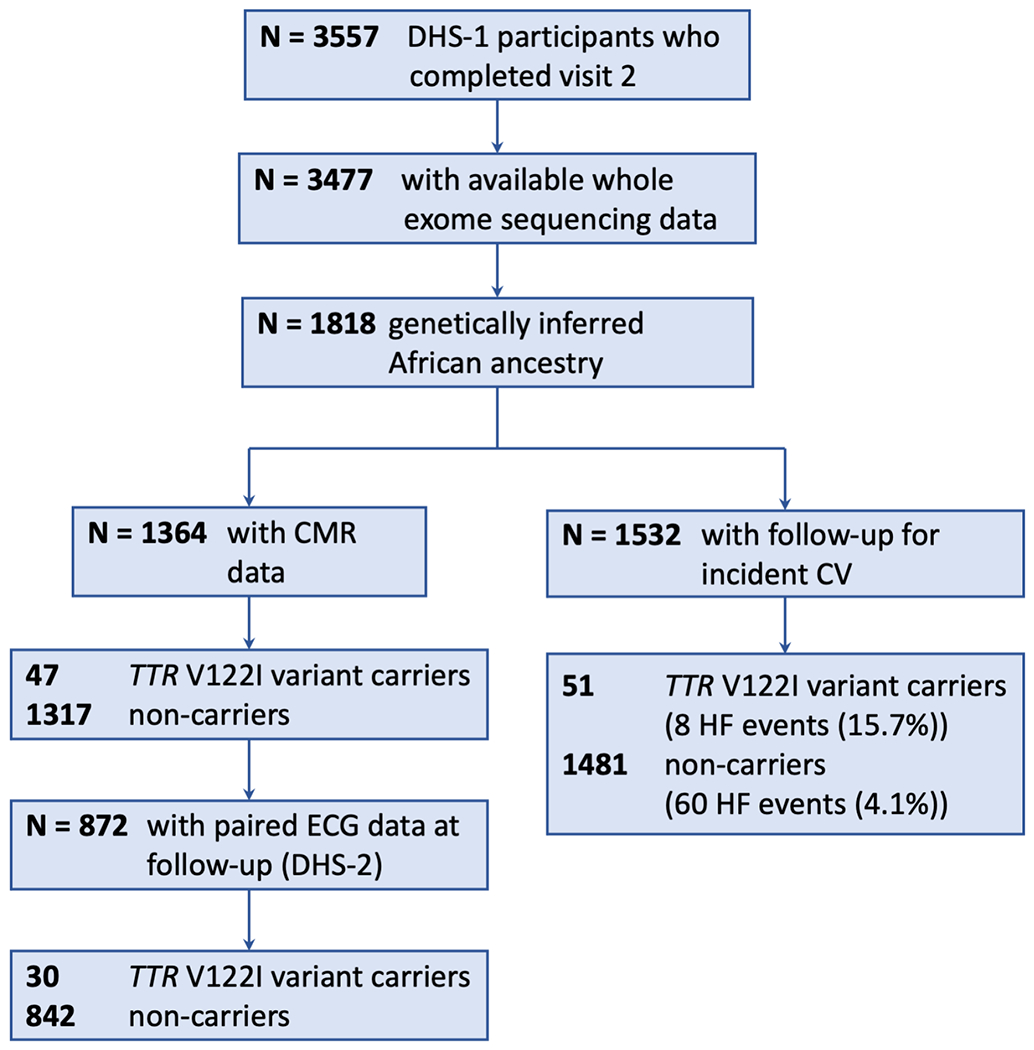
Background: The V122I variant in transthyretin (TTR) is the most common amyloidogenic mutation worldwide. The aim of this study is to describe the cardiac phenotype and risk for adverse cardiovascular outcomes of young V122I TTR carriers in the general population.
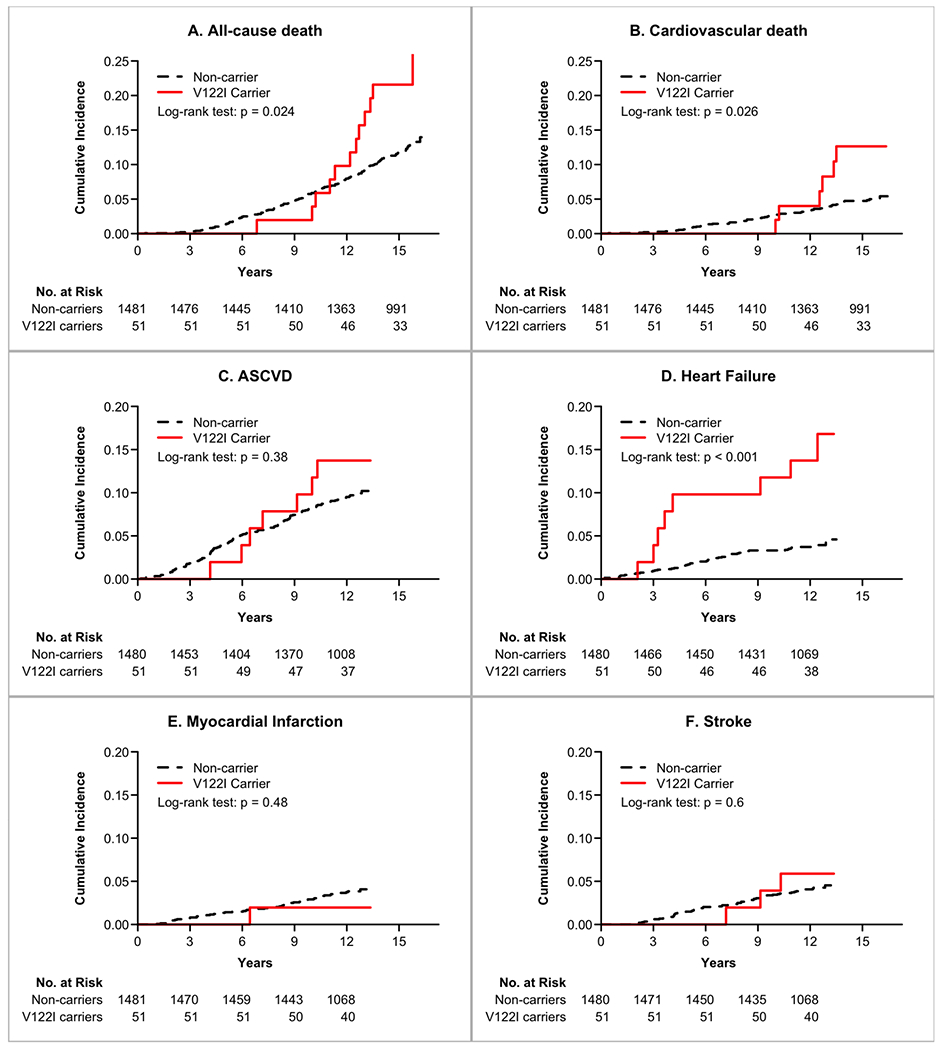
Methods and results: TTR genotypes were extracted from whole-exome sequence data in participants of the Dallas Heart Study. Participants with African ancestry, available V122I TTR genotypes (N = 1818) and either cardiac magnetic resonance imaging (n = 1364) or long-term follow-up (n = 1532) were included. The prevalence of V122I TTR carriers (45 ± 10 years) was 3.2% (n/N = 59/1818). The V122I TTR carriers had higher baseline left ventricular wall thickness (8.52 ± 1.82 vs 8.21 ± 1.62 mm, adjusted P = .038) than noncarriers, but no differences in other cardiac magnetic resonance imaging measures (P > .05 for all). Although carrier status was not associated with amino terminal pro-B-type natriuretic peptide (NT-proBNP) at baseline (P = .79), V122I TTR carriers had a greater increase in NT-proBNP on follow-up than noncarriers (median 28.5 pg/mL, interquartile range 11.4-104.1 pg/mL vs median 15.9 pg/mL, interquartile range 0.0-43.0 pg/mL, adjusted P = .018). V122I TTR carriers were at a higher adjusted risk of heart failure (hazard ratio 3.82, 95% confidence interval 1.80-8.13, P < .001), cardiovascular death (hazard ratio 2.65, 95% confidence interval 1.14-6.15, P = .023), and all-cause mortality (hazard ratio 1.95, 95% confidence interval 1.08-3.51, P = .026) in comparison with noncarriers.
Conclusions: V122I TTR carrier status was associated with a greater increase in NT-proBNP, slightly greater left ventricular wall thickness, and a higher risk for heart failure, cardiovascular death, and all-cause mortality. These findings suggest the need to develop amyloidosis screening strategies for V122I TTR carriers.
Keywords: Cardiac amyloidosis; heart failure; transthyretin.
Copyright © 2021 Elsevier Inc. All rights reserved.
Figures
References
-
- Lane T, Fontana M, Martinez-Naharro A, Quarta CC, Whelan CJ, Petrie A, Rowczenio DM, Gilbertson JA, Hutt DF, Rezk T, Strehina SG, Caringal-Galima J, Manwani R, Sharpley FA, Wechalekar AD, Lachmann HJ, Mahmood S, Sachchithanantham S, Drage EPS, Jenner HD, McDonald R, Bertolli O, Calleja A, Hawkins PN, Gillmore JD. Natural History, Quality of Life, and Outcome in Cardiac Transthyretin Amyloidosis. Circulation 2019;140(1):16–26. - PubMed
-
- Maurer MS, Schwartz JH, Gundapaneni B, Elliott PM, Merlini G, Waddington-Cruz M, Kristen AV, Grogan M, Witteles R, Damy T, Drachman BM, Shah SJ, Hanna M, Judge DP, Barsdorf AI, Huber P, Patterson TA, Riley S, Schumacher J, Stewart M, Sultan MB, Rapezzi C, Investigators A-AS. Tafamidis Treatment for Patients with Transthyretin Amyloid Cardiomyopathy. N Engl J Med 2018;379(11):1007–1016. - PubMed
-
- Judge DP, Heitner SB, Falk RH, Maurer MS, Shah SJ, Witteles RM, Grogan M, Selby VN, Jacoby D, Hanna M, Nativi-Nicolau J, Patel J, Rao S, Sinha U, Turtle CW, Fox JC. Transthyretin Stabilization by AG10 in Symptomatic Transthyretin Amyloid Cardiomyopathy. J Am Coll Cardiol 2019;74(3):285–295. - PubMed
-
- Syed IS, Glockner JF, Feng D, Araoz PA, Martinez MW, Edwards WD, Gertz MA, Dispenzieri A, Oh JK, Bellavia D, Tajik AJ, Grogan M. Role of cardiac magnetic resonance imaging in the detection of cardiac amyloidosis. JACC Cardiovasc Imaging 2010;3(2):155–64. - PubMed
MeSH terms
Substances
Grants and funding
LinkOut - more resources
Full Text Sources
Medical
Research Materials
Miscellaneous
