


Health problems and utilization of health services among Forcibly Displaced Myanmar Nationals in Bangladesh
- PMID: 34635184
- PMCID: PMC8507131
- DOI: 10.1186/s41256-021-00223-1
Health problems and utilization of health services among Forcibly Displaced Myanmar Nationals in Bangladesh
Abstract
Background: Access to and utilization of health services have remained major challenges for people living in low- and middle-income countries, especially for those living in impaired public health environment such as refugee camps and temporary settlements. This study presents health problems and utilization of health services among Forcibly Displaced Myanmar Nationals (FDMNs) living in the southern part of Bangladesh.
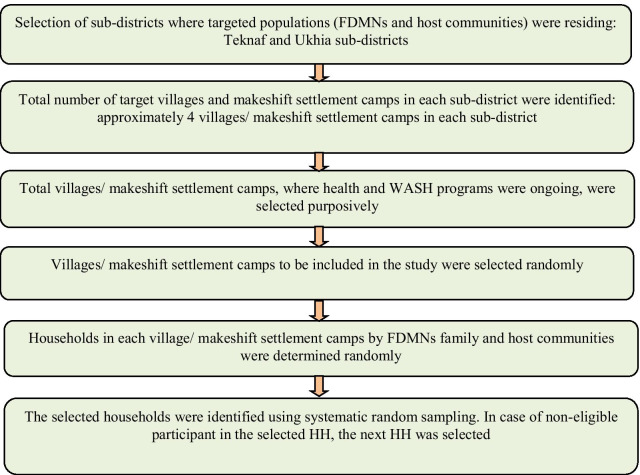
Methods: A mixed-method (quantitative and qualitative) approach was used. Altogether 999 household surveys were conducted among the FDMNs living in makeshift/temporary settlements and host communities. We used a grounded theory approach involving in-depth interviews (IDIs), focus group discussions (FGDs), and key informant interviews (KIIs) including 24 IDIs, 10 FGDs, and 9 KIIs. The quantitative data were analysed with STATA.
Results: The common health problems among the women were pregnancy and childbirth-related complications and violence against women. Among the children, fever, diarrhoea, common cold and malaria were frequently observed health problems. Poor general health, HIV/AIDS, insecurity, discrimination, and lack of employment opportunity were common problems for men. Further, 61.2% women received two or more antenatal care (ANC) visits during their last pregnancy, while 28.9% did not receive any ANC visit. The majority of the last births took place at home (85.2%) assisted by traditional birth attendants (78.9%), a third (29.3%) of whom suffered pregnancy- and childbirth-related complications. The clinics run by the non-governmental organizations (NGOs) (76.9%) and private health facilities (86.0%) were the most accessible places for seeking healthcare for the FDMNs living in the makeshift settlements. All participants heard about HIV/AIDS. 78.0% of them were unaware about the means of HIV transmission, and family planning methods were poorly used (45.2%).
Conclusions: Overall, the health of FDMNs living in the southern part of Bangladesh is poor and they have inadequate access to and utilization of health services to address the health problems and associated factors. Existing essential health and nutrition support programs need to be culturally appropriate and adopt an integrated approach to encourage men's participation to improve utilization of health and family planning services, address issues of gender inequity, gender-based violence, and improve women empowerment and overall health outcomes.
Keywords: Bangladesh; Family planning; HIV/AIDS; Health services; Rohingya refugees.
© 2021. The Author(s).
Conflict of interest statement
The authors declare that they have no competing interests.
Figures
References
-
- United Nations High Commission for Refugees (UNHCR). UNHCR global report 2019. 2019. https://www.unhcr.org/globalreport2019/. Accessed 25 Nov 2020.
-
- United Nations High Commission for Refugees (UNHCR). Global trends forced displacement in 2019. 2019. https://www.unhcr.org/5ee200e37.pdf. Accessed 25 Nov 2020.
-
- United Nations High Commission for Refugees (UNHCR). Ending statelessness. 2017. http://www.unhcr.org/en-au/stateless-people.html. Accessed 15 Jan 2018.
-
- Braithwaite A, Salehyan I, Savun B. Refugees, forced migration, and conflict: introduction to the special issue. J Peace Res. 2019;56(1):5–11. doi: 10.1177/0022343318814128. - DOI
-
- United Nations High Commission for Refugees (UNHCR). States of denial: a review of UNHCR’s response to the protracted situation of stateless Rohingya refugees in Bangladesh. 2011, Policy Development and Evaluation Service: Geneva, Switzerland.
Publication types
MeSH terms
LinkOut - more resources
Full Text Sources
