. 2021 Oct 11;12(1):5932.
doi: 10.1038/s41467-021-26272-1.

Three chromosome-level duck genome assemblies provide insights into genomic variation during domestication

Affiliations

Three chromosome-level duck genome assemblies provide insights into genomic variation during domestication

Feng Zhu et al. Nat Commun. .

Abstract

Domestic ducks are raised for meat, eggs and feather down, and almost all varieties are descended from the Mallard (Anas platyrhynchos). Here, we report chromosome-level high-quality genome assemblies for meat and laying duck breeds, and the Mallard. Our new genomic databases contain annotations for thousands of new protein-coding genes and recover a major percentage of the presumed "missing genes" in birds. We obtain the entire genomic sequences for the C-type lectin (CTL) family members that regulate eggshell biomineralization. Our population and comparative genomics analyses provide more than 36 million sequence variants between duck populations. Furthermore, a mutant cell line allows confirmation of the predicted anti-adipogenic function of NR2F2 in the duck, and uncovered mutations specific to Pekin duck that potentially affect adipose deposition. Our study provides insights into avian evolution and the genetics of oviparity, and will be a rich resource for the future genetic improvement of commercial traits in the duck.


Conflict of interest statement

The authors declare no competing interests.

Figures
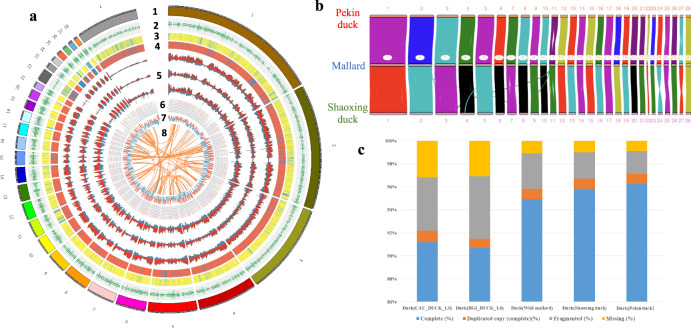
Fig. 1
Fig. 1. Overview of the assembly quality and characteristics of the duck genome.
a Chromosomal features of three duck genomes with the integration of genetics (from Chr1 to Chr25). 1: Chromosomal length of Mallard genome (Mb); 2: Gene density (100 kb window); 3: Genome collinearity of Shaoxing duck to Mallard, yellow represents the same orientation, blue represents contrary; 4: Genome collinearity of Pekin duck to Mallard, red represents the same orientation, blue represents contrary; 5: the density of SNP and Indels for Mallard, Shaoxing duck and Pekin duck in the reference Mallard genome (100 kb window). Red represents SNP, and blue represents InDels; 6: The distribution of ATAC-seq windows (100 kb window) in fat tissue; 7: The A/B compartments in Mallard genome. 8:The inner lines show syntenic blocks within the Mallard genome. b The genome collinearity of the genes among the three assemblies. c The 2,586 highly conserved genes in BUSCO dataset were used to search Mallard, Shaoxing duck and Pekin duck genomes. This analysis was carried out with the BUSCO program (version 2) with default settings. BGI_duck_1.0 and CAU_duck_1.0 are genome assemblies of Pekin duck downloaded from Genebank accessions GCA_002743455.1 and GCA_000355885.1, respectively.
Fig. 2
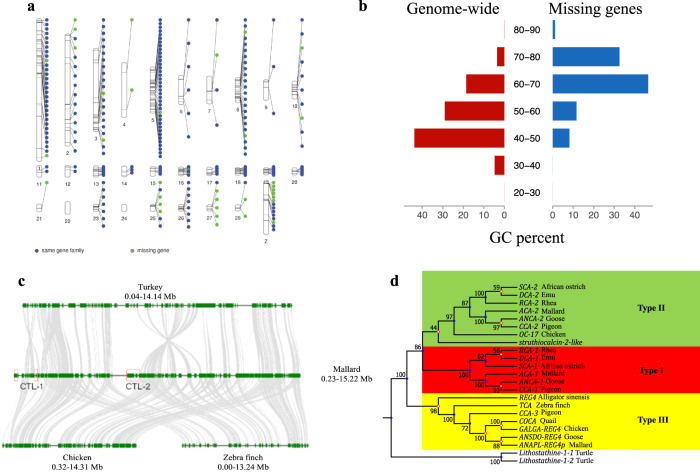
Fig. 2. Characteristics of the CTL gene family and missing genes newly annotated in the Mallard genome.
a The distribution of the presumed “missing genes” in the Mallard genome; b GC content of “missing genes” in Mallard. The figure shows that GC content distribution of missing genes in mallard was significantly higher than the genome background. c Multiple alignments of gene annotations in CTL gene family regions of Mallard, chicken, zebra finch, and turkey. In other bird chromosomes, the location and detailed annotations of CTL genes are lacking. d Phylogenetic tree of CTL members and its homologs in other birds. There are three types of CTL genes in birds, type I (green), type II (red), and type III (yellow). Ducks contain only type I and type II.
Fig. 3
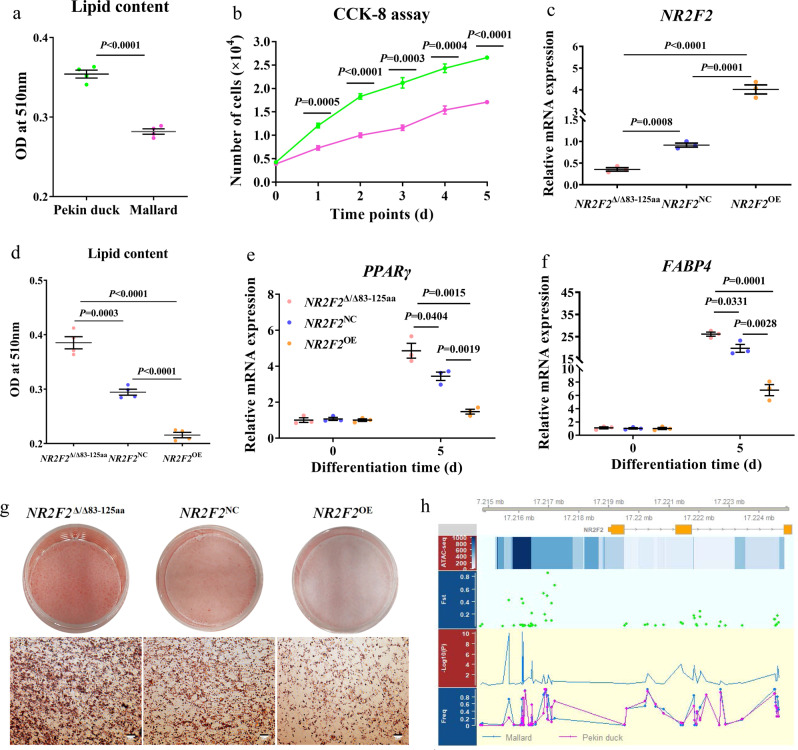
Fig. 3. Comparison of differentiation and proliferation capacity in subcutaneous preadipocytes between Pekin duck and Mallard.
a Intracellular lipid content in subcutaneous preadipocytes of Pekin duck and Mallard at day 5 post induction. The oil red O extraction assay was used to measure lipid accumulation. Green: Pekin duck and pink: mallard (n = 4 biological replicates). b Cell counting kit-8 assay (CCK8) examines the proliferation of subcutaneous preadipocytes in Pekin duck and Mallard over 5 days. Each cell number is counted by the standard curve established by CCK8 of the respective cells (n = 4 biological replicates). c mRNA levels of NR2F2 were analyzed by Q-PCR in NR2F2NC, NR2F2OE, and NR2F2Δ/Δ83-125aa cells. NC negative control, OE overexpression, Δ deleted (n = 3 biological replicates). d Intracellular lipid content in preadipocytes at day 5 post induction. The oil red O extraction assay was used to measure the lipid accumulation (n = 4 biological replicates). e, f mRNA levels of PPARγ and FABP4 were analyzed by Q-PCR at day 0 and 5 post induction (n = 3 biological replicates). g Oil Red O staining to assess lipid accumulation at day 5 post induction for NR2F2NC, NR2F2OE, and NR2F2Δ/Δ83-125aa cells. The scale bar represents 20 μm (n = 4 biological replicates). h The distribution of SNPs with a different frequency in NR2F2 for Pekin duck and Mallard populations. The track below the transcript annotation represents the windows of ATAC-seq. The color depth represents the peak score size. The following tracks are shown separately: Fixation index, −log10 (p-value of likelihood ratio test), and allele frequency. Data are presented as mean ± SEM. Statistical significance using two-tailed unpaired Students t-test for (af).

References

    1. Zhou Z, et al. An intercross population study reveals genes associated with body size and plumage color in ducks. Nat. Commun. 2018;9:2648. doi: 10.1038/s41467-018-04868-4. - DOI - PMC - PubMed
    1. Zhang ZB, et al. Whole-genome resequencing reveals signatures of selection and timing of duck domestication. Gigascience. 2018;7:1–11. - PMC - PubMed
    1. Huang Y, et al. The duck genome and transcriptome provide insight into an avian influenza virus reservoir species. Nat. Genet. 2013;45:776–783. doi: 10.1038/ng.2657. - DOI - PMC - PubMed
    1. Olsen B, et al. Global patterns of influenza a virus in wild birds. Science. 2006;312:384–388. doi: 10.1126/science.1122438. - DOI - PubMed
    1. Venkatesh D, et al. Avian influenza viruses in wild birds: virus evolution in a multihost ecosystem. J. Virol. 2018;92:599–615. doi: 10.1128/JVI.00433-18. - DOI - PMC - PubMed

Publication types

MeSH terms