


Lack of progression of beta dynamics after long-term subthalamic neurostimulation
- PMID: 34636182
- PMCID: PMC8607445
- DOI: 10.1002/acn3.51463
Lack of progression of beta dynamics after long-term subthalamic neurostimulation
Abstract
Objective: To investigate the progression of neural and motor features of Parkinson's disease in a longitudinal study, after washout of medication and bilateral subthalamic nucleus deep brain stimulation (STN DBS).
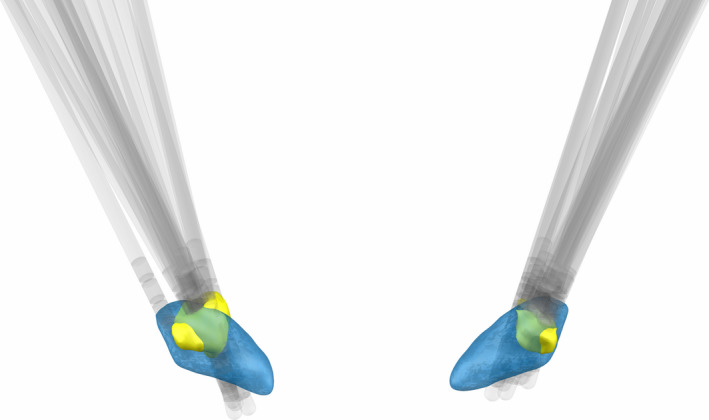
Methods: Participants with clinically established Parkinson's disease underwent bilateral implantation of DBS leads (18 participants, 13 male) within the STN using standard functional frameless stereotactic technique and multi-pass microelectrode recording. Both DBS leads were connected to an implanted investigative sensing neurostimulator (Activa™ PC + S, Medtronic, PLC). Resting state STN local field potentials (LFPs) were recorded and motor disability, (the Movement Disorder Society-Unified Parkinson's Disease Rating Scale - motor subscale, MDS-UPDRS III) was assessed off therapy at initial programming, and after 6 months, 1 year, and yearly out to 5 years of treatment. The primary endpoint was measured at 3 years. At each visit, medication had been held for over 12/24 h and DBS was turned off for at least 60 min, by which time LFP spectra reached a steady state.
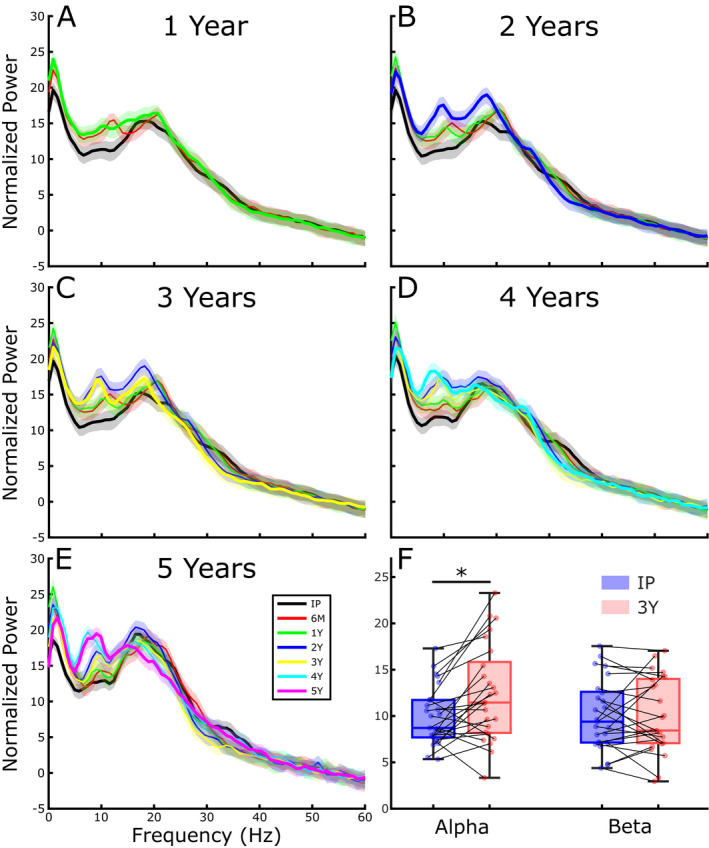
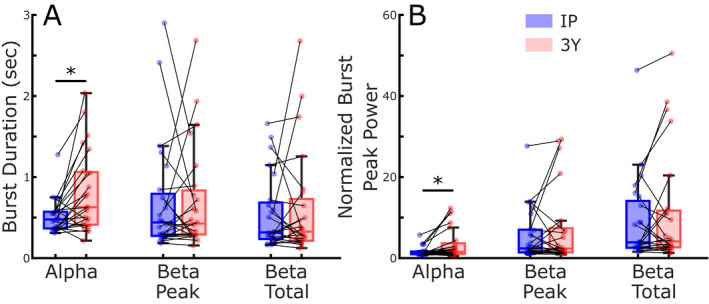
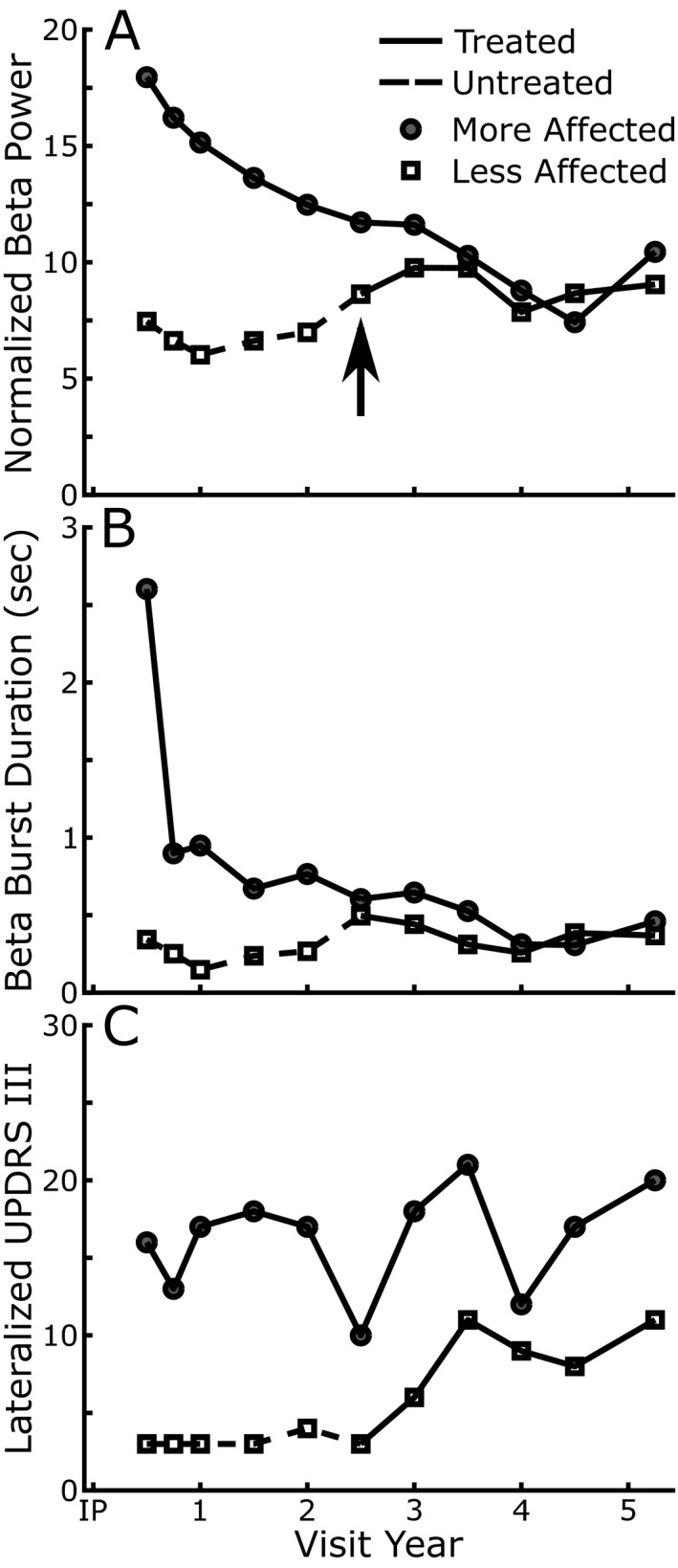
Results: After 3 years of chronic DBS, there were no increases in STN beta band dynamics (p = 0.98) but there were increases in alpha band dynamics (p = 0.0027, 25 STNs). Similar results were observed in a smaller cohort out to 5 years. There was no increase in the MDS-UPDRS III score.
Interpretation: These findings provide evidence that the beta oscillopathy does not substantially progress following combined STN DBS plus medication in moderate to advanced Parkinson's disease.
© 2021 The Authors. Annals of Clinical and Translational Neurology published by Wiley Periodicals LLC on behalf of American Neurological Association.
Conflict of interest statement
Dr. Bronte‐Stewart serves on a clinical advisory board for Medtronic PLC which supplied investigative sensing neurostimulators.
Figures
References
-
- Goetz CG, Stebbins GT, Blasucci LM. Differential progression of motor impairment in levodopa‐treated Parkinson’s disease. Mov Disord. 2000;15(3):479‐484. - PubMed
-
- Bergman H, Wichmann T, Karmon B, DeLong MR. The primate subthalamic nucleus. II. Neuronal activity in the MPTP model of Parkinsonism. J Neurophysiol. 1994;72(2):507‐520. - PubMed
-
- Brown P. Oscillatory nature of human basal ganglia activity: relationship to the pathophysiology of Parkinson’s disease. Mov Disord. 2003;18(4):357‐363. - PubMed
Publication types
MeSH terms
Grants and funding
- R21 NS096398-02/NINDS Grant 5
- PF-FBS-2024/Parkinson's Foundation
- R01 NS119520/NS/NINDS NIH HHS/United States
- R21 NS096398/NS/NINDS NIH HHS/United States
- Robert and Ruth Halperin Foundation
- John A. Blume Foundation
- 9605/Michael J. Fox Foundation for Parkinson's Research
- UH3 NS107709/NS/NINDS NIH HHS/United States
- Helen M. Cahill Award for Research in Parkinson's Disease
- 1UH3NS107709/NIH Brain Initiative
- AA023165-01A1/GF/NIH HHS/United States
- R01 AA023165/AA/NIAAA NIH HHS/United States
- The Sanches Family Foundation
- PF-FBS-1899/Parkinson's Foundation
LinkOut - more resources
Full Text Sources
Medical
Research Materials
Miscellaneous
