


Comment
doi: 10.1016/j.cub.2021.08.053.
Neurobiology: Novel peptide pathways impact threat discrimination
Affiliations
- PMID: 34637710
- PMCID: PMC10885684
- DOI: 10.1016/j.cub.2021.08.053
Item in Clipboard
Comment
Neurobiology: Novel peptide pathways impact threat discrimination
Curr Biol.
.
Abstract
Discriminating dangerous predictive stimuli from non-threatening stimuli is vital for maintaining optimal behavioral strategies. A new study finds that novel stress-related peptide pathways to the dopaminergic midbrain play a fundamental role in threat generalization.
Copyright © 2021 Elsevier Inc. All rights reserved.
Figures
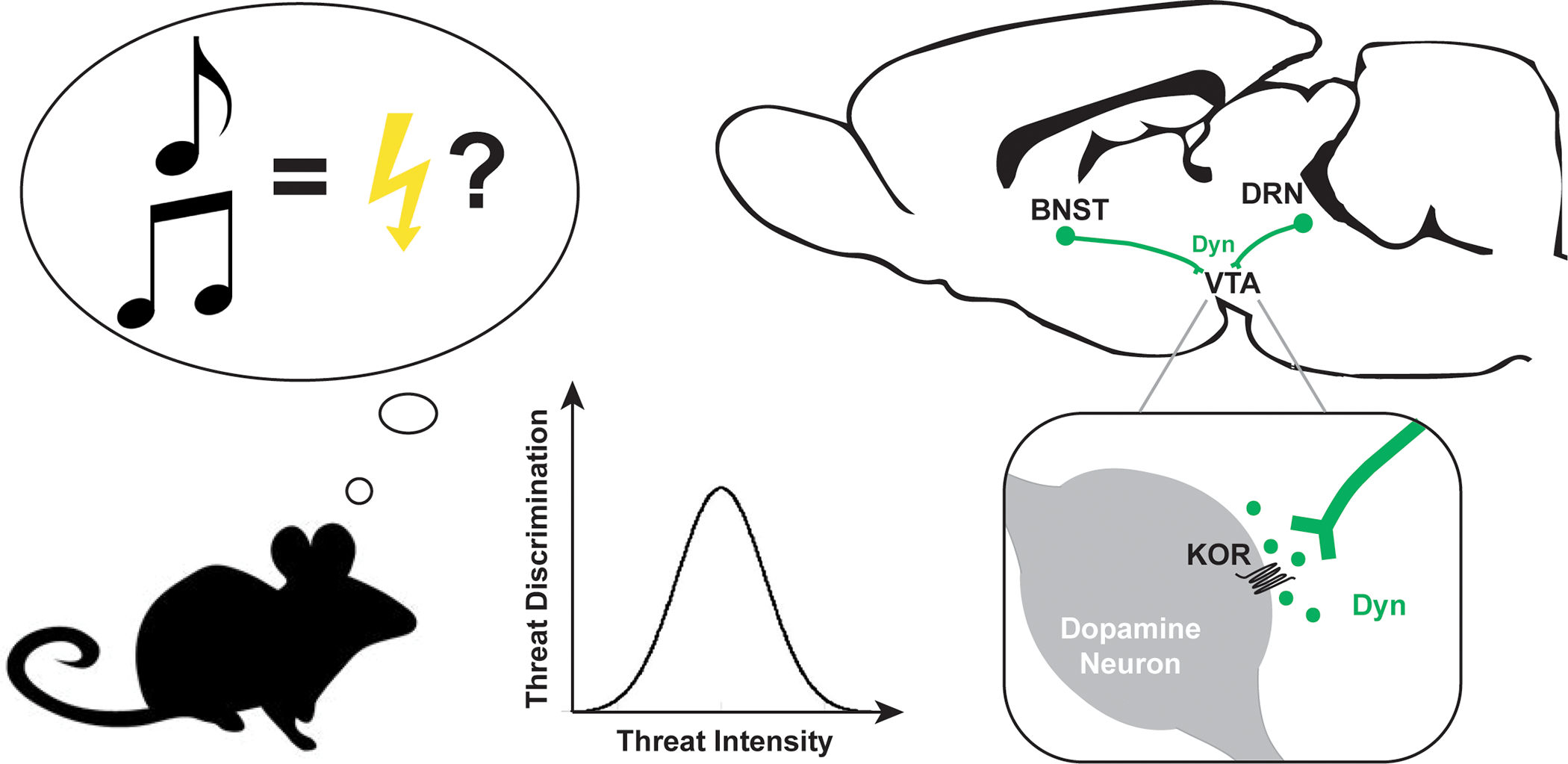
Associative memories guide the behavioral response to previously encountered stimuli. Behavioral discrimination between cues that were paired with shock and cues that were not shock-predictive follows an inverted U-shaped pattern, with optimal discrimination at moderate threat intensities and generalization at high intensities. Fellinger et al demonstrate that threat generalization requires dynorphin signaling at kappa opioid receptors in the ventral tegmental area (VTA). Tracing studies revealed previously unidentified dynorphin inputs to the VTA from the bed nucleus of the stria terminalis (BNST) and the dorsal raphe (DRN). Activating either of these dynorphin projections is sufficient to induce anxiety-like behavior; however, only activation of the DRN projection promotes threat generalization.
Comment on
-
A midbrain dynorphin circuit promotes threat generalization.Curr Biol. 2021 Oct 11;31(19):4388-4396.e5. doi: 10.1016/j.cub.2021.07.047. Epub 2021 Aug 12. Curr Biol. 2021. PMID: 34388372 Free PMC article.
References
-
- Laxmi TR, Stork O, and Pape HC (2003). Generalisation of conditioned fear and its behavioural expression in mice. Behav Brain Res 145, 89–98. - PubMed
-
- Baldi E, Lorenzini CA, and Bucherelli C (2004). Footshock intensity and generalization in contextual and auditory-cued fear conditioning in the rat. Neurobiol Learn Mem 81, 162–166. - PubMed
Publication types
MeSH terms
Substances
Grants and funding
LinkOut - more resources
Full Text Sources
