. 2021 Dec:96:105108.
doi: 10.1016/j.meegid.2021.105108. Epub 2021 Oct 9.

Identification and characterization of SARS-CoV-2 clusters in the EU/EEA in the first pandemic wave: additional elements to trace the route of the virus

Affiliations

Identification and characterization of SARS-CoV-2 clusters in the EU/EEA in the first pandemic wave: additional elements to trace the route of the virus

Giovanni Faggioni et al. Infect Genet Evol. 2021 Dec.

Abstract

A high-quality dataset of 3289 complete SARS-CoV-2 genomes collected in Europe and European Economic Area (EAA) in the early phase of the first wave of the pandemic was analyzed. Among all single nucleotide mutations, 41 had a frequency ≥ 1%, and the phylogenetic analysis showed at least 6 clusters with a specific mutational profile. These clusters were differentially distributed in the EU/EEA, showing a statistically significant association with the geographic origin. The analysis highlighted that the mutations C14408T and C14805T played an important role in clusters selection and further virus spread. Moreover, the molecular analysis suggests that the SARS-CoV-2 strain responsible for the first Italian confirmed COVID-19 case was already circulating outside the country.

Keywords: COVID-19; Cluster analysis; SARS-CoV-2; SNVs analysis.


Conflict of interest statement

None.

Figures
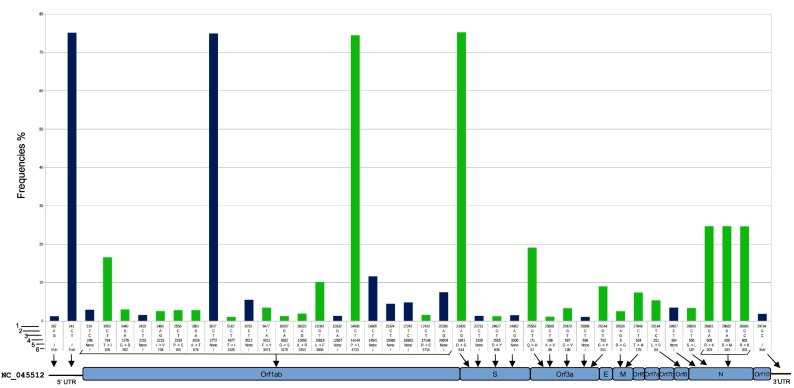
Fig. 1
Fig. 1
Single nucleotide variants analysis (SNVs). A total of 41 SNVs detected on the high-quality dataset with a frequency > 1% are shown. The frequency of each mutation is represented by the bar height. At the bottom, the genomic organization of SARS-CoV-2 and the relative mutation localization. Blue bars = silent mutations; green bars = missense mutations; 1) = nucleotide position; 2) = ancestral nucleotide; 3) = variant nucleotide; 4) = CDS position; 5) = AA change; 6) codon number. (For interpretation of the references to colour in this figure legend, the reader is referred to the web version of this article.)
Fig. 2
Fig. 2
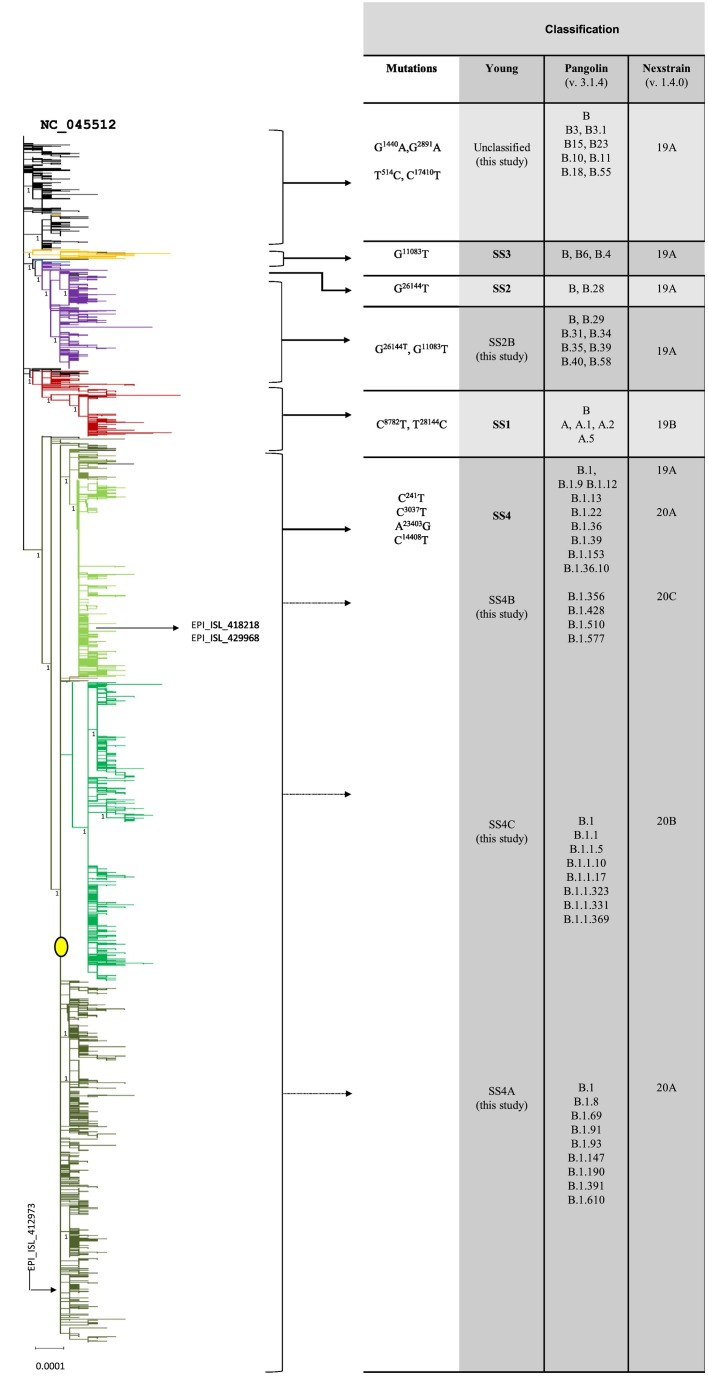
Phylogenetic tree of the entire dataset in collapsed form (rooted). The picture shows the phylogram of the entire dataset resulting from the ML analysis in collapsed form (full resolution image in Supplementary Fig. S1). The six main clusters are shown in different colors: black = unclassified; yellow = SS3; blue = SS2; violet = SS2B; red = SS1; green = SS4 (olive green SS4B, emerald green SS4C, dark green SS4A). The branch representing the central node at the root of the SS4 cluster is labeled by a filled yellow circle (see discussion and Fig. 4). The numbers next to the main nodes represent the output of the aRLT-SH-like analysis. On the right, the main mutations hosted by each cluster and the corresponding classifications according to Yang et al. (2020), Pangolin and Nexstrain nomenclatures are shown. (For interpretation of the references to colour in this figure legend, the reader is referred to the web version of this article.)
Fig. 3
Fig. 3
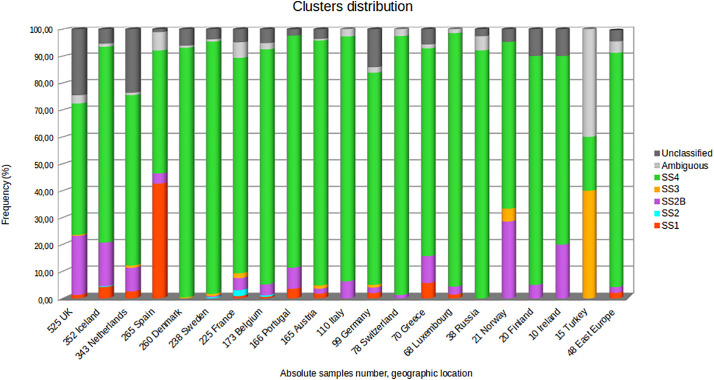
Clusters distribution in EU/EEA area. The distributions and the relative frequencies of the six main clusters in the EU/EAA along with the ambiguous sequences are shown in different colors. The absolute genomes number for each country is reported.
Fig. 4
Fig. 4
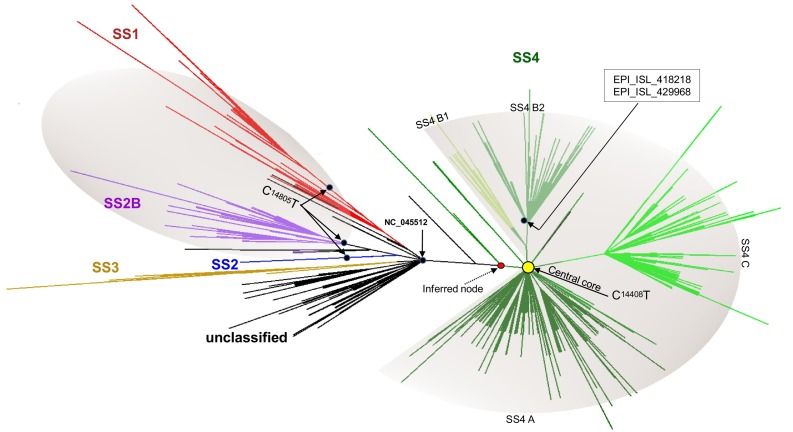
Phylogenetic tree of the entire dataset in radial/collapsed form (unrooted). The picture shows the unrooted tree resulting from the ML analysis built from the entire dataset visualized in radial form. The main clusters (SS) are shown in different colors. The relative entry point of the C14805T and C14408T mutations in the tree, their area of influence (shaded area), the inferred node from which evolved the SS4 cluster and the central node at the root of the SS4 cluster (filled yellow circle) are shown. (For interpretation of the references to colour in this figure legend, the reader is referred to the web version of this article.)

References

    1. Addetia A., Xie H., Roychoudhury P., Shrestha L., Loprieno M., Huang M.L., Jerome K.R., Greninger A.L. Identification of multiple large deletions in ORF7a resulting in in-frame gene fusions in clinical SARS-CoV-2 isolates. J. Clin. Virol. 2020 Aug;129:104523. doi: 10.1016/j.jcv.2020.104523. - DOI - PMC - PubMed
    1. Albarello F., Pianura E., Di Stefano F., Cristofaro M., Petrone A., Marchioni L., Palazzolo C., Schininà V., Nicastri E., Petrosillo N., Campioni P., Eskild P., Zumla A. Ippolito G; COVID 19 INMI study group. 2019-novel coronavirus severe adult respiratory distress syndrome in two cases in Italy: an uncommon radiological presentation. Int. J. Infect. Dis. 2020 Apr;93:192–197. doi: 10.1016/j.ijid.2020.02.043. - DOI - PMC - PubMed
    1. Becerra-Flores M., Cardozo T. SARS-CoV-2 viral spike G614 mutation exhibits higher case fatality rate. Int. J. Clin. Pract. 2020 Aug;74(8) doi: 10.1111/ijcp.13525. - DOI - PMC - PubMed
    1. Benedetti F., Snyder G.A., Giovanetti M., Angeletti S., Gallo R.C., Ciccozzi M., Zella D. Emerging of a SARS-CoV-2 viral strain with a deletion in nsp1. J. Transl. Med. 2020 Aug 31;18(1):329. doi: 10.1186/s12967-020-02507-5. - DOI - PMC - PubMed
    1. Benvenuto D., Giovanetti M., Salemi M., Prosperi M., De Flora C., Junior Alcantara L.C., Angeletti S., Ciccozzi M. The global spread of 2019-nCoV: a molecular evolutionary analysis. Pathog. Glob. Health. 2020 Mar;114(2):64–67. doi: 10.1080/20477724.2020.1725339. - DOI - PMC - PubMed

Publication types

Supplementary concepts