Review
. 2021 Sep 23;13(19):4746.
doi: 10.3390/cancers13194746.

Defining the Role of GLI/Hedgehog Signaling in Chemoresistance: Implications in Therapeutic Approaches

Affiliations
Review

Defining the Role of GLI/Hedgehog Signaling in Chemoresistance: Implications in Therapeutic Approaches

Jian Yi Chai et al. Cancers (Basel). .

Abstract

Insight into cancer signaling pathways is vital in the development of new cancer treatments to improve treatment efficacy. A relatively new but essential developmental signaling pathway, namely Hedgehog (Hh), has recently emerged as a major mediator of cancer progression and chemoresistance. The evolutionary conserved Hh signaling pathway requires an in-depth understanding of the paradigm of Hh signaling transduction, which is fundamental to provide the necessary means for the design of novel tools for treating cancer related to aberrant Hh signaling. This review will focus substantially on the canonical Hh signaling and the treatment strategies employed in different studies, with special emphasis on the molecular mechanisms and combination treatment in regard to Hh inhibitors and chemotherapeutics. We discuss our views based on Hh signaling's role in regulating DNA repair machinery, autophagy, tumor microenvironment, drug inactivation, transporters, epithelial-to-mesenchymal transition, and cancer stem cells to promote chemoresistance. The understanding of this Achilles' Heel in cancer may improve the therapeutic outcome for cancer therapy.

Keywords: cancer; chemoresistance; hedgehog inhibitors; hedgehog pathway; molecular mechanism.


Conflict of interest statement

The authors declare no conflict of interest.

Figures
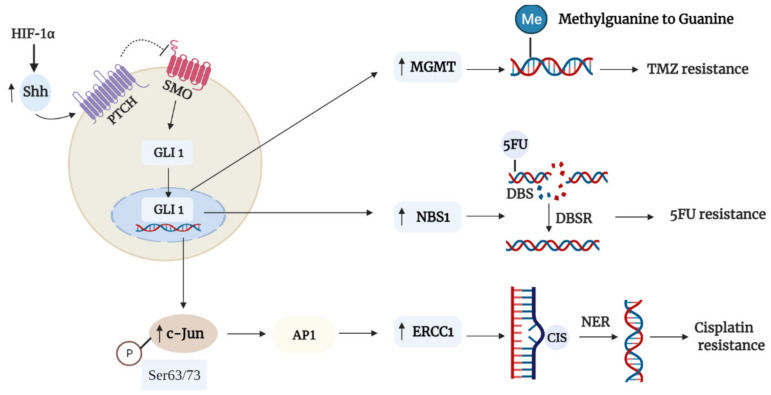
Figure 1
Figure 1
A schematic representation of the Hedgehog (Hh) signaling in the regulation of different DNA repair mechanisms to promote chemoresistance. Under the hypoxic condition, HIF-1α stimulation triggers the autocrine secretion of Shh, which activates canonical Hedgehog-glioma-associated oncogene homolog 1 (Hh-GLI1) signaling in tumor cells to induce high levels of MGMT. Consequently, MGMT repairs O-6-methylguanine lesions induced by TMZ, which results in TMZ resistance. Activation of Hh-GLI1 signaling also upregulates NBS1 of the MRN complex as well as promotes c-Jun phosphorylation (Ser63/73) and AP1-mediated upregulation of ERCC1 to repair DNA breaks induced by 5-FU and cisplatin, respectively.
Figure 2
Figure 2
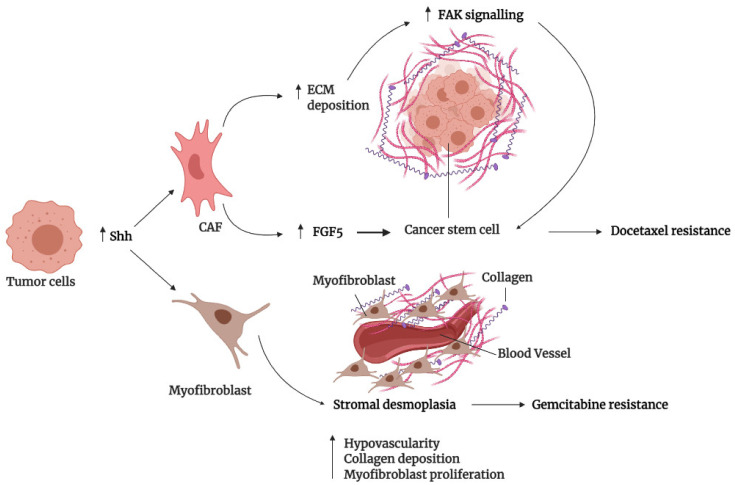
A simplified illustration of the Hh signaling in the reprogramming of TME to confer chemotherapeutic drug resistance. Paracrine Hh signaling between tumor and stromal cells (CAF and myofibroblast) via tumor-derived shh induces stromal cells to reshape TME via increased ECM deposition (e.g., collagen), which leads to increased CSC niche and stromal desmoplasia (also characterized by increased myofibroblast and decreased blood vessel). Additionally, Hh-activated CAF also secretes FGF5, which binds to FGFR on adjacent tumor cells to induce CSC phenotype. Consequently, the increase in CSC niche and decreased blood vessel formation resulting from stromal desmoplasia enhance innate resistance to cancer therapeutics and decrease drug delivery, resulting in decreased chemotherapeutic drug response.
Figure 3
Figure 3
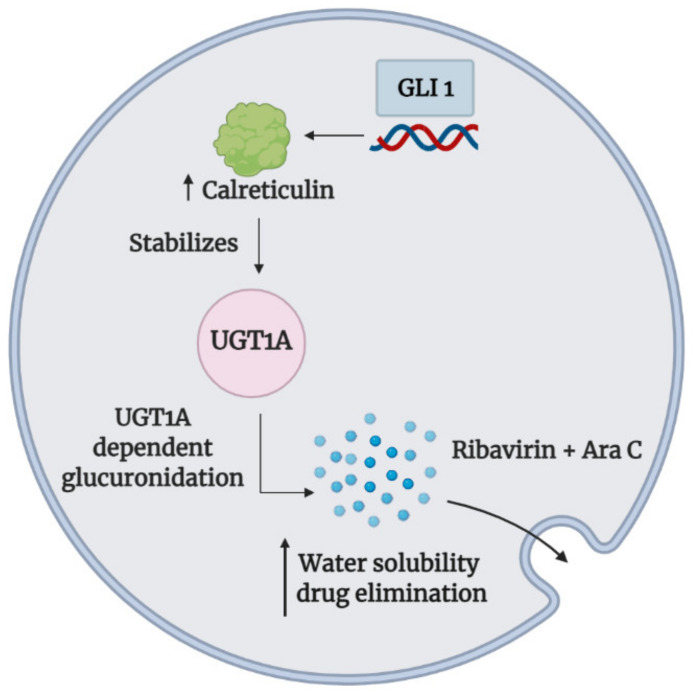
A simplified illustration of GLI1 in the regulation of UGT1A-dependent glucuronidation of ribavirin and cytarabine (Ara-C, cytosine arabinoside). GLI1 upregulates the chaperone calreticulin, which stabilizes UGT1A protein levels to promote UGT1A-dependent glucuronidation of ribavirin and Ara-C. This results in the formation of glucuronides that are more water-soluble and, therefore, more readily excreted.
Figure 4
Figure 4
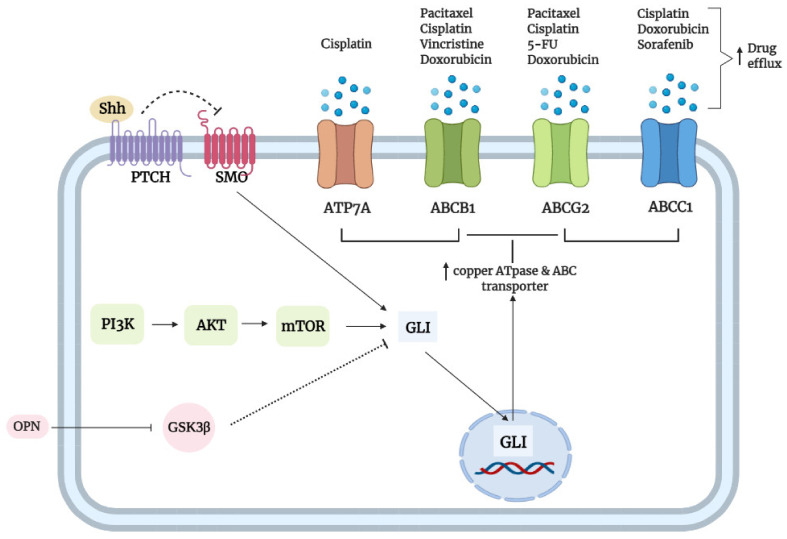
A simplified representation of canonical and noncanonical regulation of GLI in promoting transporter-mediated drug efflux. In the canonical axis, Shh binds to PTCH1, resulting in the alleviation of SMO repression and subsequent GLI activation. In the noncanonical axis, OPN inhibits the negative regulator of GLI, GSK3β, alleviating the repression of GLI1 function. Activated GLI then translocates into the nucleus, inducing the transcriptional upregulation of copper ATPase and ABC transporters to enhance drug efflux and, consequently, reduce intracellular drug levels.
Figure 5
Figure 5
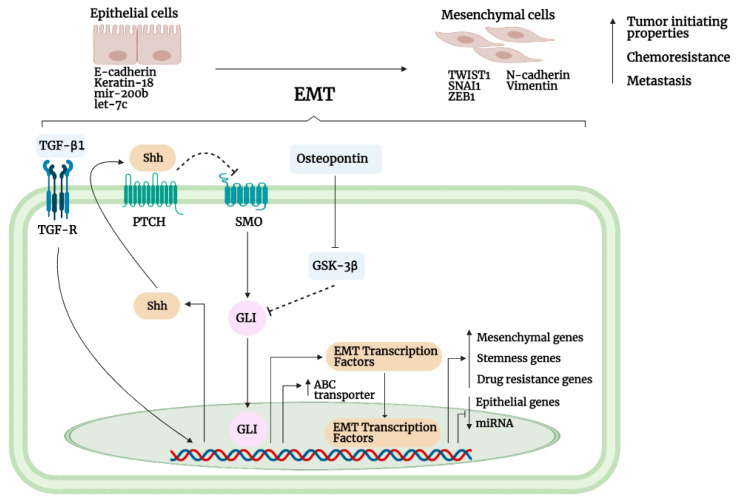
A schematic representation of canonical and noncanonical GLI regulation in promoting EMT and chemoresistance. TGF-β1 stimulation induced the transcriptional upregulation of Shh, which activates canonical Hh-GLI signaling in an autocrine manner. On the other hand, OPN inactivates GSK3β, promoting the activation of GLI independent of canonical input. Activated GLI translocates into the nucleus, where it upregulates the expression of EMT transcription factors (e.g., TWIST1, SNAI1, ZEB1). In turn, upregulated EMT transcription factors induce the expression of mesenchymal (e.g., N-cadherin, Vimentin), stemness (e.g., SOX2, OCT4, ALDH), and drug resistance genes (e.g., ALDH, ABC transporters) while concomitantly downregulating epithelial (E-cadherin) genes and miRNAs (mir-200b and let-7 family). Consequently, this results in the formation of mesenchymal cells with tumor-initiating-like properties and the increased capability to metastasize and resist cytotoxic chemotherapeutics. Additionally, increased GLI1 activity also upregulates ABC transporters, further enhancing chemoresistance by increasing drug efflux in mesenchymal cells.

References

    1. Bray F., Ferlay J., Soerjomataram I., Siegel R.L., Torre L.A., Jemal A. Global Cancer Statistics 2018: GLOBOCAN estimates of incidence and mortality worldwide for 36 cancers in 185 countries. CA Cancer J. Clin. 2018;68:394–424. doi: 10.3322/caac.21492. - DOI - PubMed
    1. André T., Boni C., Mounedji-Boudiaf L., Navarro M., Tabernero J., Hickish T., Topham C., Zaninelli M., Clingan P., Bridgewater J., et al. Oxaliplatin, fluorouracil, and leucovorin as adjuvant treatment for colon cancer. N. Engl. J. Med. 2004;350:2343–2351. doi: 10.1056/NEJMoa032709. - DOI - PubMed
    1. Thompson A.M., Moulder-Thompson S.L. Neoadjuvant treatment of breast cancer. Ann. Oncol. 2012;23:231. doi: 10.1093/annonc/mds324. - DOI - PMC - PubMed
    1. D’Alterio C., Scala S., Sozzi G., Roz L., Bertolini G. Paradoxical effects of chemotherapy on tumor relapse and metastasis promotion. Semin. Cancer Biol. 2020;60:351–361. doi: 10.1016/j.semcancer.2019.08.019. - DOI - PubMed
    1. Madden E.C., Gorman A.M., Logue S.E., Samali A. Tumour cell secretome in chemoresistance and tumour recurrence. Trends Cancer. 2020;6:489–505. doi: 10.1016/j.trecan.2020.02.020. - DOI - PubMed

LinkOut - more resources