. 2021 Sep 28;13(19):4871.
doi: 10.3390/cancers13194871.

Rapid Escalation of High-Volume Exercise during Caloric Restriction; Change in Visceral Adipose Tissue and Adipocytokines in Obese Sedentary Breast Cancer Survivors

Affiliations

Rapid Escalation of High-Volume Exercise during Caloric Restriction; Change in Visceral Adipose Tissue and Adipocytokines in Obese Sedentary Breast Cancer Survivors

Carol J Fabian et al. Cancers (Basel). .

Abstract

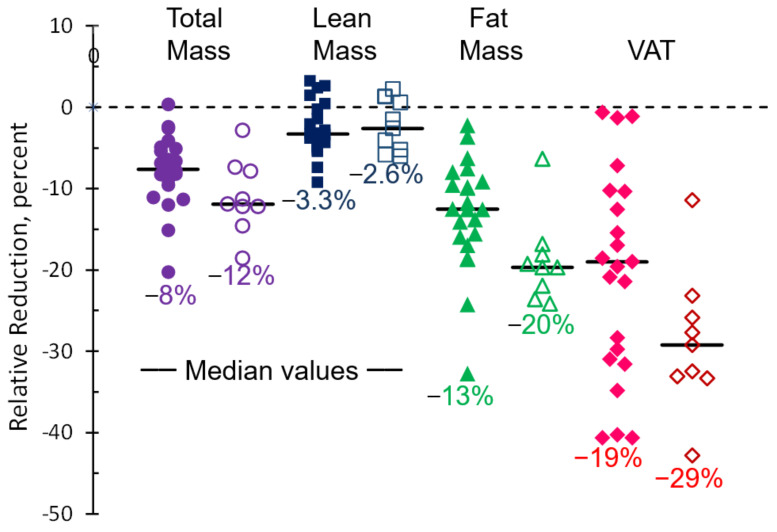
Aerobic exercise reduces risk for breast cancer and recurrence and promotes visceral adipose tissue (VAT) loss in obesity. However, few breast cancer survivors achieve recommended levels of moderate to vigorous physical activity (MVPA) without supervision. In a two-cohort study, feasibility of 12 weeks of partially supervised exercise was started concomitantly with caloric restriction and effects on body composition and systemic risk biomarkers were explored. In total, 22 obese postmenopausal sedentary women (including 18 breast cancer survivors) with median age of 60 and BMI of 37 kg/m2 were enrolled. Using personal trainers twice weekly at area YMCAs, MVPA was escalated to ≥200 min/week over 9 weeks. For cohort 2, maintenance of effect was assessed when study provided trainer services were stopped but monitoring, group counseling sessions, and access to the exercise facility were continued. Median post-escalation MVPA was 219 min/week with median 12-week mass and VAT loss of 8 and 19%. MVPA was associated with VAT loss which was associated with improved adiponectin:leptin ratio. In total, 9/11 of cohort-2 women continued the behavioral intervention for another 12 weeks without trainers. High MVPA continued with median 24-week mass and VAT loss of 12 and 29%. This intervention should be further studied in obese sedentary women.

Keywords: DXA; biomarkers; breast cancer prevention; exercise; visceral adipose tissue.


Conflict of interest statement

The authors declare no conflict of interest.

Figures
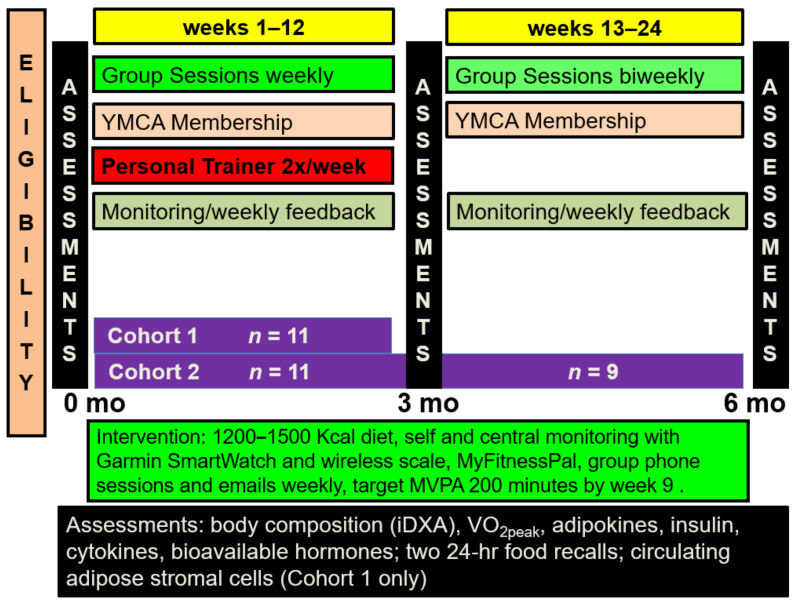
Figure 1
Figure 1
Diet and exercise interventional design for the two cohorts.
Figure 2
Figure 2
Change in body composition after 12 weeks (closed symbols) for 22 participants in cohorts 1 and 2; and 24 weeks (open symbols) for 9 participants in cohort 2.
Figure 3
Figure 3
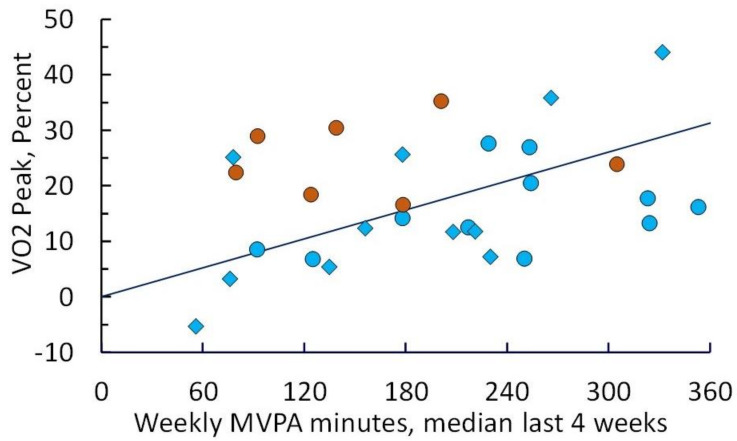
Improvement in cardiopulmonary fitness after 12 and 24 weeks of intervention as measured by peak oxygen consumption (VO2peak) relative to baseline, plotted as a function of weekly MVPA achieved (median of recorded values weeks 9–12 or weeks 21–24). Diamonds denote participants in cohort 1; circles denote participants in cohort 2 (blue = 12-week values; orange = 24-week values). Linear regression yields a slope of 0.057% change in VO2peak per min of MVPA (p = 0.021).
Figure 4
Figure 4
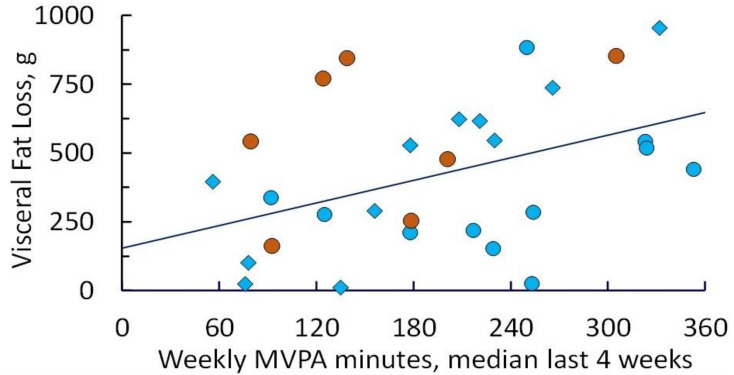
Visceral fat lost (percent relative to baseline) as assessed by iDXA after 12 and 24 weeks of intervention, plotted as a function of weekly MVPA achieved (median of recorded values for weeks 9–12 or weeks 21–24). Diamonds denote participants in cohort 1; circles denote participants in cohort 2 (blue = 12-week values; orange = 24-week values). Linear regression yields a slope of 0.063% visceral fat loss per min of MVPA (p = 0.011).
Figure 5
Figure 5
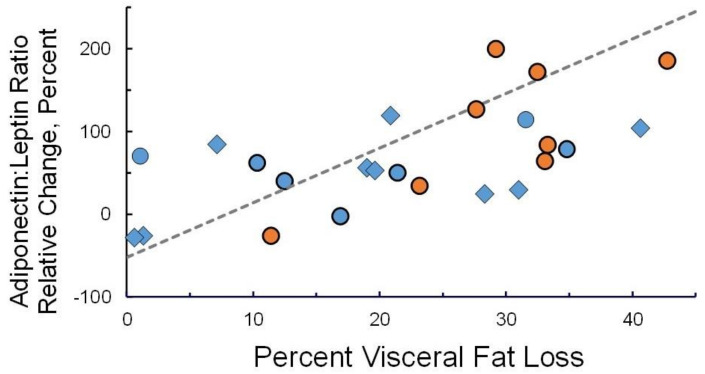
Change in serum adiponectin:leptin ratio at 12 and 24 weeks as a function of visceral fat lost, both relative to baseline values. Diamonds denote participants in cohort 1; circles denote participants in cohort 2 (blue = 12-week values; orange = 24-week values). Linear regression yields a slope of 6.6% change in adiponectin:leptin ratio per percent visceral fat loss (p < 0.001).

References

    1. Pizot C., Boniol M., Mullie P., Koechlin A., Boniol M., Boyle P., Autier P. Physical activity, hormone replacement therapy and breast cancer risk: A meta-analysis of prospective studies. Eur. J. Cancer. 2016;52:138–154. doi: 10.1016/j.ejca.2015.10.063. - DOI - PubMed
    1. Hardefeldt P.J., Penninkilampi R., Edirimanne S., Eslick G.D. Physical activity and weight loss reduce the risk of breast cancer: A meta-analysis of 139 prospective and retrospective studies. Clin. Breast Cancer. 2018;18:e601–e612. doi: 10.1016/j.clbc.2017.10.010. - DOI - PubMed
    1. Eliassen A.H., Hankinson S.E., Rosner B., Holmes M.D., Willett W.C. Physical activity and risk of breast cancer among postmenopausal women. Arch Intern. Med. 2010;170:1758–1764. doi: 10.1001/archinternmed.2010.363. - DOI - PMC - PubMed
    1. Fournier A., Dos Santos G., Guillas G., Bertsch J., Duclos M., Boutron-Ruault M.C., Clavel-Chapelon F., Mesrine S. Recent recreational physical activity and breast cancer risk in postmenopausal women in the E3N cohort. Cancer Epidemiol. Biomark. Prev. 2014;23:1893–1902. doi: 10.1158/1055-9965.EPI-14-0150. - DOI - PubMed
    1. Niehoff N.M., Nichols H.B., Zhao S., White A.J., Sandler D.P. Adult physical activity and breast cancer risk in women with a family history of breast cancer. Cancer Epidemiol. Biomark. Prev. 2019;28:51–58. doi: 10.1158/1055-9965.EPI-18-0674. - DOI - PMC - PubMed

LinkOut - more resources