Review
. 2021 Sep 26;22(19):10373.
doi: 10.3390/ijms221910373.

Prognostic and Predictive Biomarkers in Gliomas

Affiliations
Review

Prognostic and Predictive Biomarkers in Gliomas

Paulina Śledzińska et al. Int J Mol Sci. .

Abstract

Gliomas are the most common central nervous system tumors. New technologies, including genetic research and advanced statistical methods, revolutionize the therapeutic approach to the patient and reveal new points of treatment options. Moreover, the 2021 World Health Organization Classification of Tumors of the Central Nervous System has fundamentally changed the classification of gliomas and incorporated many molecular biomarkers. Given the rapid progress in neuro-oncology, here we compile the latest research on prognostic and predictive biomarkers in gliomas. In adult patients, IDH mutations are positive prognostic markers and have the greatest prognostic significance. However, CDKN2A deletion, in IDH-mutant astrocytomas, is a marker of the highest malignancy grade. Moreover, the presence of TERT promoter mutations, EGFR alterations, or a combination of chromosome 7 gain and 10 loss upgrade IDH-wildtype astrocytoma to glioblastoma. In pediatric patients, H3F3A alterations are the most important markers which predict the worse outcome. MGMT promoter methylation has the greatest clinical significance in predicting responses to temozolomide (TMZ). Conversely, mismatch repair defects cause hypermutation phenotype predicting poor response to TMZ. Finally, we discussed liquid biopsies, which are promising diagnostic, prognostic, and predictive techniques, but further work is needed to implement these novel technologies in clinical practice.

Keywords: WHO CNS5; biomarker; brain neoplasms; gliomas; liquid biopsy; predictive value; prognosis.


Conflict of interest statement

The authors declare no conflict of interest.

Figures
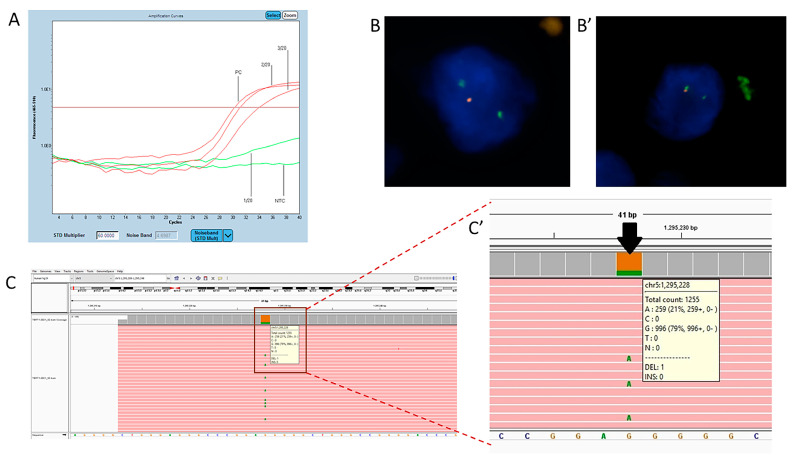
Figure 1
Figure 1
Application of fluorescence in situ hybridization (FISH), next-generation sequencing (NGS), and quantitative polymerase chain reaction (qPCR) in the genetic diagnosis of glioma. (A) Representative screenshot of an isocitrate dehydrogenase 1 (IDH1) mutation. Red amplification curves represent positive signals for the mutation in exon 4, codon 132 of the IDH1 gene detected in positive control (PC) and two patients’ samples (2/20 and 3/20). The test does not distinguish between IDH1 changes: R132H (c.395G>A), R132C (c.394C>T), R132S (c.394C>A), R132G (c.394C>G), R132L (c.395G>T), R132P (c.395G>C). Sample 1/20 negative for the presence of mutations in IDH1 codons 132 and 100 and the IDH2 gene at codons 140 and 172 (IDH-RT38, Entrogen). (B) Applications of FISH in genetic diagnostics in glioma on biological material collected by stereotactic biopsy. Deletion of 1p32 (cell on the left). (B’) Deletion of 19q13 (cell on the right) (Abbott, Molecular). (C) Representative screenshot of a telomerase reverse transcriptase (TERT) variant using Integrative Genomics Viewer (IGV). Aligned NGS data produced with Entrogen’s Targeted Hotspot Panel 16 kit. (C’) Close-up of TERT promoter variant NC_00005.9: g.1295228G>A; (commonly called C228T mutation) Reported as pathogenic.
Figure 2
Figure 2
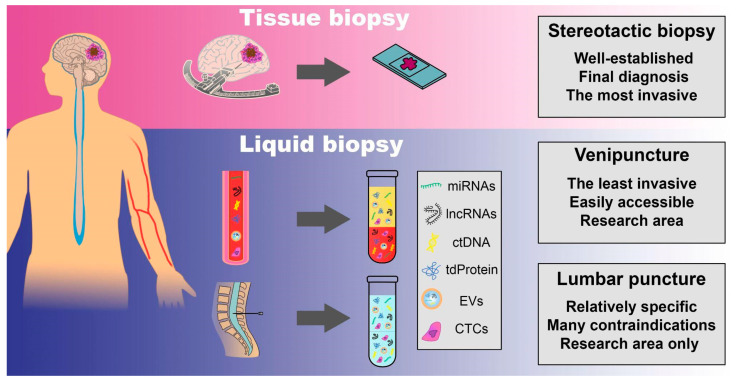
Obtaining the material to analyze biomarkers in glioma patients. The material can be obtained using tissue biopsy or liquid biopsies. A stereotactic biopsy is a well-established surgical procedure used to acquire tissue samples. Venipuncture and lumbar puncture are methods to obtain liquid biopsies. Circulating tumor cells (CTCs), extracellular vesicles (EVs), tumor-derived proteins (dtProteins), circulating tumor DNA (ctDNA), long non-coding RNAs (lncRNAs) and microRNA (miRNAs) are released into the bloodstream and cerebrospinal fluid (CSF) from primary tumors and metastatic deposits. Material collected by venipuncture, the least invasive technique, can be extracted, and plasma or serum can then be analyzed. The evaluation of circulating biomarkers in CSF is a relatively specific method, however it has many contraindications and currently remains only in the research area.

References

    1. Louis D.N., Perry A., Wesseling P., Brat D.J., Cree I.A., Figarella-Branger D., Hawkins C., Ng H.K., Pfister S.M., Reifenberger G., et al. The 2021 WHO Classification of Tumors of the Central Nervous System: A summary. Neuro-Oncology. 2021;23:1231–1251. doi: 10.1093/neuonc/noab106. - DOI - PMC - PubMed
    1. Schwartzbaum J.A., Fisher J.L., Aldape K.D., Wrensch M. Epidemiology and molecular pathology of glioma. Nat. Clin. Pract. Neurol. 2006;2:494–503. doi: 10.1038/ncpneuro0289. - DOI - PubMed
    1. Ostrom Q.T., Bauchet L., Davis F.G., Deltour I., Fisher J.L., Langer C.E., Pekmezci M., Schwartzbaum J.A., Turner M.C., Walsh K.M., et al. The epidemiology of glioma in adults: A “state of the science” review. Neuro-Oncology. 2014;16:896–913. doi: 10.1093/neuonc/nou087. - DOI - PMC - PubMed
    1. Molinaro A.M., Taylor J.W., Wiencke J.K., Wrensch M.R. Genetic and molecular epidemiology of adult diffuse glioma. Nat. Rev. Neurol. 2019;15:405–417. doi: 10.1038/s41582-019-0220-2. - DOI - PMC - PubMed
    1. McNeill K.A. Epidemiology of Brain Tumors. Neurol. Clin. 2016;34:981–998. doi: 10.1016/j.ncl.2016.06.014. - DOI - PubMed

MeSH terms