. 2021 Sep 28;22(19):10467.
doi: 10.3390/ijms221910467.

Untargeted Metabolic Profiling of Extracellular Vesicles of SARS-CoV-2-Infected Patients Shows Presence of Potent Anti-Inflammatory Metabolites

Affiliations

Untargeted Metabolic Profiling of Extracellular Vesicles of SARS-CoV-2-Infected Patients Shows Presence of Potent Anti-Inflammatory Metabolites

Faisal A Alzahrani et al. Int J Mol Sci. .

Abstract

Extracellular vesicles (EVs) carry important biomolecules, including metabolites, and contribute to the spread and pathogenesis of some viruses. However, to date, limited data are available on EV metabolite content that might play a crucial role during infection with the SARS-CoV-2 virus. Therefore, this study aimed to perform untargeted metabolomics to identify key metabolites and associated pathways that are present in EVs, isolated from the serum of COVID-19 patients. The results showed the presence of antivirals and antibiotics such as Foscarnet, Indinavir, and lymecycline in EVs from patients treated with these drugs. Moreover, increased levels of anti-inflammatory metabolites such as LysoPS, 7-α,25-Dihydroxycholesterol, and 15-d-PGJ2 were detected in EVs from COVID-19 patients when compared with controls. Further, we found decreased levels of metabolites associated with coagulation, such as thromboxane and elaidic acid, in EVs from COVID-19 patients. These findings suggest that EVs not only carry active drug molecules but also anti-inflammatory metabolites, clearly suggesting that exosomes might play a crucial role in negotiating with heightened inflammation during COVID-19 infection. These preliminary results could also pave the way for the identification of novel metabolites that might act as critical regulators of inflammatory pathways during viral infections.

Keywords: 15-d-PGJ2; 7-α,25-Dihydroxycholesterol; COVID-19; extracellular vesicles; metabolomics.


Conflict of interest statement

The authors declare no conflicts of interest.

Figures
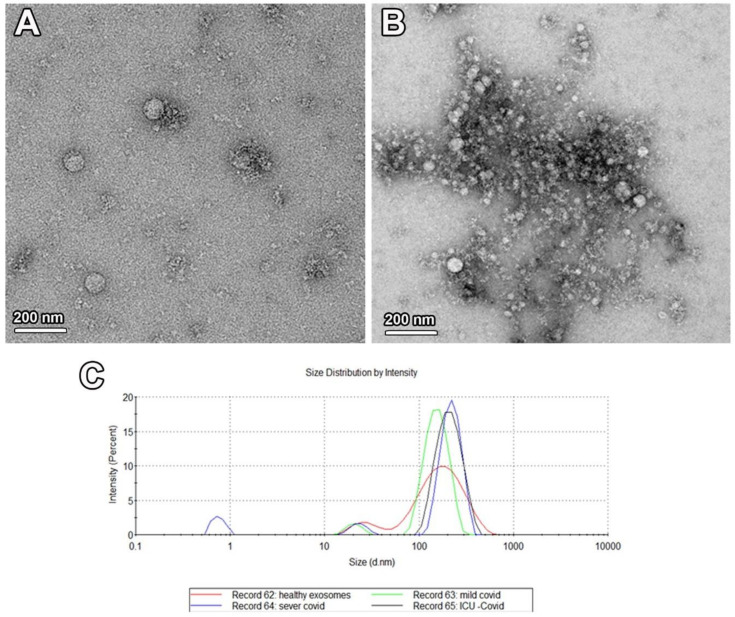
Figure 1
Figure 1
Characterization of isolated exosomes from control and patient samples. TEM examination shows MVs in serum samples isolated from the healthy controls (A) and COVID-19 patients (B). (C) NanoSight graph shows average size of the isolated exosomes.
Figure 2
Figure 2
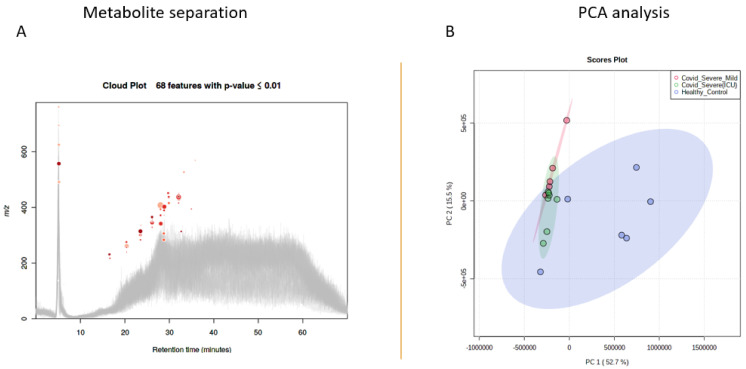
Metabolite separation and statistical analysis. (A) Total ion chromatogram of EVs isolated from both healthy and COVID-19 patient samples. (B) Scores plot between the healthy and COVID-19 patient samples. The explained variances are shown in brackets.
Figure 3
Figure 3
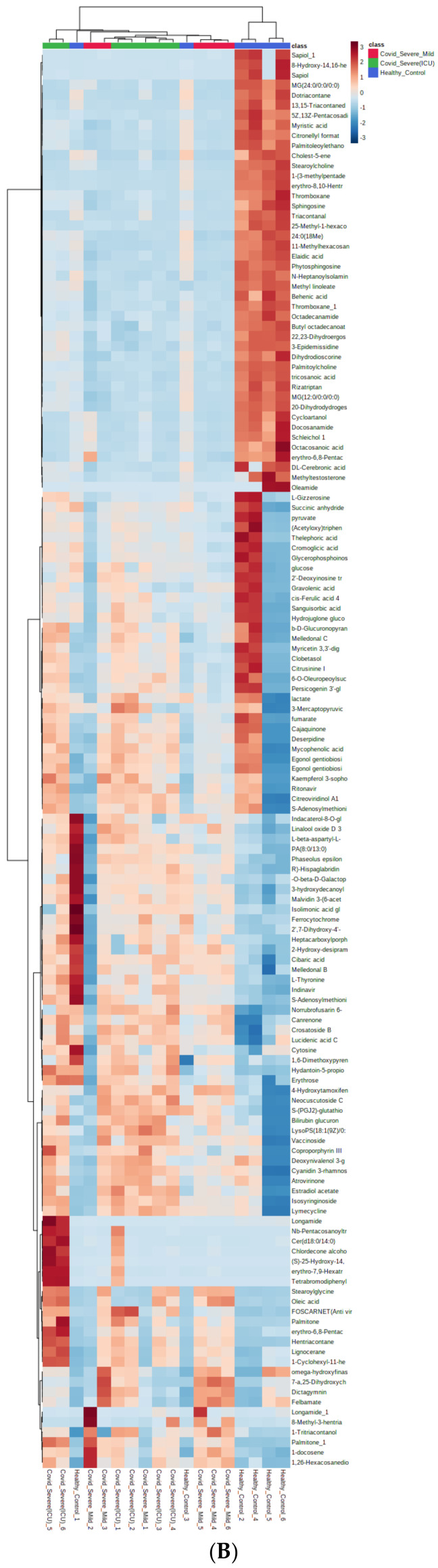
Correlation and expression of identified metabolites from both control and patient samples. (A) Correlation analysis of differentially modulated metabolites identified in both healthy and COVID-19 patient samples. (B) Clustering result is shown as a heatmap (distance measure using Euclidean distance and clustering algorithm using Ward heat map of individual samples).
Figure 3
Figure 3
Correlation and expression of identified metabolites from both control and patient samples. (A) Correlation analysis of differentially modulated metabolites identified in both healthy and COVID-19 patient samples. (B) Clustering result is shown as a heatmap (distance measure using Euclidean distance and clustering algorithm using Ward heat map of individual samples).
Figure 4
Figure 4
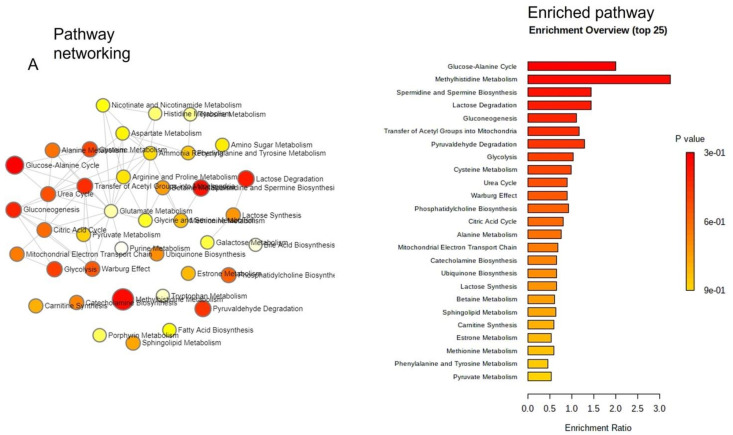
(A,B) Metabolite enrichment analysis: pathway networking, enriched pathways, and classification of accumulated lipid classes found in healthy control and COVID-19 patient EVs.
Figure 4
Figure 4
(A,B) Metabolite enrichment analysis: pathway networking, enriched pathways, and classification of accumulated lipid classes found in healthy control and COVID-19 patient EVs.
Figure 5
Figure 5
(AC) Quantitative levels of statistically significant metabolites (p < 0.01) found to be upregulated in COVID-19 EVs when compared to healthy samples. Data are presented as box plot, median, and interquartile range (n = 3/group).
Figure 5
Figure 5
(AC) Quantitative levels of statistically significant metabolites (p < 0.01) found to be upregulated in COVID-19 EVs when compared to healthy samples. Data are presented as box plot, median, and interquartile range (n = 3/group).
Figure 6
Figure 6
Quantitative levels of LysoPS, 7-α,25-Dihydroxycholesterol, and 15-d-PGJ2 in COVID-19 EVs when compared to healthy control samples.
Figure 7
Figure 7
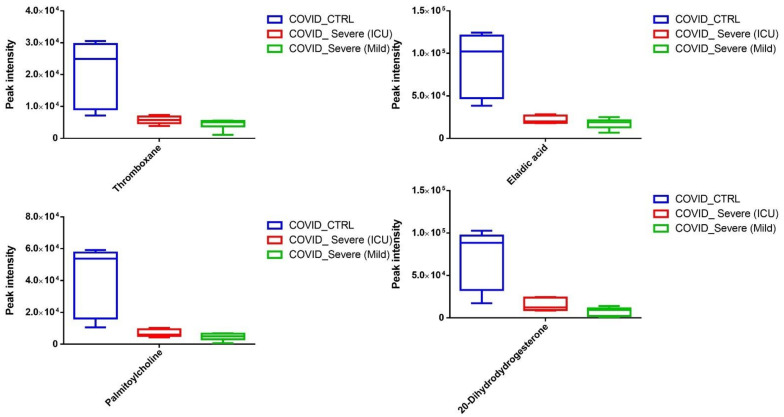
Quantitative level of statistically significant metabolites (p < 0.01) found to be downregulated in COVID-19 EVs when compared to healthy control samples. Data are presented as box plot, median, and interquartile range (n = 3/group).
Figure 8
Figure 8
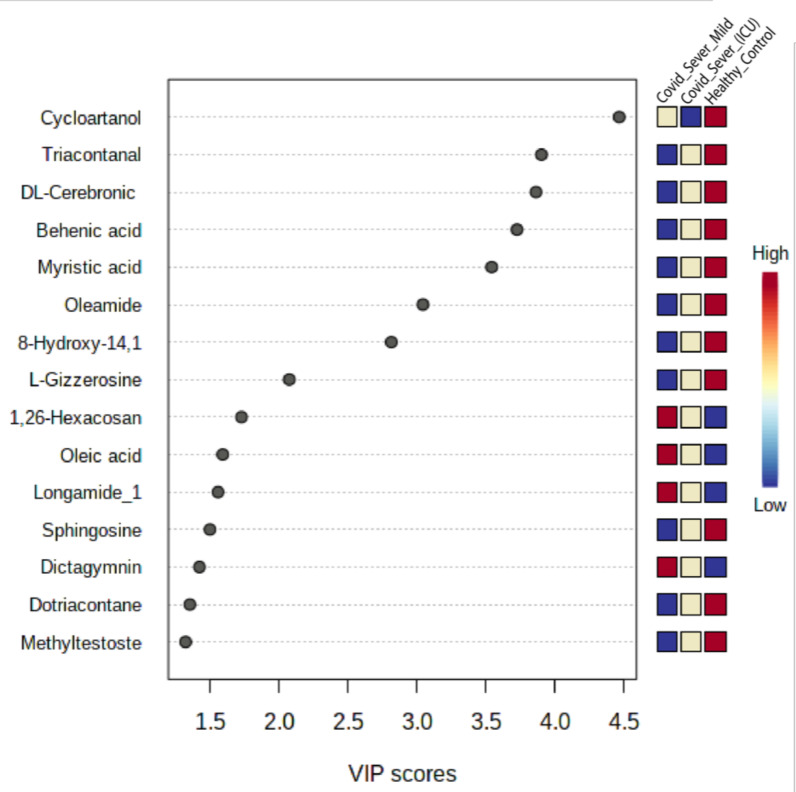
PLS-DA analysis for identification of crucial metabolites associated with disease. The colored boxes on the right indicate the relative concentration of the corresponding metabolites from EVs that are taken from both healthy and COVID-19 patient samples.

References

    1. Zhou P., Yang X.L., Wang X.G., Hu B., Zhang L., Zhang W., Si H.R., Zhu Y., Li B., Huang C.L., et al. A pneumonia outbreak associated with a new coronavirus of probable bat origin. Nature. 2020;579:270–273. doi: 10.1038/s41586-020-2012-7. - DOI - PMC - PubMed
    1. Prompetchara E., Ketloy C., Palaga T. Immune responses in COVID-19 and potential vaccines: Lessons learned from sars and mers epidemic. Asian Pac. J. Allergy Immunol. 2020;38:1–9. - PubMed
    1. Hoffmann M., Kleine-Weber H., Schroeder S., Kruger N., Herrler T., Erichsen S., Schiergens T.S., Herrler G., Wu N.H., Nitsche A., et al. SARS-CoV-2 cell entry depends on ACE2 and TMPRSS2 and is blocked by a clinically proven protease inhibitor. Cell. 2020;181:271–280.e278. doi: 10.1016/j.cell.2020.02.052. - DOI - PMC - PubMed
    1. Coutard B., Valle C., de Lamballerie X., Canard B., Seidah N.G., Decroly E. The spike glycoprotein of the new coronavirus 2019-ncov contains a furin-like cleavage site absent in cov of the same clade. Antivir. Res. 2020;176:104742. doi: 10.1016/j.antiviral.2020.104742. - DOI - PMC - PubMed
    1. Ma Y., Huang Y., Wang T., Xiang A.P., Huang W. ACE2 shedding and furin abundance in target organs may influence the efficiency of SARS-CoV-2 entry. Open Bioinform. J. 2021;14:1–12. doi: 10.2174/1875036202114010001. - DOI

Substances