Review
. 2021 Sep 29;22(19):10507.
doi: 10.3390/ijms221910507.

Genomic Changes Driven by Radiation-Induced DNA Damage and Microgravity in Human Cells

Affiliations
Review

Genomic Changes Driven by Radiation-Induced DNA Damage and Microgravity in Human Cells

Afshin Beheshti et al. Int J Mol Sci. .

Abstract

The space environment consists of a complex mixture of different types of ionizing radiation and altered gravity that represents a threat to humans during space missions. In particular, individual radiation sensitivity is strictly related to the risk of space radiation carcinogenesis. Therefore, in view of future missions to the Moon and Mars, there is an urgent need to estimate as accurately as possible the individual risk from space exposure to improve the safety of space exploration. In this review, we survey the combined effects from the two main physical components of the space environment, ionizing radiation and microgravity, to alter the genetics and epigenetics of human cells, considering both real and simulated space conditions. Data collected from studies on human cells are discussed for their potential use to estimate individual radiation carcinogenesis risk from space exposure.

Keywords: OsaD; genetic and epigenetic changes; microgravity; radiation carcinogenesis risk; space radiation.


Conflict of interest statement

The authors declare no conflict of interest.

Figures
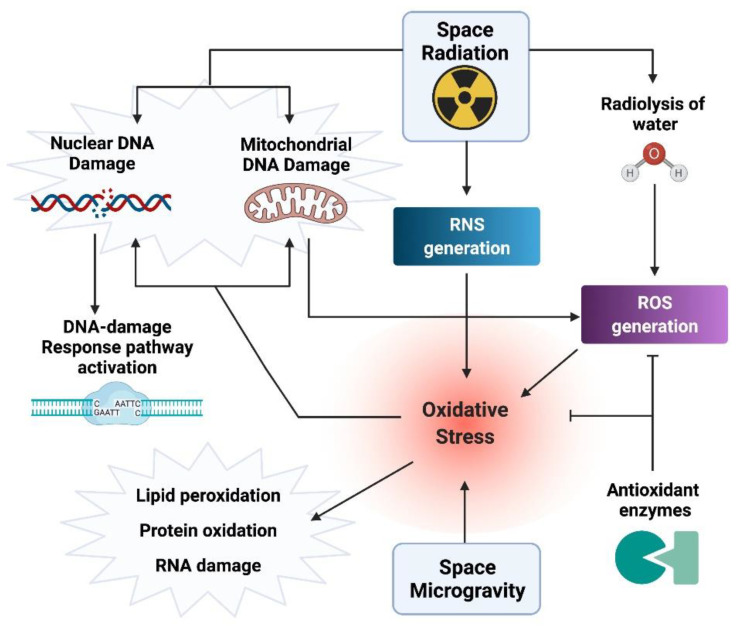
Figure 1
Figure 1
Scheme of the OsaD response in the space environment. The space environment is characterized by a mixture of ionizing radiation of different quality and by reduced gravity (microgravity). Under these conditions, reactive oxygen species (ROS) are generated by radiation-induced water radiolysis and by microgravity causing oxidative stress leading to cellular damage in the form of oxidative DNA/RNA damage, lipid peroxidation, protein oxidation, and impairment of antioxidant activity. Reactive nitrogen species (RNS) induced by radiation also participate in the increase of oxidative stress. Once activated, the OsaD response interfaces with the DNA-Damage Response pathway to counteract the combined effects of radiation and microgravity. “Created with BioRender.com”.
Figure 2
Figure 2
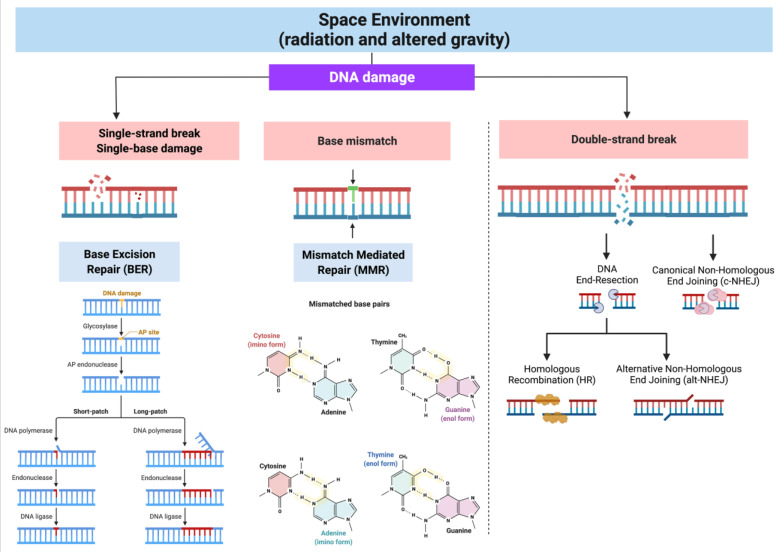
DNA repair pathways associated with DNA damage originated in space environment. The different types of DNA damage induced by ionizing radiation and altered gravity are repaired by components of Base Excision Repair (BER), Mismatch Mediated Repair (MMR), Homologous Recombination (HR) and Non-Homologous End Joining (NHEJ, canonical and alternative) pathways. Oxidative DNA damage in the form of oxidized bases, oxidized pyrimidine derivatives, oxidized base-derived apurinic/apyrimidinic sites are repaired by BER and MMR systems. SSBs and DSBs, originated directly by radiation or indirectly by oxidative DNA damage, are repaired by BER and HR/NHEJ pathways, respectively. “Created with BioRender.com”.

References

    1. Longnecker D.E., Manning F.J., Worth M.H. Jr., editors. Review of NASA’s Longitudinal Study of Astronaut. Health. National Academies Press; Washington, DC, USA: 2004. - PubMed
    1. Afshinnekoo E., Scott R.T., MacKay M.J., Pariset E., Cekanaviciute E., Barker R., Gilroy S., Hassane D., Smith S.M., Zwart S.R., et al. Fundamental Biological Features of Spaceflight: Advancing the Field to Enable Deep-Space Exploration. Cell. 2020;183:1162–1184. doi: 10.1016/j.cell.2020.10.050. - DOI - PMC - PubMed
    1. Garrett-Bakelman F.E., Darshi M., Green S.J., Gur R.C., Lin L., Macias B.R., McKenna M.J., Meydan C., Mishra T., Nasrini J., et al. The NASA Twins Study: A multidimensional analysis of a year-long human spaceflight. Science. 2019:364. doi: 10.1126/science.aau8650. - DOI - PMC - PubMed
    1. Luxton J.J., McKenna M.J., Lewis A., Taylor L.E., George K.A., Dixit S.M., Moniz M., Benegas W., Mackay M.J., Mozsary C., et al. Telomere Length Dynamics and DNA Damage Responses Associated with Long-Duration Spaceflight. Cell Rep. 2020;33:108457. doi: 10.1016/j.celrep.2020.108457. - DOI - PubMed
    1. Durante M., Cucinotta F.A. Heavy ion carcinogenesis and human space exploration. Nat. Rev. Cancer. 2008;8:465–472. doi: 10.1038/nrc2391. - DOI - PubMed

LinkOut - more resources