


Eco-Evolutionary Dynamics in Microbial Communities from Spontaneous Fermented Foods
- PMID: 34639397
- PMCID: PMC8508538
- DOI: 10.3390/ijerph181910093
Eco-Evolutionary Dynamics in Microbial Communities from Spontaneous Fermented Foods
Abstract
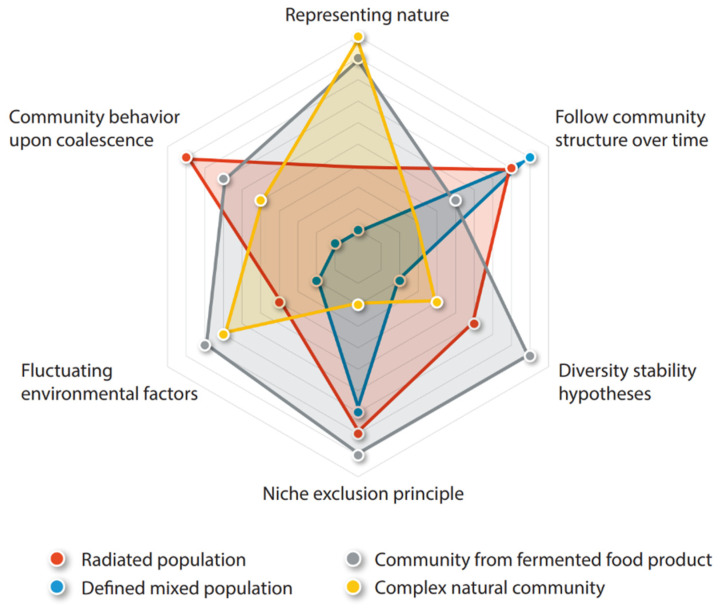
Eco-evolutionary forces are the key drivers of ecosystem biodiversity dynamics. This resulted in a large body of theory, which has partially been experimentally tested by mimicking evolutionary processes in the laboratory. In the first part of this perspective, we outline what model systems are used for experimental testing of eco-evolutionary processes, ranging from simple microbial combinations and, more recently, to complex natural communities. Microbial communities of spontaneous fermented foods are a promising model system to study eco-evolutionary dynamics. They combine the complexity of a natural community with extensive knowledge about community members and the ease of manipulating the system in a laboratory setup. Due to rapidly developing sequencing techniques and meta-omics approaches incorporating data in building ecosystem models, the diversity in these communities can be analysed with relative ease while hypotheses developed in simple systems can be tested. Here, we highlight several eco-evolutionary questions that are addressed using microbial communities from fermented foods. These questions relate to analysing species frequencies in space and time, the diversity-stability relationship, niche space and community coalescence. We provide several hypotheses of the influence of these factors on community evolution specifying the experimental setup of studies where microbial communities of spontaneous fermented food are used.
Keywords: eco-evolutionary dynamics; experimental evolution; food fermentation; microbial community; model system.
Conflict of interest statement
The authors declare no conflict of interest. The funders had no role in the design of the paper; in the collection, analyses, or interpretation of literature; in the writing of the manuscript, or in the decision to publish the paper.
Figures
References
-
- Hendry A. Eco-Evolutionary Dynamics. Princeton University Press; Princeton, NJ, USA: 2016. - DOI
Publication types
MeSH terms
LinkOut - more resources
Full Text Sources
