


Interventions to Improve Medication Adherence in Patients with Schizophrenia or Bipolar Disorders: A Systematic Review and Meta-Analysis
- PMID: 34639510
- PMCID: PMC8508496
- DOI: 10.3390/ijerph181910213
Interventions to Improve Medication Adherence in Patients with Schizophrenia or Bipolar Disorders: A Systematic Review and Meta-Analysis
Abstract
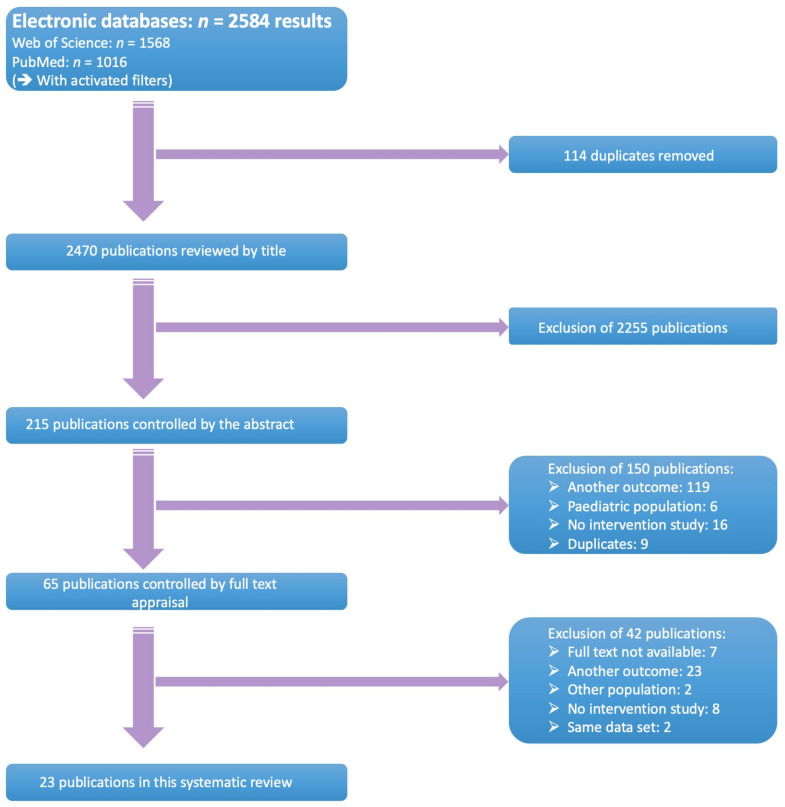
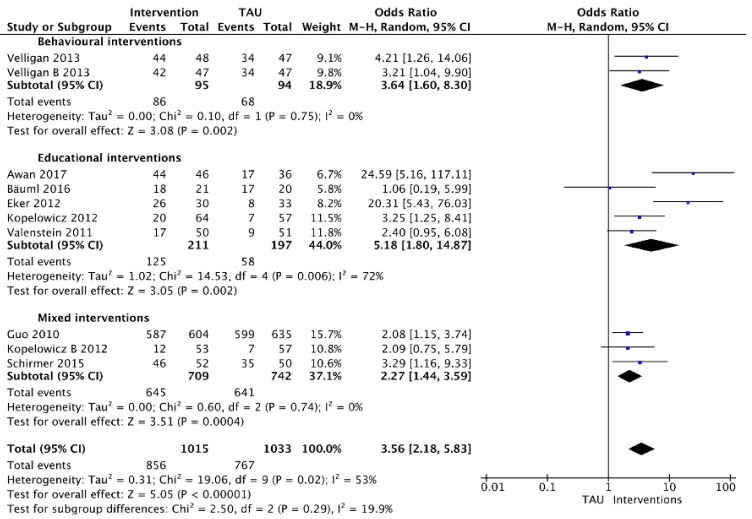
Adherence to prescribed medication regimes improves outcomes for patients with severe mental illness such as schizophrenia or bipolar disorders. The aim of this systematic review and meta-analysis was to compare the effectiveness among interventions to improve medication adherence in patients with schizophrenia or bipolar disorders. Literature published in the last decade was searched for interventions studies to improve adherence in patients with schizophrenia or a bipolar disorder. Interventions were categorised on the basis of type, and the context and effectiveness of the interventions were described. Two review authors independently extracted and assessed data, following criteria outlined by the Cochrane Handbook for Systematic Reviews of Interventions. The GRADEPro (McMaster University, 2020, Ontario, Canada) was used for assessing the quality of the evidence. Twenty-three publications met the selection criteria. Different types of interventions aiming to improve adherence were tested: educational, behavioural, family-based, technological, or a combination of previous types. Meta-analysis could be performed for 10 interventions. When considered separately by subgroups on the basis of intervention type, no significant differences were found in adherence among interventions (p = 0.29; I2 = 19.9%). This review concluded that successful interventions used a combination of behavioural and educational approaches that seem easy to implement in daily practice.
Keywords: adherence; bipolar disorders; compliance; interventions; schizophrenia.
Conflict of interest statement
The authors declare no conflict of interest.
Figures
References
-
- World Health Organization . The Global Economic Burden of Non-Communicable Diseases. World Economic Forum; Geneva, Switzerland: 2011.
-
- World Health Organization . The Global Economic Burden of Non-Communicable Diseases. World Economic Forum; Geneva, Switzerland: 2018.
-
- Hartung D., Low A., Jindai K., Mansoor D., Judge M., Mendelson A., Kansagara D., Motu M., Freeman M., Kondo K. Interventions to Improve Pharmacological Adherence Among Adults With Psychotic Spectrum Disorders and Bipolar Disorder: A Systematic Review. Psychosomatics. 2017;58:101–112. doi: 10.1016/j.psym.2016.09.009. - DOI - PubMed
-
- Mibel F.H.E., Mari L. Non-Compliance to Medication in Psychiatric Patients. Volume 2013 Tuku University of Applied Sciences; Turku, Finland: 2013.
Publication types
MeSH terms
LinkOut - more resources
Full Text Sources
Medical
Miscellaneous
