. 2021 Sep 30;14(19):5711.
doi: 10.3390/ma14195711.

Study on Possible Application of Rubber Granulate from the Recycled Tires as an Elastic Cover of Prototype Rail Dampers, with a Focus on Their Operational Durability

Affiliations

Study on Possible Application of Rubber Granulate from the Recycled Tires as an Elastic Cover of Prototype Rail Dampers, with a Focus on Their Operational Durability

Cezary Kraśkiewicz et al. Materials (Basel). .

Abstract

This study is an attempt to investigate possible applications of rubber granulate SBR (styrene-butadiene rubber) produced from recycled waste tires as an elastic cover for prototype rail dampers, which are aimed at reducing the level of railway noise emitted in the environment. The authors present laboratory procedures and discuss the results of several experimental tests performed on seven different SBR materials with the following densities: 1100, 1050, 1000, 850, 750, 700 and 650 kg/m3. It is proven that rubber granulate SBR produced from recycled waste tires, can be used as an elastic cover in steel inserts in rail dampers, provided that the material density is not lower than 1000 kg/m3. In the conducted tests, samples of the materials with high densities exhibited good static and dynamic elastic characteristics and had sufficient operational durability.

Keywords: elastic characteristics; noise reduction; operational durability; rail dampers; track structure.


Conflict of interest statement

The authors declare no conflict of interest.

Figures

Figure 1
Figure 1
Prototype rail dampers: (a) Schematic location within the ballasted track structure; (b) Cross-section of a static damper; (c) Cross-section of a dynamic damper with a steel insert and an elastic cover based on rubber granulate SBR.
Figure 2
Figure 2
SBR samples with visible porosity increase for the materials with lower densities (higher numbers).
Figure 3
Figure 3
Diagrams of static characteristics of the elastic cover of prototype rail dampers obtained for seven densities of SBR granulate (650–1100 kg/m3).
Figure 4
Figure 4
Diagrams of dynamic characteristics of the elastic cover of prototype rail dampers obtained for two extreme densities of SBR granulate: (a) 1100 kg/m3; (b) 650 kg/m3.
Figure 5
Figure 5
Sample dimensions in mm.
Figure 6
Figure 6
Tensile test of the elastomeric materials: (a) test stand; (b) sample with visible marks and video extensometer before the test.
Figure 7
Figure 7
Tensile strength depending on the elastomeric material density.
Figure 8
Figure 8
Elongation at break depending on the elastomeric material density.
Figure 9
Figure 9
Samples of the elastomeric material with various densities prepared for ageing tests (high temperature and UV radiation).
Figure 10
Figure 10
Samples of the elastomeric material in the climatic chamber Feutron, simulating high temperature and solar radiation.
Figure 11
Figure 11
Influence of density on tensile strength of the samples for two analyzed conditions: blue line—1 (normal conditions), red line—2 (ageing conditions).
Figure 12
Figure 12
Influence of conditioning on tensile strength of the analyzed elastomeric materials with various densities: blue line—SBR 650, red line—SBR 700, green line—SBR 850, purple line—SBR 1000, black line—SBR 1050, grey line—SBR 1100.
Figure 13
Figure 13
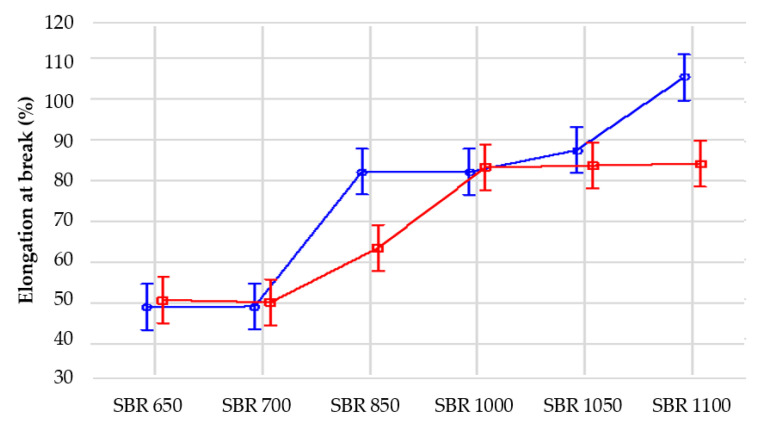
Influence of density on elongation at break of the samples for two analyzed conditions: blue line—1 (normal conditions), red line—2 (ageing conditions).
Figure 14
Figure 14
Influence of conditioning on elongation at break of the analyzed elastomeric materials with various densities: blue line—SBR 650, red line—SBR 700, green line—SBR 850, purple line—SBR 1000, black line—SBR 1050, grey line—SBR 1100.
Figure 15
Figure 15
Views of: (a) Samples cutter; (b) Compressive plates; (c) Samples of elastomeric materials.
Figure 16
Figure 16
Samples’ deformation in the time domain, measured during relaxation after compression tests of the elastomeric material SBR 1050 at –30 °C; the deformation of 0% corresponds to the initial height of the sample before the test.
Figure 17
Figure 17
Change of length for sample SBR 650 after 7 days in oil.
Figure 18
Figure 18
Prototype rail dampers with the elastic cover made of rubber granulate SBR 1050 during the test of resistance in contact with ballast grains: (a) Rail dampers adjusted to the Vignole rail 60E1 before the test; (b) Rail dampers adjusted to the Vignole rail 49E1 during the test; (c) Rail dampers adjusted to the Vignole rail 49E1 after the test—no visible damages or permanent deformations.

References

    1. Scossa-Romano E., Oertli J. Rail Dampers, Acoustic Rail Grinding, Low Height Noise Barriers. A Report on the State of the Art. Bern. 2012. [(accessed on 29 September 2021)]. Available online: https://uic.org/IMG/pdf/2012_dampers_grinding_lowbarriers.pdf.
    1. Kraśkiewicz C., Mossakowski P., Zbiciak A., Al Sabouni-Zawadzka A. Experimental identification of dynamic characteristics of a track structure influencing the level of noise emission. Arch. Civ. Eng. 2021;4 in press.
    1. EN 15461:2008+A1:2010 Railway Applications—Noise Emission—Characterization of the Dynamic Properties of Track Sections for Pass by Noise Measurements. [(accessed on 29 September 2021)]. Available online: https://standards.iteh.ai/catalog/standards/cen/26269fce-8011-4fbf-a206-....
    1. Sieglitz R., Czolbe C. Wirsamkeit von Schienenabsorbern in Abhaegigkeit Verschiedener Fahrzeugtypen. DAGA; Darmstadt, Germany: 2012.
    1. Sol-Sánchez M., Moreno-Navarro F., Gámez M. The Use of Deconstructed Tires as Elastic Elements in Railway Tracks. Materials. 2014;7:5903–5919. doi: 10.3390/ma7085903. - DOI - PMC - PubMed

LinkOut - more resources