. 2021 Sep 26;26(19):5839.
doi: 10.3390/molecules26195839.

Probing the Suitability of Different Ca2+ Parameters for Long Simulations of Diisopropyl Fluorophosphatase

Affiliations

Probing the Suitability of Different Ca2+ Parameters for Long Simulations of Diisopropyl Fluorophosphatase

Alexander Zlobin et al. Molecules. .

Abstract

Organophosphate hydrolases are promising as potential biotherapeutic agents to treat poisoning with pesticides or nerve gases. However, these enzymes often need to be further engineered in order to become useful in practice. One example of such enhancement is the alteration of enantioselectivity of diisopropyl fluorophosphatase (DFPase). Molecular modeling techniques offer a unique opportunity to address this task rationally by providing a physical description of the substrate-binding process. However, DFPase is a metalloenzyme, and correct modeling of metal cations is a challenging task generally coming with a tradeoff between simulation speed and accuracy. Here, we probe several molecular mechanical parameter combinations for their ability to empower long simulations needed to achieve a quantitative description of substrate binding. We demonstrate that a combination of the Amber19sb force field with the recently developed 12-6 Ca2+ models allows us to both correctly model DFPase and obtain new insights into the DFP binding process.

Keywords: DFPase; QM/MM; diisopropyl fluorophosphatase; force field; metadynamics; molecular dynamics; substrate binding.


Conflict of interest statement

The authors declare no conflict of interest.

Figures
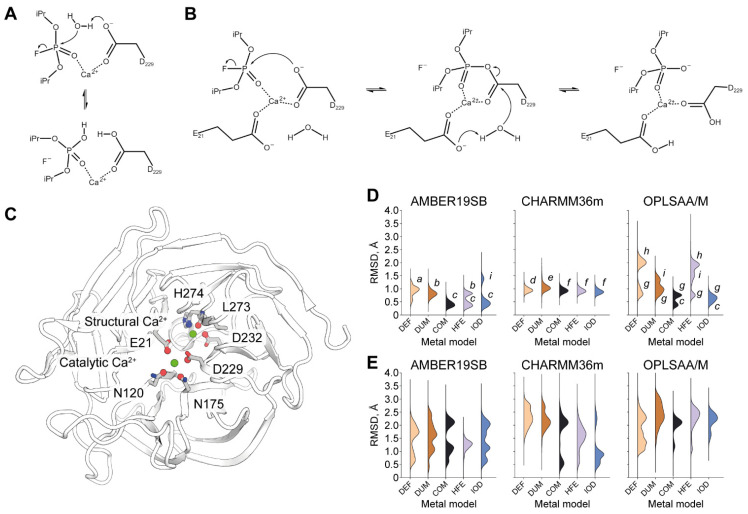
Figure 1
Figure 1
Overview of DFPase reaction, calcium-binding sites and modeling of their dynamic behavior. (A). A scheme of the proposed general-base reaction mechanism. (B) A scheme of the proposed nucleophilic reaction mechanism. (C) DFPase structure. Coordinating residues are highlighted. Atoms involved in RMSD calculation are shown as spheres. (D). Stability of catalytic Ca2+ site. Individual states of interest are marked as lowercase letters to be referenced later on in text and figures. (E). Stability of structural Ca2+ site. Each violin plot represents RMSD over the last 10 ns of 5 replicas for each parameter combination. Explanation of system naming can be found in the Materials and Methods section.
Figure 2
Figure 2
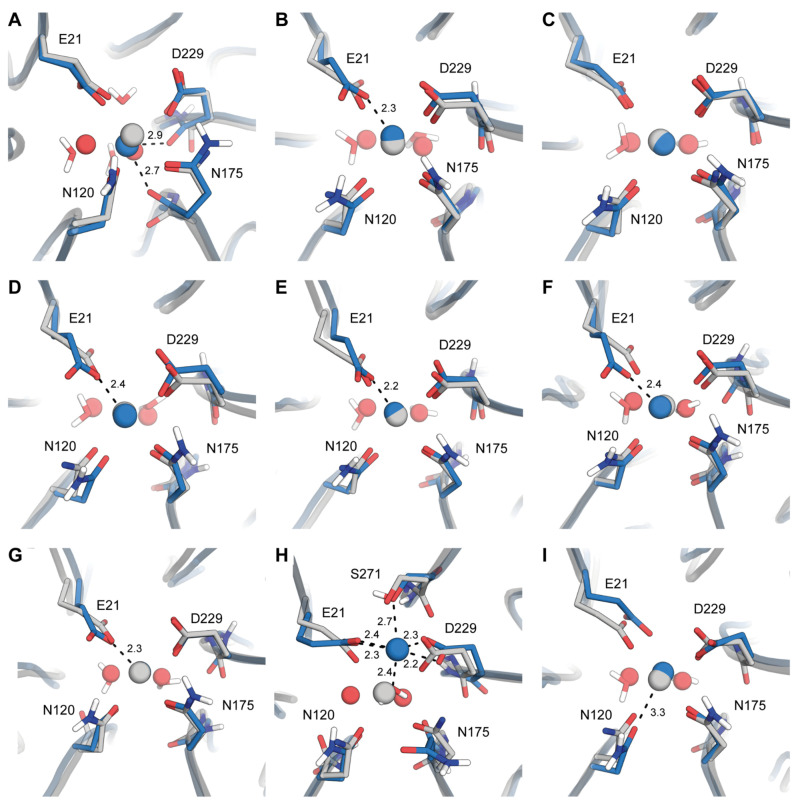
Structural disturbances in catalytic Ca2+ site of DFPase when modeled with different parameter combinations. (A) State a showcased on Amber19sb-DEF results. (B) State b, Amber19sb-DUM. (C) State c, Amber19sb-COM. (D) State d, CHARMM36m-DEF. (E) State e, CHARMM36m-DUM. (F) State f, CHARMM36m-COM. (G) State g, OPLS-AA/M-DEF. (H) State h, OPLS-AA/M-DEF. (I) State i, OPLS-AA/M-DUM. Modeled systems are shown in blue, shown in gray are coordinates from PDB ID 3O4P. Non-polar hydrogen atoms and outer dummy atoms in DUM models are omitted for clarity.
Figure 3
Figure 3
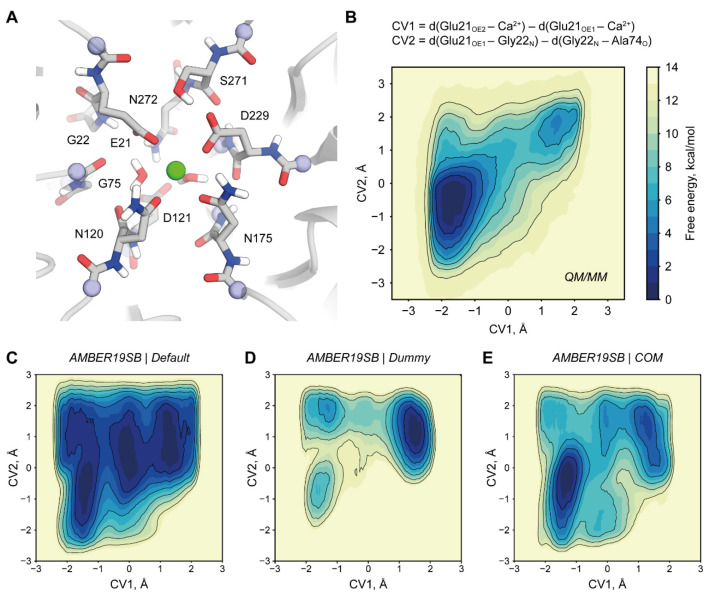
Competition for a hydrogen bond with G22 and its influence on the E21 conformation studied with QM/MM and MM treatment. (A) Composition of QM subsystem. Linking atoms are shown in blue. (B) QM/MM free energy profile of E21 conformation switch. (CE) Free energy profiles of Amber19sb systems showing the benefit of using the COM metal model to approach QM/MM reference. Similar data for other force fields are shown in Figure S4. Non-polar hydrogen atoms are omitted for clarity.
Figure 4
Figure 4
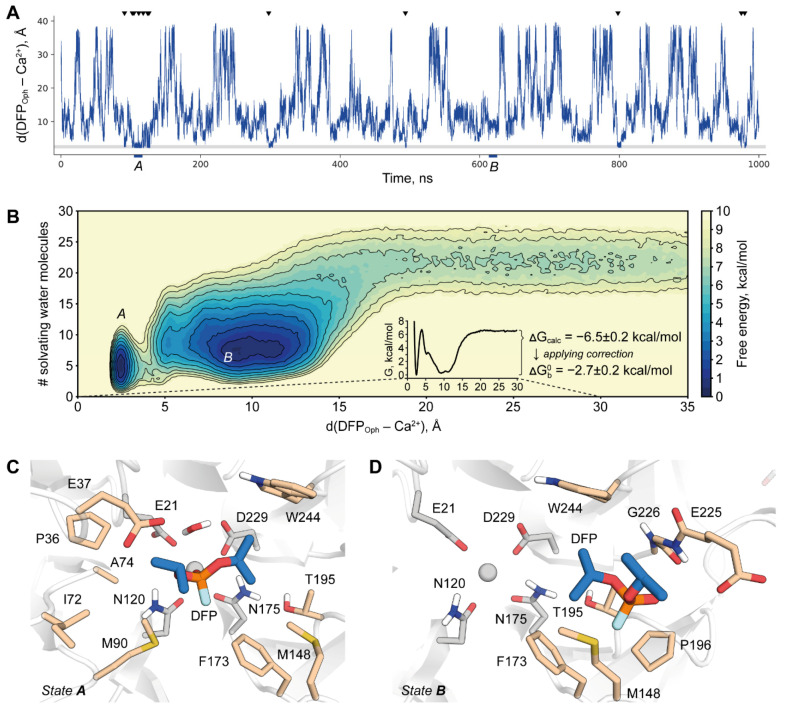
Funnel metadynamics simulation of DFPase-DFP interaction upon binding. (A) Time progression of the simulation. Shaded gray area corresponds to Ca2+ coordination by phosphoryl oxygen. Black arrows indicate reaching the pre-reaction state. Time ranges used to extract frames of binding modes of interest are marked with capital letters. (B) Free energy profile of substrate binding. Minima corresponding to stable binding modes are marked with capital letters. (C) Pre-reaction state reached in the simulation. (D) The alternative stable state reached in the simulation. DFP carbon atoms are shown in blue, catalytic residues are colored gray and hydrophobic residues forming binding pockets for both states are shown in wheat. Non-polar hydrogen atoms are omitted for clarity.

References

    1. Hoskin F.C., Long R.J. Purification of a DFP-Hydrolyzing Enzyme from Squid Head Ganglion. Arch. Biochem. Biophys. 1972;150:548–555. doi: 10.1016/0003-9861(72)90073-2. - DOI - PubMed
    1. Hoskin F.C., Roush A.H. Hydrolysis of Nerve Gas by Squid-Type Diisopropyl Phosphorofluoridate Hydrolyzing Enzyme on Agarose Resin. Science. 1982;215:1255–1257. doi: 10.1126/science.7058344. - DOI - PubMed
    1. Matula M., Kucera T., Soukup O., Pejchal J. Enzymatic Degradation of Organophosphorus Pesticides and Nerve Agents by EC: 3.1.8.2. Catalysts. 2020;10:1365. doi: 10.3390/catal10121365. - DOI
    1. Blum M.M., Mustyakimov M., Rüterjans H., Kehe K., Schoenborn B.P., Langan P., Chen J.C.-H. Rapid Determination of Hydrogen Positions and Protonation States of Diisopropyl Fluorophosphatase by Joint Neutron and X-Ray Diffraction Refinement. Proc. Natl. Acad. Sci. USA. 2009;106:713–718. doi: 10.1073/pnas.0807842106. - DOI - PMC - PubMed
    1. Blum M.M., Löhr F., Richardt A., Rüterjans H., Chen J.C.H. Binding of a Designed Substrate Analogue to Diisopropyl Fluorophosphatase: Implications for the Phosphotriesterase Mechanism. J. Am. Chem. Soc. 2006;128:12750–12757. doi: 10.1021/ja061887n. - DOI - PubMed

MeSH terms

LinkOut - more resources