. 2022 Dec;55(6 Pt 1):1076-1083.
doi: 10.1016/j.jmii.2021.09.005. Epub 2021 Sep 29.

Possibility of underestimation of COVID-19 prevalence by PCR and serological tests

Affiliations

Possibility of underestimation of COVID-19 prevalence by PCR and serological tests

Shinichiro Ota et al. J Microbiol Immunol Infect. 2022 Dec.

Abstract

Background: Exact comprehension of the prevalence of SARS-CoV-2 infection is essential for the preventive measures. In the clinical settings, however, patients infected with SARS-CoV-2 may not be fully detected by PCR. In the long-term prevalence study, cut-off of IgG assay may not be appropriate due to waning IgG titer.

Methods: 24 PCR-negative subjects suspected of COVID-19 were categorized into cohorts termed "presumed COVID-19 positive" and "presumed COVID-19 negative" by chest CT images. IgG against nucleocapsid protein of SARS-CoV-2 (IgG (N)) and IgG against receptor biding domain of SARS-CoV-2 (IgG (RBD)) were measured in sera of the subjects and the concordance with the cohort categorization was assessed by receiver operating characteristics (ROC) analyses.

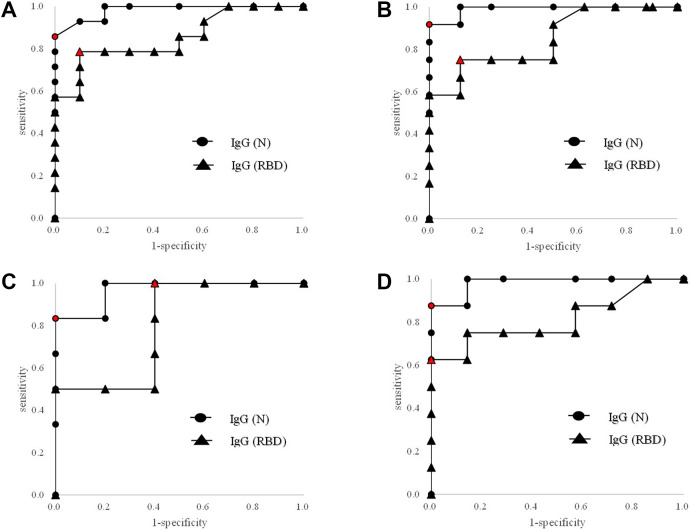
Results: Area under the curves (AUC's) by the ROC analyses with the 24 subjects were 0.982 with IgG (N) and 0.854 with IgG (RBD). Even when we excluded the subjects whose initial PCR was performed after five days from symptom onset, the AUC's were 0.967 with IgG (N) and 0.800 with IgG (RBD). The ROC analysis indicated 0.2 S/C as the optimum cut-off forIgG (N).

Conclusion: Both IgG (N) and IgG (RBD) titers were significantly elevated in subjects whose PCR never showed positive but suggestive of SARS-CoV-2 infection, which indicated the necessity of serological tests in complementing the shortcomings of PCR. For a long-term prevalence study, a cut-off lower than the one used in the ongoing infection phase (e.g. 0.2 S/C vs. 1.4 S/C) was indicated to be more appropriate for IgG (N).

Keywords: COVID-19; IgG; PCR; Prevalence; SARS-CoV-2; Serological test.


Figures

Figure 1
Figure 1
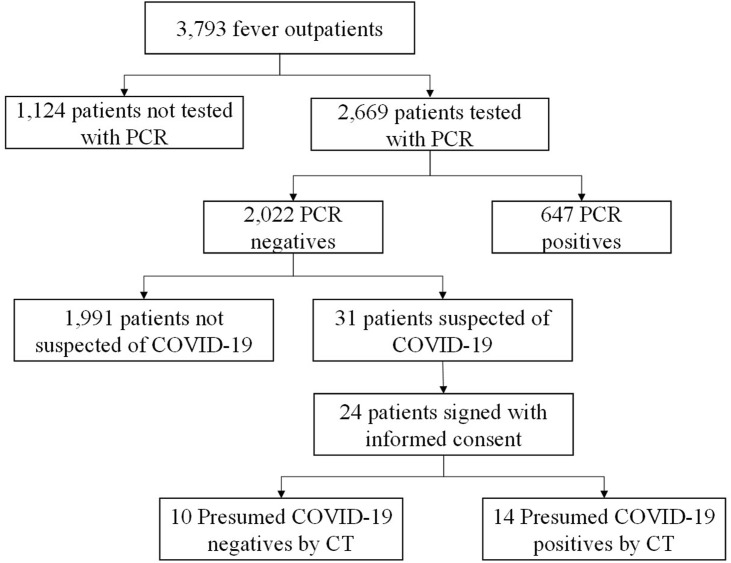
Flow chart of subject inclusion criteria.
Figure 2
Figure 2
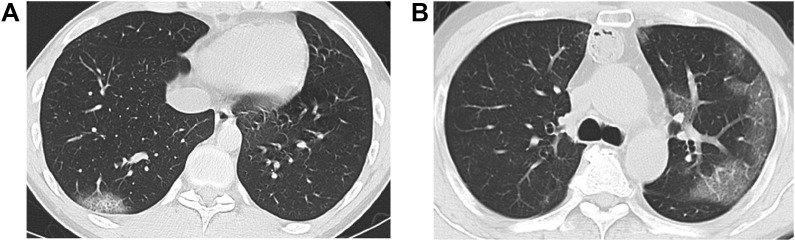
Typical CT imaging features for COVID-19. Unenhanced, thin-section axial images of two subjects presumed of COVID-19 postive who showed rounded and peripheral GGO with superimposed interlobular septal thickening and visible intralobular lines (“crazy-paving”). A) 27-year-old male (subject ID #17). B) 51-year-old male (subject ID #21). GGO; ground-glass opacity.
Figure 3
Figure 3
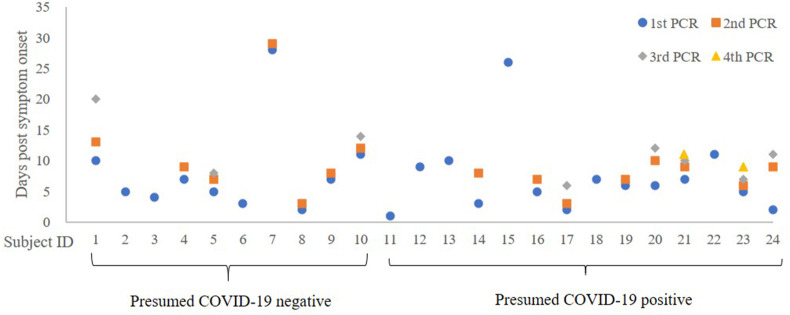
Days of PCR sample collection from symptom onset. Subject #1–10: presumed COVID-19 negative. Subject #11–24: presumed COVID-19 positive. Blue circle: 1st PCR sample collection. Orange square: 2nd PCR sample collection. Grey diamond: 3rd PCR sample collection. Yellow triangle: 4th PCR sample collection.
Figure 4
Figure 4
ROC analyses for presumed COVID-19 with IgG (N) or IgG (RBD). Circle: IgG (N). Triangle: IgG (RBD). The circle or triangle in red signifies the point that gave the optimum cut-off. A) Total subjects. B) Subjects with PCR confirmed within ten days from symptom onset. C) Subjects with PCR confirmed within five days from symptom onset. D) Subjects with more than one PCR tests.
Figure 5
Figure 5
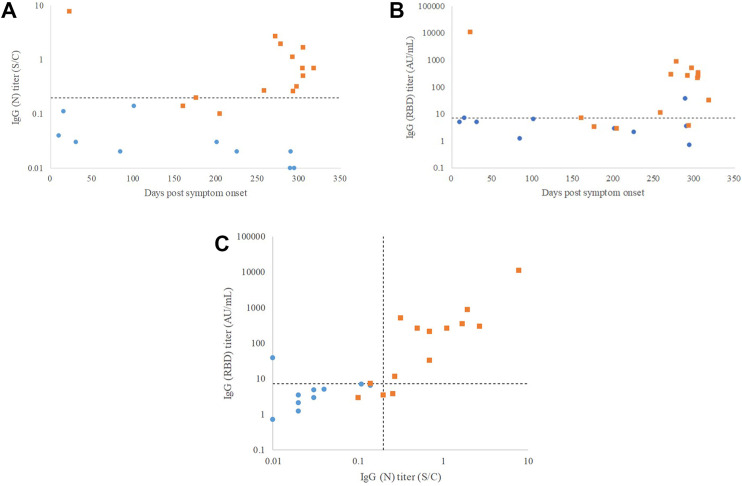
IgG titers against days of sample collection from symptom onset and correlation between IgG (N) and IgG (RBD) titers. Blue circle: presumed COVID-19 negative. Orange square: presumed COVID-19 positive. A) IgG (N). B) IgG (RBD). C) Correlation between IgG (N) and IgG (RBD) titers. Dotted lines indicate the cut-offs derived from the ROC analyses; 0.2 S/C and 7.2 AU/mL for IgG (N) and IgG (RBD), respectively. ROC; receiver operating characteristic.

References

    1. Hu B., Guo H., Zhou P., Shi Z. Characteristics of SARS- CoV-2 and COVID-19. Nat Rev Microbiol. 2020 doi: 10.1038/s41579-020-00459-7. - DOI - PMC - PubMed
    1. Dong E., Du H., Gardner L. An interactive web-based dashboard to track COVID-19 in real time. Lancet Infect Dis. 2020;20:533–534. doi: 10.1016/S1473-3099(20)30120-1. 2020. - DOI - PMC - PubMed
    1. Elezkurtaj S., Greuel S., Ihlow J., Michaelis E.G., Bischoff P., Kunze C.A., et al. Causes of death and comorbidities in hospitalized patients with COVID-19. Sci Rep. 2021;11:4263. - PMC - PubMed
    1. Kanji J.N., Zelyas N., MacDonald C., Pabbaraju K., Khan M.N., Prasad A., et al. False negative rate of COVID-19 PCR testing: a discordant testing analysis. Virol J. 2021;18:13. - PMC - PubMed
    1. Mallett S., Allen A.J., Graziadio A., Taylor S.A., Sakai N.S., Green K., et al. At what times during infection is SARS-CoV-2 detectable and no longer detectable using RT-PCR-based tests? A systematic review of individual participant data. BMC Med. 2020;18:346. - PMC - PubMed