. 2021 Oct 12;12(1):5942.
doi: 10.1038/s41467-021-26188-w.

The genomic landscape of Mexican Indigenous populations brings insights into the peopling of the Americas

Affiliations

The genomic landscape of Mexican Indigenous populations brings insights into the peopling of the Americas

Humberto García-Ortiz et al. Nat Commun. .

Abstract

The genetic makeup of Indigenous populations inhabiting Mexico has been strongly influenced by geography and demographic history. Here, we perform a genome-wide analysis of 716 newly genotyped individuals from 60 of the 68 recognized ethnic groups in Mexico. We show that the genetic structure of these populations is strongly influenced by geography, and our demographic reconstructions suggest a decline in the population size of all tested populations in the last 15-30 generations. We find evidence that Aridoamerican and Mesoamerican populations diverged roughly 4-9.9 ka, around the time when sedentary farming started in Mesoamerica. Comparisons with ancient genomes indicate that the Upward Sun River 1 (USR1) individual is an outgroup to Mexican/South American Indigenous populations, whereas Anzick-1 was more closely related to Mesoamerican/South American populations than to those from Aridoamerica, showing an even more complex history of divergence than recognized so far.


Conflict of interest statement

The authors declare no competing interests.

Figures
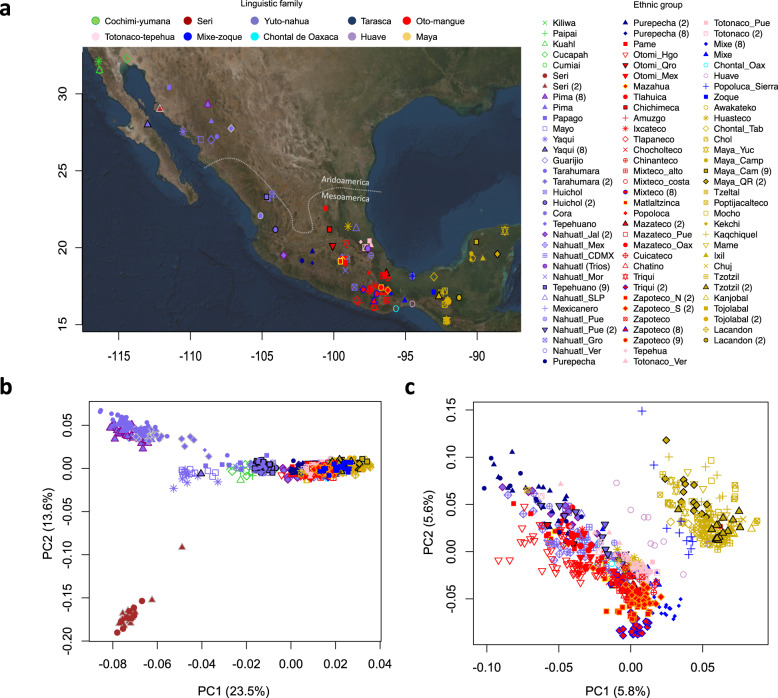
Fig. 1
Fig. 1. Geographic distribution and genetic relationships of Indigenous populations in Mexico.
a Map with locations of the sampled communities. The points in the map denote the approximate location where each ethnic group samples were collected. b PCA projection of all Mexican Indigenous groups tested, with the first two axes of variation differentiating ethnic groups from Aridoamerica and Mesoamerica. c PCA projection of Indigenous groups from Mesoamerica that resembles the geography of central and southern Mexico. Dot shapes denote the ethnic group and color the linguistic family according to INALI classification. Numbers between brackets are the corresponding references.
Fig. 2
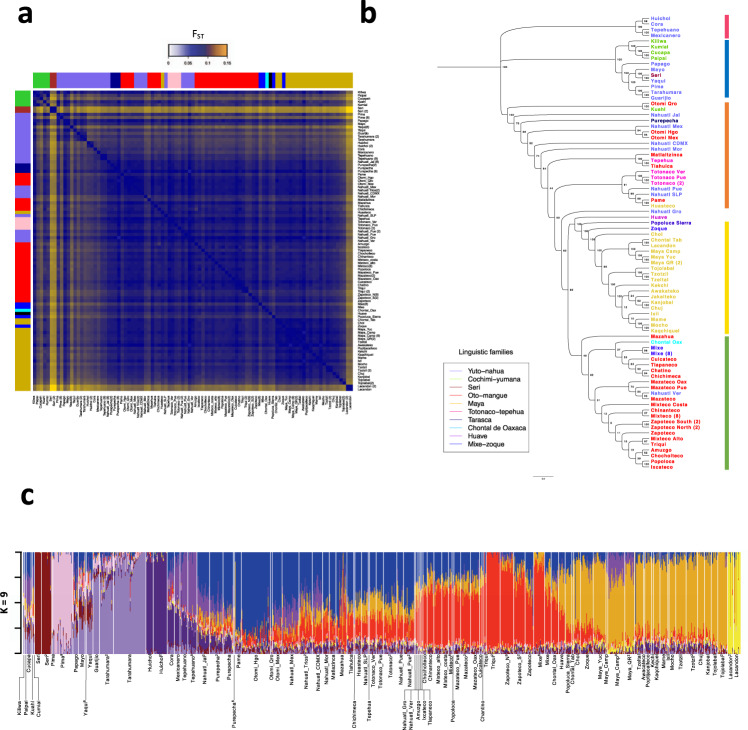
Fig. 2. The genetic diversity of Indigenous groups correlates with their geographic distribution.
a Pairwise-FST matrix for all tested populations. Colored bars represent the linguistic family. b FST-based neighbor-joining tree showing the correlation with geographic location independent of linguistic classification (colored names), the numbers above the branches indicate the bootstrap values. Colored vertical lines represent the identified geographic regions: North (blue), Northwest (red), Central-east (orange), South (green), and Southeast (yellow). c Admixture analysis assuming K = 9 clusters in Mexican Indigenous populations. Superscript numbers are the corresponding references.
Fig. 3
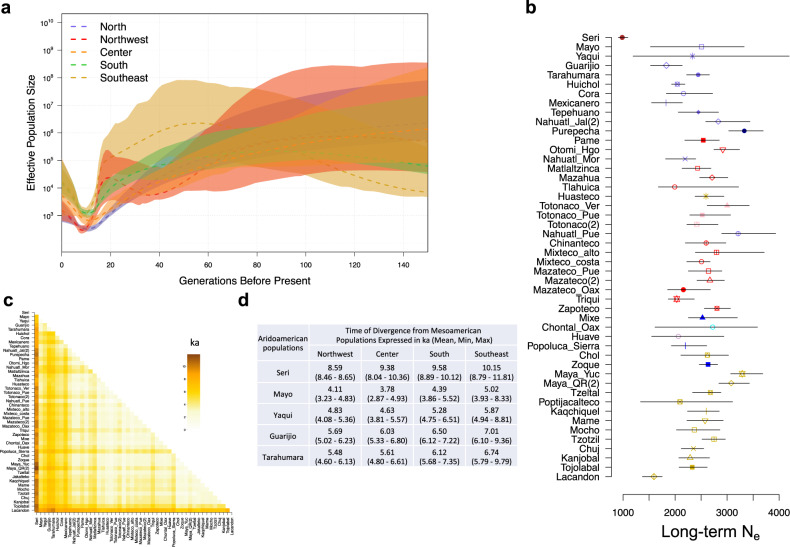
Fig. 3. Effective population size and divergence time estimates.
a Demographic measure of effective population size across time showing a decline in population sizes in the five main geographic regions identified here: North, Northwest, Center, South and Southeast. b Long-term Ne of all tested populations, shapes represent the long-term Ne and errors bars represent the 95% confidence interval. Colors are according to the legends in Fig. 1. Numbers between brackets are the corresponding references. c Divergence time between pairs of populations. d Mean of the observed T between Aridoamerican and Mesoamerican populations expressed in ka.
Fig. 4
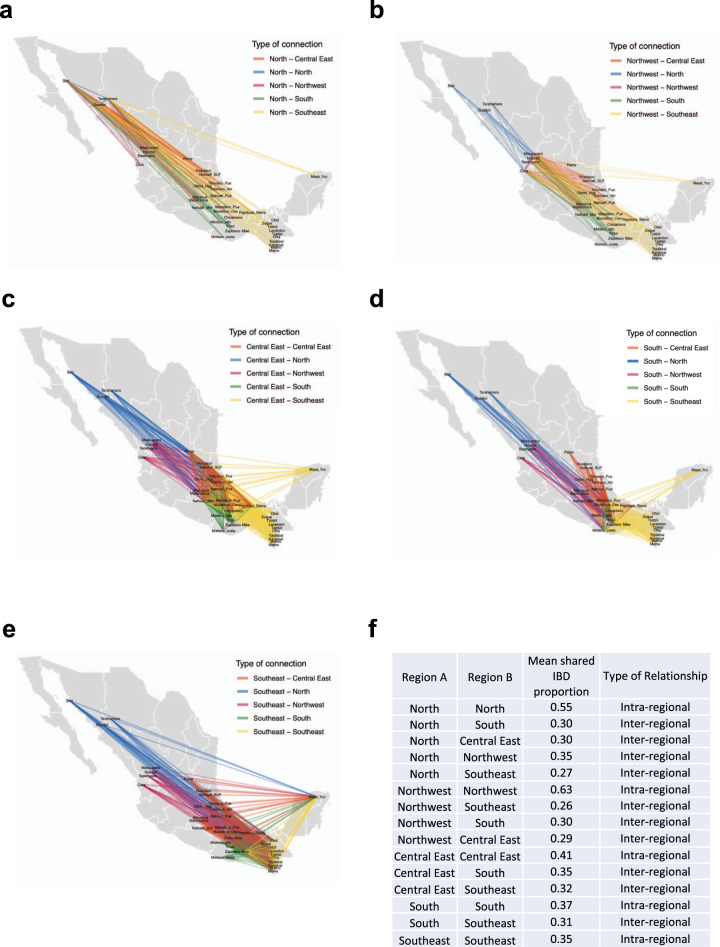
Fig. 4. IBD segments analysis.
IBD segments analysis performed in Indigenous populations with at least 99% of Native American ancestry inferred from Admixture K = 4. Analyses were restricted for segments >7 cM. Shared IBD fragments shown proximal and distal connections between populations from the same and different regions. a North IBD segments, b Northeast IBD segments, c Central East IBD segments and d South IBD segments and e Southeast IBD segments. The width of each edge is proportional to the mean IBD length. f Table showing the mean values of IBD sharing within and between regions.
Fig. 5
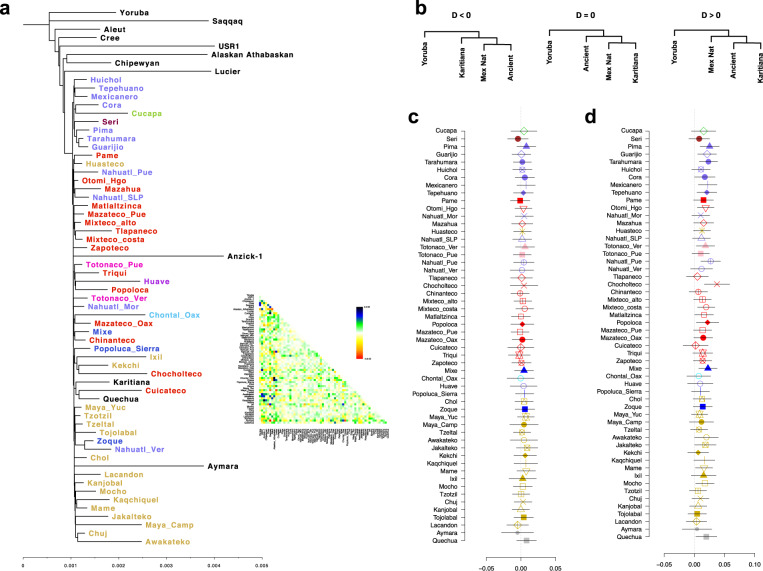
Fig. 5. Genetic relationship of Mexican Native populations with the ancient genomes of USR1 and Anzick-1.
a Maximum-likelihood tree inferred from allele frequency, residual plot from the maximum-likelihood tree is shown. b Possible tree topologies resolved by D-statistics. c D-statistic in the form of D(Yoruba, USR1; Mex Nat, Karitiana) shows that all Mexican populations are related to the USR1 genome. d D-statistic in the form of D(Yoruba, Ancient; Mex Nat, Karitiana). Error bars in c, d represent 3 standard errors estimated by a weighted block jackknife. Mex Nat Mexican Native population.

References

    1. Dixon EJ. Human colonization of the Americas: timing, technology and process. Quat. Sci. Rev. 2001;20:277–299. doi: 10.1016/S0277-3791(00)00116-5. - DOI
    1. Moreno-Estrada A, et al. Human genetics. The genetics of Mexico recapitulates Native American substructure and affects biomedical traits. Science. 2014;344:1280–1285. doi: 10.1126/science.1251688. - DOI - PMC - PubMed
    1. Raghavan M, et al. Population genetics. Genomic evidence for the Pleistocene and recent population history of Native Americans. Science. 2015;349:aab3884. doi: 10.1126/science.aab3884. - DOI - PMC - PubMed
    1. Hoffecker JF, et al. Beringia and the global dispersal of modern humans. Evol. Anthropol. 2016;25:64–78. doi: 10.1002/evan.21478. - DOI - PubMed
    1. Romero-Hidalgo S, et al. Demographic history and biologically relevant genetic variation of Native Mexicans inferred from whole-genome sequencing. Nat. Commun. 2017;8:1005. doi: 10.1038/s41467-017-01194-z. - DOI - PMC - PubMed

Publication types