


Evolution of HER2-low expression from primary to recurrent breast cancer
- PMID: 34642348
- PMCID: PMC8511010
- DOI: 10.1038/s41523-021-00343-4
Evolution of HER2-low expression from primary to recurrent breast cancer
Erratum in
-
Author Correction: Evolution of HER2-low expression from primary to recurrent breast cancer.NPJ Breast Cancer. 2021 Nov 24;7(1):149. doi: 10.1038/s41523-021-00359-w. NPJ Breast Cancer. 2021. PMID: 34819500 Free PMC article. No abstract available.
Abstract
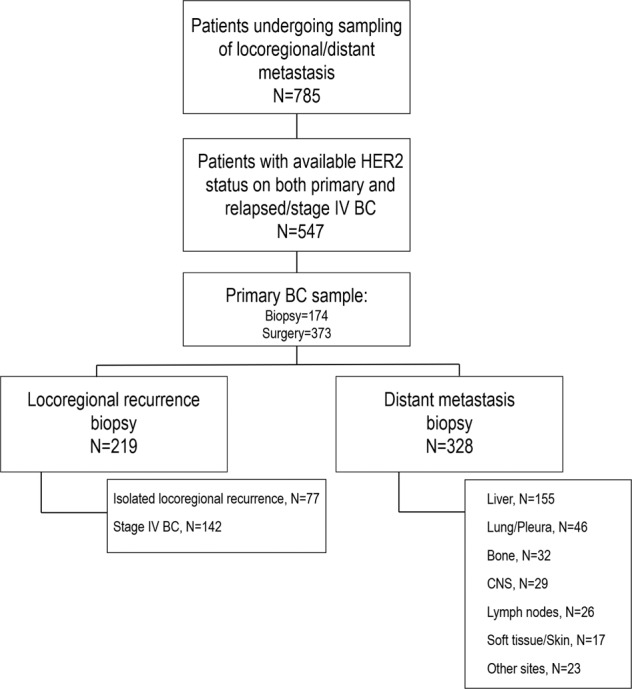
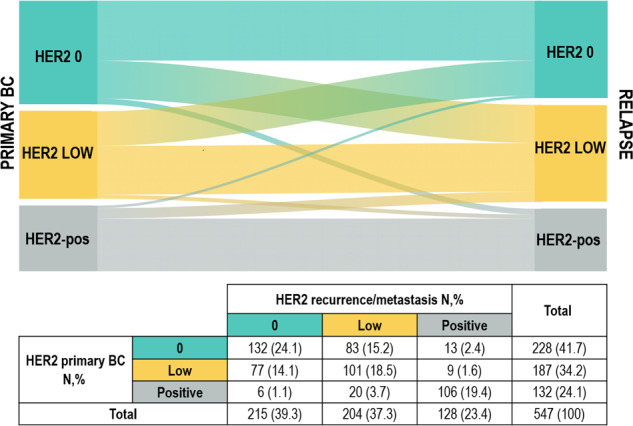
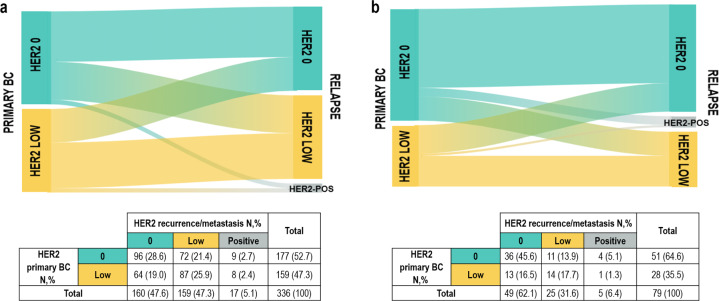
About a half of HER2-negative breast cancer (BC) show HER2-low expression that can be targeted by new antibody-drug conjugates. The main aim of this study is to describe the evolution of HER2 expression from primary BC to relapse by including HER2-low category in both primary and recurrent BC samples. Patients with matched primary and relapse BC samples were included. HER2 was evaluated according to ASCO/CAP recommendations in place at the time of diagnosis. A cutoff of >10% cells staining for HER2-positivity was applied. HER2-negative cases were sub-classified as HER2-low (IHC = 1 + /2+ and ISH not amplified), or HER2-0 (IHC-0). 547 patients were included. The proportion of HER2-low cases was 34.2% on the primary tumor and 37.3% on the relapse samples. Among HER2-negative cases, HER2-low status was more frequent in HR-positive vs triple-negative tumors (47.3% vs 35.4% on primary tumor samples, 53.8% vs 36.2% on relapse samples). The overall rate of HER2 discordance was 38.0%, mostly represented by HER2-0 switching to HER2-low (15%) and HER2-low switching to HER2-0 (14%). Among patients with a primary HER2-negative tumor, the rate of HER2 discordance was higher in HR-positive/HER2-negative vs triple-negative cases (45.5% vs 36.7% p = 0.170). This difference was mostly driven by cases switching from HER2-0 to HER2-low. HER2-low expression is highly unstable during disease evolution. Relapse biopsy in case of a primary HER2-0 tumor may open new therapeutic opportunities in a relevant proportion of patients.
© 2021. The Author(s).
Conflict of interest statement
M.F. received honoraria for consulting, advisory role, speaker bureau, and/or research funding from Astellas Pharma, QED Therapeutics, Diaceutics, Tesaro, Roche, Eli Lilly, and Novartis, all outside the submitted work. PFC reports personal fees from Novartis, EliLilly, AstraZeneca, Tesaro, BMS, Roche, all outside the submitted work. V.G.: reports personal fees from Roche, Novartis, Eli Lilly, MSD outside the submitted work. MVD reports personal fees from Lilly, Genomic Health, Novartis and Celgene, all outside the submitted work. All remaining authors have declared no conflicts of interest.
Figures
References
Grants and funding
LinkOut - more resources
Full Text Sources
Other Literature Sources
Research Materials
Miscellaneous
