. 2022 Jan;61(1):22-25.
doi: 10.1177/00099228211044842. Epub 2021 Oct 13.

COVID-19 Restrictions Are Associated With a Significant Decrease of All Common Respiratory Viral Illnesses in Children

Affiliations

COVID-19 Restrictions Are Associated With a Significant Decrease of All Common Respiratory Viral Illnesses in Children

Melanie M Randall et al. Clin Pediatr (Phila). 2022 Jan.

Abstract

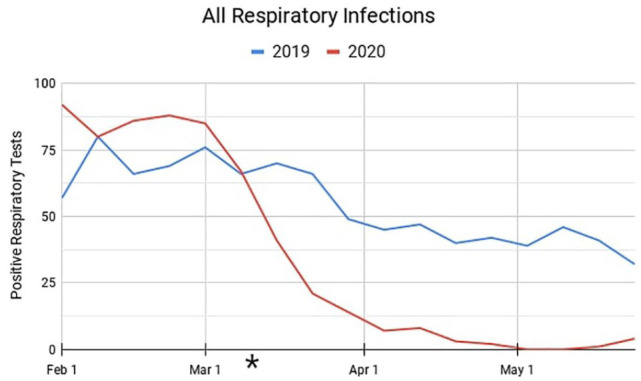
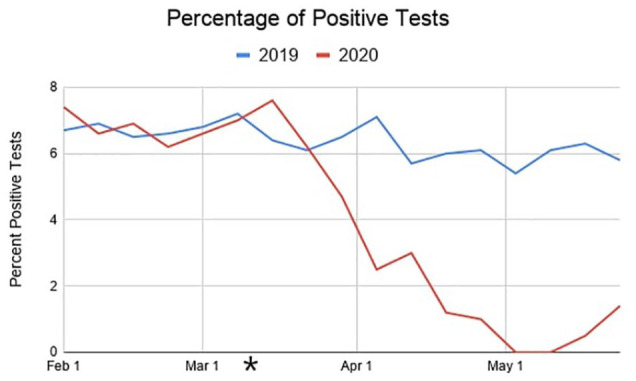
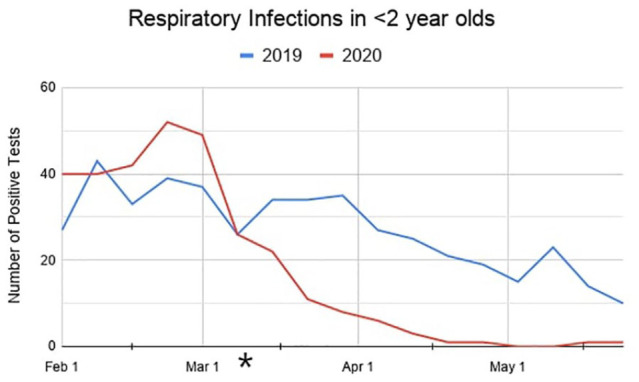
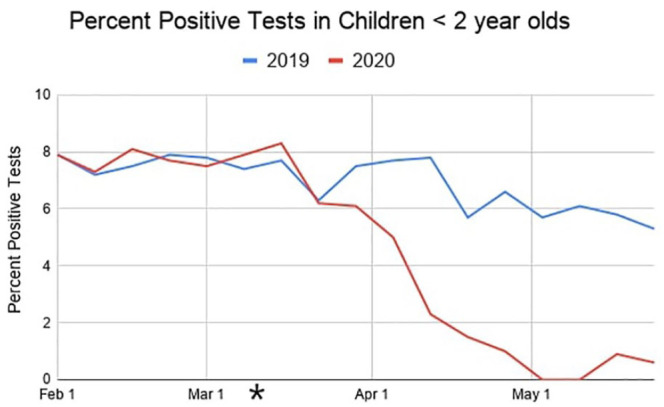
To combat the spread of coronavirus disease 2019 (COVID-19), significant measures were enacted including school and business closures, social distancing, and facial coverings. We hypothesized that this would have an impact on all respiratory infections in children. Using nasopharyngeal panel test results of children in the emergency department, we evaluated cross-sectional data from February to May in both 2019 and 2020. Respiratory panel testing included 11 common respiratory viruses and bacteria. After the restrictions were enacted, we observed a large drop in the number and percentage positive of all common respiratory viral infections in 2020 compared with the same time in 2019. When analyzing data from children <2 years old, a similar decrease was seen. Restrictions enacted to prevent the spread of COVID-19 were associated with a significant decrease in respiratory viral infections in children of all ages. This association could guide future public health recommendations and guidelines.

Keywords: COVID-19 restrictions; pandemic; respiratory infections; viral testing.


Conflict of interest statement

Declaration of Conflicting Interests: The author(s) declared no potential conflicts of interest with respect to the research, authorship, and/or publication of this article.

Figures

Figure 1.
Figure 1.
The number of respiratory infections by week in 2019 compared with 2020. The asterisk denotes the time when coronavirus disease 2019 restrictions were begun.
Figure 2.
Figure 2.
The percentage of positive tests by week in 2019 compared with 2020. The asterisk denotes the time when coronavirus disease 2019 restrictions were begun.
Figure 3.
Figure 3.
The number of respiratory infections in <2 year olds by week in 2019 compared with 2020. The asterisk denotes the time when coronavirus disease 2019 restrictions were begun.
Figure 4.
Figure 4.
The percentage of positive tests in <2 year olds by week in 2019 compared with 2020. The asterisk denotes the time when coronavirus disease 2019 restrictions were begun.

References

    1. Britton PN, Hu N, Saravanos G, et al.. COVID-19 public health measures and respiratory syncytial virus. Lancet Child Adolesc Health. 2020;4:e42-e43. doi:10.1016/S2352-4642(20)30307-2 - DOI - PMC - PubMed
    1. Cauchemez S, Valleron AJ, Boëlle PY, Flahault A, Ferguson NM.Estimating the impact of school closure on influenza transmission from Sentinel data. Nature. 2008;452:750-754. doi:10.1038/nature06732 - DOI - PubMed
    1. Cowling BJ, Ali ST, Ng TWY, et al.. Impact assessment of non-pharmaceutical interventions against coronavirus disease 2019 and influenza in Hong Kong: an observational study. Lancet Public Health. 2020;5:e279-e288. doi:10.1016/S2468-2667(20)30090-6. - DOI - PMC - PubMed
    1. Huang QS, Wood T, Jelley L, et al.. Impact of the COVID-19 nonpharmaceutical interventions on influenza and other respiratory viral infections in New Zealand. Nat Commun. 2021;12:1001. doi:10.1038/s41467-021-21157-9 - DOI - PMC - PubMed
    1. Kuo SC, Shih SM, Chien LH, Hsiung CA.Collateral benefit of COVID-19 control measures on influenza activity, Taiwan. Emerg Infect Dis. 2020;26:1928-1930. doi:10.3201/eid2608.201192 - DOI - PMC - PubMed