. 2021 Aug 3:149:e194.
doi: 10.1017/S0950268821001886.

Prevalence and determinants of serum antibodies to SARS-CoV-2 in the general population of the Gardena valley

Affiliations

Prevalence and determinants of serum antibodies to SARS-CoV-2 in the general population of the Gardena valley

Roberto Melotti et al. Epidemiol Infect. .

Abstract

Estimating the spread of SARS-CoV-2 infection in communities is critical. We surveyed 2244 stratified random sample community members of the Gardena valley, a winter touristic area, amidst the first expansion phase of the COVID-19 pandemic in Europe. We measured agreement between Diasorin and Abbott serum bioassay outputs and the Abbott optimal discriminant threshold of serum neutralisation titres with recursive receiver operating characteristic curve. We analytically adjusted serum antibody tests for unbiased seroprevalence estimate and analysed the determinants of infection with non-response weighted multiple logistic regression. SARS-CoV-2 seroprevalence was 26.9% (95% CI 25.2-28.6) by June 2020. The bioassays had a modest agreement with each other. At a lower threshold than the manufacturer's recommended level, the Abbott assay reflected greater discrimination of serum neutralisation capacity. Seropositivity was associated with place and economic activity, not with sex or age. Symptoms like fever and weakness were age-dependent. SARS-CoV-2 mitigation strategies should account for context in high prevalence areas.

Keywords: COVID-19; Coronavirus; SARS-CoV-2; neutralising antibodies; prevalence.


Conflict of interest statement

None.

Figures
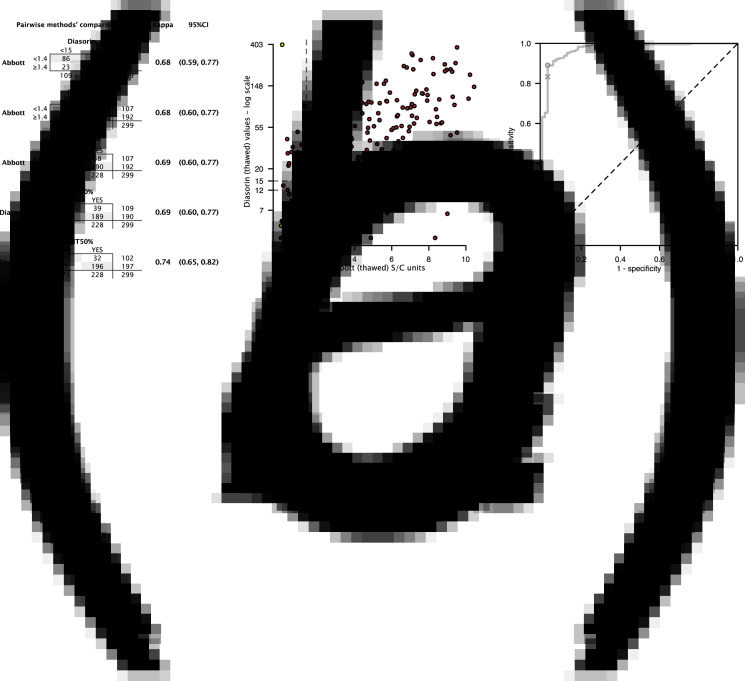
Fig. 1.
Fig. 1.
Antibody test performance evaluations. (a) Pairwise comparisons and κ statistics with their 95% CIs across all antibody assays and PRNT at 50%. (b) Scatterplot of the Abbott assay results (x-axis) vs. the Diasorin assay results (y-axis, in logarithmic scale), in the context of PRNT results (yellow dots: negative; brown dots: positive). Dashed lines indicate the clinically relevant thresholds for positivity. (c) ROC curve used to define the optimal cut-off for S/C (AAI) values as a classifier. Plotted here is the true-positive rate (sensitivity) vs. the false-positive rate (1 – specificity) for increasing values of AAI for all 299 individuals subject to PRNT. The diagonal corresponds to the ROC curve of a random classifier. Discriminative classifiers produce curves drawn towards the upper left corner, where sensitivity = specificity = 1. A perfectly discriminating classifier generates a ROC curve that starts at the lower left corner and advances as a vertical line to the upper left corner and from there horizontally to the upper right corner. The cross corresponds to the classifier performance using AAI = 1.4. In the sample under investigation, optimal classifier performance is achieved for AAI = 1.16 (circle).
Fig. 2.
Fig. 2.
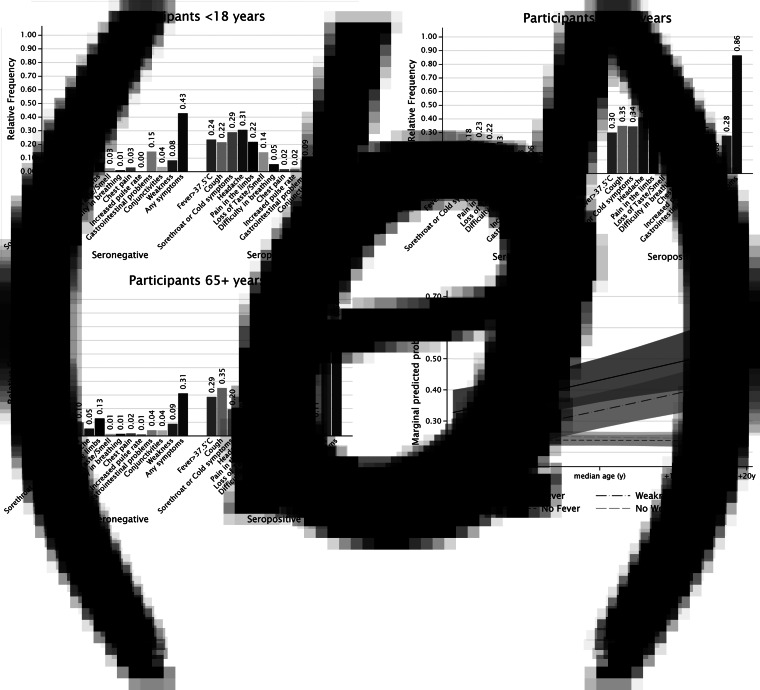
Association between reported symptoms and seroprevalence. (a) to (c) Symptoms frequency distribution in seronegative and seropositive participants, by age group; (a) <18 years old; (b) 18–64 years old; (c) 65+ years old. (d) Marginal predicted probabilities of anti-SARS-CoV-2 IgG antibodies by linear effect of age as moderated by specific symptoms. Linear predictions and 95% confidence bands are displayed on the graph for participants with fever (plain line and dark grey bands), with no fever (dash line and mild grey bands), with weakness (long-dash dot line and plain grey bands) and with no weakness (long-dash line and light grey bands). For example, a participant of median age would have roughly the same marginal probability of infection of either older or younger participants, if they had no symptoms of fever and weakness, integrating across all possible predictors (e.g. Pr = 0.24 if no fever present and median age, 95% CI 0.22–0.26). However, the estimated marginal probability of infection was 0.33 (95% CI 0.26–0.40) for participants 20 years younger than the median age and 0.54 (95% CI 0.42–0.65) for participants 20 years older than the median age if they had fever. Corresponding probabilities for participants with weakness were 0.24 (95% CI 0.17–0.31) and 0.44 (95% CI 0.36–0.52), for participants 20 years younger and 20 years older than the median age, respectively.
Fig. 3.
Fig. 3.
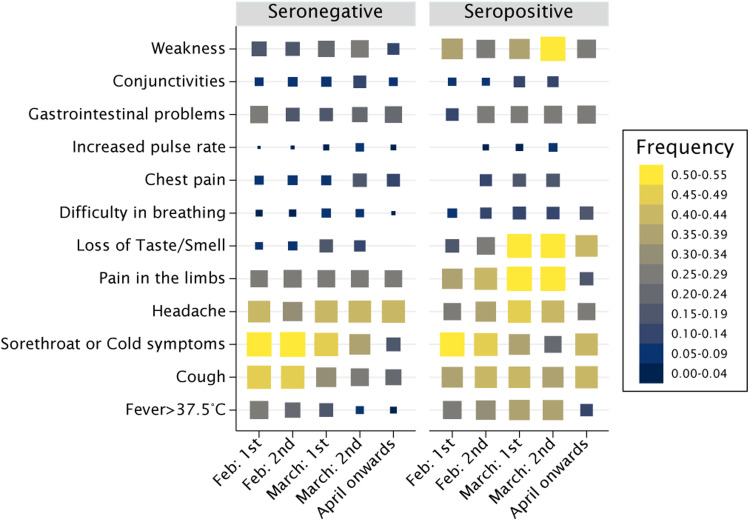
Reported symptoms by time of symptom onset in seronegative and seropositive participants. Rectangle sizes are proportional to the frequency of symptoms across periods, within groups. The symptoms most predictive of seropositivity (loss of taste or smell; weakness; pain in the limbs; fever; and breathlessness) were apparently more prevalent among seropositive than seronegative participants at the time of peak incidence of the epidemic first wave in the valley, between late February, throughout March and part of April.

References

    1. Gudbjartsson DFet al. (2020) Spread of SARS-CoV-2 in the Icelandic population. New England Journal of Medicine 382, 2302–2315. - PMC - PubMed
    1. Lipsitch M, Swerdlow DL and Finelli L (2020) Defining the epidemiology of Covid-19 – studies needed. New England Journal of Medicine 382, 1194–1196. - PubMed
    1. Lavezzo Eet al. (2020) Suppression of a SARS-CoV-2 outbreak in the Italian municipality of Vo’. Nature 584, 425–429. - PubMed
    1. Rostami Aet al. (2021) SARS-CoV-2 seroprevalence worldwide: a systematic review and meta-analysis. Clinical Microbiology and Infection 27, 331–340. - PMC - PubMed
    1. Bryan Aet al. (2020) Performance characteristics of the Abbott architect SARS-CoV-2 IgG assay and seroprevalence in Boise, Idaho. Journal of Clinical Microbiology 58, e00941-20. - PMC - PubMed

Publication types