Review
. 2022 Jan;47(1):41-57.
doi: 10.1038/s41386-021-01137-9. Epub 2021 Oct 13.

Development of prefrontal cortex

Affiliations
Review

Development of prefrontal cortex

Sharon M Kolk et al. Neuropsychopharmacology. 2022 Jan.

Abstract

During evolution, the cerebral cortex advances by increasing in surface and the introduction of new cytoarchitectonic areas among which the prefrontal cortex (PFC) is considered to be the substrate of highest cognitive functions. Although neurons of the PFC are generated before birth, the differentiation of its neurons and development of synaptic connections in humans extend to the 3rd decade of life. During this period, synapses as well as neurotransmitter systems including their receptors and transporters, are initially overproduced followed by selective elimination. Advanced methods applied to human and animal models, enable investigation of the cellular mechanisms and role of specific genes, non-coding regulatory elements and signaling molecules in control of prefrontal neuronal production and phenotypic fate, as well as neuronal migration to establish layering of the PFC. Likewise, various genetic approaches in combination with functional assays and immunohistochemical and imaging methods reveal roles of neurotransmitter systems during maturation of the PFC. Disruption, or even a slight slowing of the rate of neuronal production, migration and synaptogenesis by genetic or environmental factors, can induce gross as well as subtle changes that eventually can lead to cognitive impairment. An understanding of the development and evolution of the PFC provide insight into the pathogenesis and treatment of congenital neuropsychiatric diseases as well as idiopathic developmental disorders that cause intellectual disabilities.


Conflict of interest statement

The authors declare no competing interests.

Figures

Fig. 1
Fig. 1. Prefrontal birthdating experiment in nonhuman primate.
A Pen drawing of a macaque brain (side view) with the PFC indicated in pink. B Schematic overview of the time line for which [3H] thymidine ([3H]dT) injections were given at particular embryonic (E) time points indicated by green arrowheads. sac, sacrifice. C Relationship of time of origin and the final position of neurons destined for the PFC in macaque monkeys based on autoradiographic labeling of DNA replication by [3H] thymidine at various days of gestation (for details of the approach and methodology see Rakic [48]. Embryonic days are represented on the horizontal axis, vertical lines indicate the embryonic day on which an animal received a pulse of [3H]dT and the horizontal markers on the vertical lines represent the positions of heavily labeled neurons in the PFC. A schematic representation of the approximate position of layers I–VI and the white matter (WM) is indicated on the left (green rectangle). The data show that all neurons in PFC are generated between embryonic (E) day 40 and E90 within the 165-day-long gestational period in this primate species.
Fig. 2
Fig. 2. The evolution of corticogenesis.
A Three-dimensional reconstruction of postmitotic neurons migrating along radial glial fibers, based on electron micrographs of semi-serial sections of the monkey fetal cerebral cortex with permission from Rakic [56]. B Representation of the radial unit hypothesis based on Rakic [33] with permission from Silver et al. [396]. C Illustration of the dynamics of major developmental events and diversity of progenitors involved in the development of primate cerebral neocortex based on studies of Rakic, with permission from Silver et al. [396].
Fig. 3
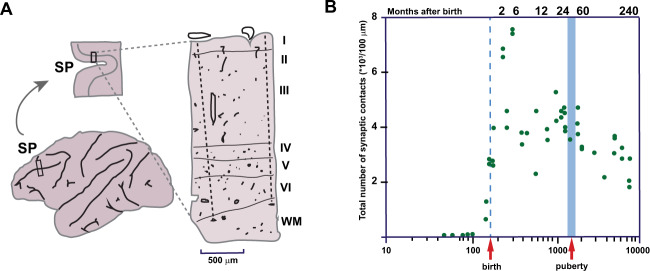
Fig. 3. Primate synaptogenesis in the PFC assessed by quantitative electron microscopy.
A Schematic representation of the site of the block dissection from the depth of the Sulcus Principalis (SP). On the right: The section of the cortex in the SP showing the vertical (radial) probes across layers I–VI, which were examined by electron microscopy. B The total number of synaptic contacts in each vertical probe as represented by the green dots. The semi-log plot in abscissa represents the number of days after conception. Adapted from Bourgeois et al. [49].
Fig. 4
Fig. 4. Development of dendritic spines on layer IIIC and layer V pyramidal neurons in the human PFC.
A Low-magnification photograph of the rapid Golgi-impregnated layer IIIc and V pyramidal cells in the dorsolateral PFC of a 16-year-old subject. B Neurolucida reconstruction of layer IIIc pyramidal neuron of a 49-year-old subject showing distal oblique (green), proximal oblique (blue) and basal dendrites (red). C Representative high-power magnification images of rapid Golgi-impregnated layer IIIc pyramidal neurons in a 1 month old infant, 2.5-year-old child, and 16-, 28-, and 49-year-old subjects. D Graphs representing number of dendritic spines per 50-μm dendrite segment on basal dendrites after the first bifurcation (red); apical proximal oblique dendrites originating within 100 μm from the apical main shaft (blue); and apical distal oblique dendrites originating within the second 100-μm segment from the apical main shaft (green) of layer IIIc (filled symbols) and layer V (open symbols) pyramidal cells in the human dorsolateral PFC. Squares represent males; circles represent females. The age in postnatal years is shown on a logarithmic scale. From Petanjek et al. [12].
Fig. 5
Fig. 5. Risk factors in PFC development.
Schematic overview of genetic and environmental risk factors during pregnancy to be the possible cause of NDDs (Clockwise: Genetic causes, Smoking, Drinking, prescription or recreational Drugs, certain combination of Nutrients, Physical factors such as UV, ultrasound or various radiations, Toxins, Virus infections). Possible causes for NDDs include specific genetic or environmental factors as well as a combination of both.

References

    1. Fuster JM. Prefrontal neurons in networks of executive memory. Brain Res Bull. 2000;52:331–6. - PubMed
    1. Fuster JM. Memory networks in the prefrontal cortex. Prog brain Res. 2000;122:309–16. - PubMed
    1. Goldman-Rakic PS. Circuitry of the primate prefrontal cortex and the regulation of behavior by representational memory. Handbook of Physiology, The Nervous System, Higher Functions of the Brain. In: Plum F, editor. Handbook of physiology, the nervous system, higher functions of the brain. Bethesda: American Physiological Society; 1987. pp. 373–417.
    1. Li H, Yan G, Luo W, Liu T, Wang Y, Liu R, et al. Mapping fetal brain development based on automated segmentation and 4D brain atlasing. Brain Struct Funct. 2021;226:1961–72. - PubMed
    1. Flak JN, Solomon MB, Jankord R, Krause EG, Herman JP. Identification of chronic stress-activated regions reveals a potential recruited circuit in rat brain. Eur J Neurosci. 2012;36:2547–55. - PMC - PubMed

Publication types

Substances