


It's Not Over Till It's Over: A Prospective Cohort Study and Analysis of "Anesthesia Stat!" Emergency Calls in the Pediatric Post-Anesthesia Care Unit (PACU)
- PMID: 34646626
- PMCID: PMC8480442
- DOI: 10.7759/cureus.17571
It's Not Over Till It's Over: A Prospective Cohort Study and Analysis of "Anesthesia Stat!" Emergency Calls in the Pediatric Post-Anesthesia Care Unit (PACU)
Abstract
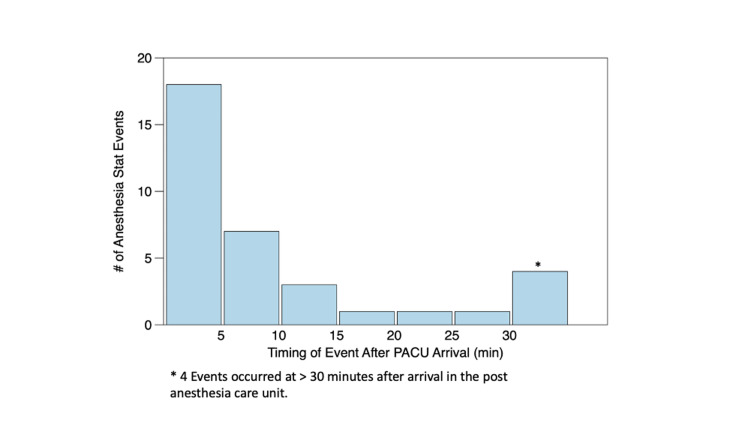
Background Emergency "Anesthesia Stat!" (AS!) calls remain a common practice in medical centers even when advanced communication infrastructures are available. We hypothesize that the analysis of post-procedure "AS!" calls will lead to actionable insights which may enhance patient safety. Methods After institutional review board approval, we prospectively collected data from April 2015 through May 2018 on "AS!" calls throughout the pediatric operating rooms (OR), off-site locations, and post-anesthesia care unit (PACU) at a tertiary university medical center. Data recorded included demographic information, location, time of the event, event duration, vital signs, medications, anesthesia staff, attending anesthesiologist, and staff responding to the call. A narrative account of the event was also documented. Results A total of 82 "AS!" calls occurred, with ages ranging from 11 days old to 17 years old. Forty-nine of the 82 calls (60%) occurred at emergence. Seventy-one of the 82 calls (87%) were solely respiratory-related. Thirty-five of 49 emergence calls (71%) occurred in the PACU. Further, 34 of 35 PACU calls (97%) were respiratory-related, with 30 of 35 PACU calls (86%) associated with desaturation requiring intervention by anesthesia staff. Finally, 31 of 35 PACU calls (89%) occurred within 30 minutes of patient arrival to PACU. Conclusion Analysis of "AS!" events from our PACU continues to support the need for the prompt and continuous availability of at least one staff member with advanced airway management skills. Further, pediatric patients undergoing general anesthesia and surgery should likely be monitored for a minimum of 30 minutes following arrival in the PACU.
Keywords: academic medical centers; anesthesia; child; emergencies; operating rooms; patient safety; pediatric anesthesiology.
Copyright © 2021, Vishneski et al.
Conflict of interest statement
The authors have declared that no competing interests exist.
Figures
References
-
- Pediatric perioperative adverse events requiring rapid response: a retrospective case-control study. Schleelein LE, Vincent AM, Jawad AF, et al. Paediatr Anaesth. 2016;26:734–741. - PubMed
-
- The anesthesia perioperative "Call for Help"-experience at a quaternary pediatric medical center: analysis of 67,564 anesthesia encounters. Vlassakova BG, Sinnott SM, Askins N, et al. Anesth Analg. 2018;127:126–133. - PubMed
-
- A prospective study of the efficiency of the "code 333" process at the Ottawa hospital. Amankwah Y, Caughey S, Walker M. J Obstet Gynaecol Can. 2011;33:244–251. - PubMed
-
- Critical incidents, including cardiac arrest, associated with pediatric anesthesia at a tertiary teaching children's hospital. Lee JH, Kim EK, Song IK, Kim EH, Kim HS, Kim CS, Kim JT. Paediatr Anaesth. 2016;26:409–417. - PubMed
-
- Pediatric critical incidents reported over 15 years at a tertiary care teaching hospital of a developing country. Abbasi S, Khan FA, Khan S. https://pubmed.ncbi.nlm.nih.gov/29643628/ J Anaesthesiol Clin Pharmacol. 2018;34:78–83. - PMC - PubMed
LinkOut - more resources
Full Text Sources
Research Materials
Miscellaneous