


Brain energy failure in dementia syndromes: Opportunities and challenges for glucagon-like peptide-1 receptor agonists
- PMID: 34647685
- PMCID: PMC8940606
- DOI: 10.1002/alz.12474
Brain energy failure in dementia syndromes: Opportunities and challenges for glucagon-like peptide-1 receptor agonists
Abstract
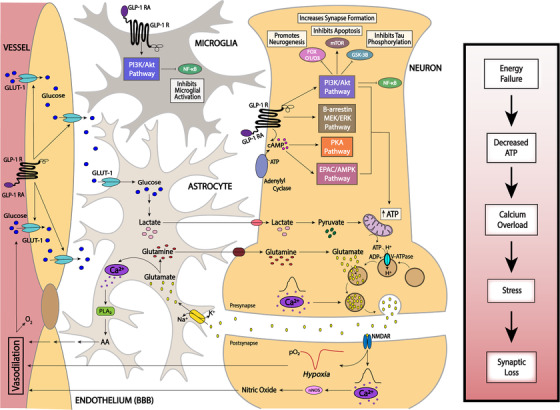
Medications for type 2 diabetes (T2DM) offer a promising path for discovery and development of effective interventions for dementia syndromes. A common feature of dementia syndromes is an energy failure due to reduced energy supply to neurons and is associated with synaptic loss and results in cognitive decline and behavioral changes. Among diabetes medications, glucagon-like peptide-1 (GLP-1) receptor agonists (RAs) promote protective effects on vascular, microglial, and neuronal functions. In this review, we present evidence from animal models, imaging studies, and clinical trials that support developing GLP-1 RAs for dementia syndromes. The review examines how changes in brain energy metabolism differ in conditions of insulin resistance and T2DM from dementia and underscores the challenges that arise from the heterogeneity of dementia syndromes. The development of GLP-1 RAs as dementia therapies requires a deeper understanding of the regional changes in brain energy homeostasis guided by novel imaging biomarkers.
Keywords: Alzheimer's disease; glucagon-like peptide-1; insulin resistance; type 2 diabetes.
© 2021 The Authors. Alzheimer's & Dementia published by Wiley Periodicals LLC on behalf of Alzheimer's Association.
Conflict of interest statement
Hussein N. Yassine is the co‐chair of the Nutrition, Metabolism and Dementia Professional Interest Area (PIA), ISTAART. HCC sits on advisory panel of the Alzheimer's Association Los Angeles–no payments received. MNB is the director of the Masters in Neuroimaging and Informatics program at USC. Lon S. Schneider receives consulting fees from Abbott, AC Immune, Avraham, Ltd, Boehringer Ingelheim, Cognition Therapeutics, Cortexyme, Eisai, Fujifilm, Immunobrain Checkpoint Ltd, Neurally Inc, Neurim Ltd, Neuronix Ltd, Samus, Takeda, and vTv. All other authors report no other disclosures.
Figures
References
-
- Minoshima S, Cross DJ, Foster NL, Henry TR, Kuhl DE. Discordance between traditional pathologic and energy metabolic changes in very early Alzheimer's disease. Pathophysiological implications. Ann N Y Acad Sci. 1999;893:350‐352. - PubMed
-
- Simpson IA, Chundu KR, Davies‐Hill T, Honer WG, Davies P. Decreased concentrations of GLUT1 and GLUT3 glucose transporters in the brains of patients with Alzheimer's disease. Ann Neurol. 1994;35:546‐551. - PubMed
Publication types
MeSH terms
Substances
Grants and funding
- R01 AG057684/AG/NIA NIH HHS/United States
- P50 AG005142/AG/NIA NIH HHS/United States
- R01 AG062687/AG/NIA NIH HHS/United States
- R01 AG067063/AG/NIA NIH HHS/United States
- R01 AG055770/AG/NIA NIH HHS/United States
- R01 AG062007/AG/NIA NIH HHS/United States
- U01 AG051218/AG/NIA NIH HHS/United States
- R01 AG057658/AG/NIA NIH HHS/United States
- RF1 MH123223/MH/NIMH NIH HHS/United States
- P01 AG012435/AG/NIA NIH HHS/United States
- P30 AG066530/AG/NIA NIH HHS/United States
- R01 AG054434/AG/NIA NIH HHS/United States
- R01 AG051346/AG/NIA NIH HHS/United States
- R21 AG056518/AG/NIA NIH HHS/United States
LinkOut - more resources
Full Text Sources
Medical
