doi: 10.3201/eid2712.211426.
Epub 2021 Oct 14.
Heartland Virus Transmission, Suffolk County, New York, USA
- PMID: 34648421
- PMCID: PMC8632170
- DOI: 10.3201/eid2712.211426
Item in Clipboard
Heartland Virus Transmission, Suffolk County, New York, USA
Emerg Infect Dis.
2021 Dec.
Abstract
During 2018, Heartland virus RNA was detected in an Amblyomma americanum tick removed from a resident of Suffolk County, New York, USA. The person showed seroconversion. Tick surveillance and white-tailed deer (Odocoileus virginianus) serosurveys showed widespread distribution in Suffolk County, emphasizing a need for disease surveillance anywhere A. americanum ticks are established or emerging.
Keywords: Amblyomma americanum; HRTV; Heartland virus; New York; Suffolk County; United States; arboviruses; lone star tick; surveillance; ticks; transmission; vector-borne infections; viruses; white-tailed deer; zoonoses.
Figures
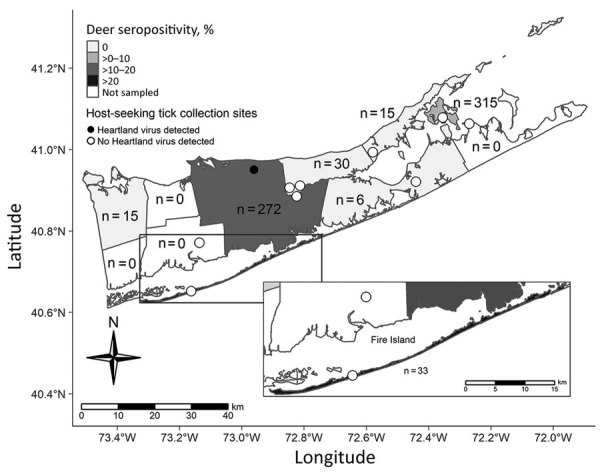
Tick collection sites in study of heartland virus transmission, Suffolk County, New York, USA. Numbers within townships indicate sample size of deer tested for neutralizing antibody.
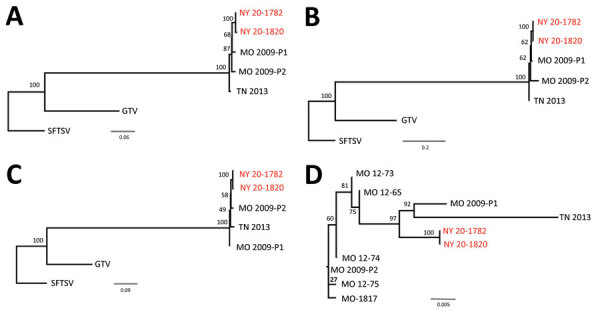
Phylogenetic relationship among Heartland virus isolates, Suffolk County, Long Island, New York, USA. Separate alignments of large segments (A), medium segments (B), small segments (C), and partial nonstructural sequences (D) were created with MAFFT in Geneious version 11.1.5 (https://www.geneious.com ). Maximum–likelihood analyses were completed with RAxML (https://cme.h–its.org ) using 1,000 bootstraps. Bootstrap values are indicated at each node. Phylogenetic trees for each segment were rooted to SFTSV strain HB154 (GenBank accession nos. JQ733560–62). Guerta virus strain DXM was included as an additional outgroup (GenBank accession nos. 328591–93). New York isolates from this study (red text), together with the 3 previously available full–genome sequences (MO 2009–P1 [patient 1, GenBank accession nos. JX005842, 4, 6]; MO 2009–P2 [patient 2, GenBank accession nos. X005843, 5, and 7]; and TN 2013 [TN, GenBank accession nos. J740146–8]), were included in these analyses (panels A, B, and C). Six additional partial sequences available for a 606–nt region of the nonstructural protein gene (GenBank accession nos. C466555, KC466560, KC466561, KC466562, KC466563, and MT052710) are indicated in an unrooted maximum–likelihood tree in panel D. Scale bars indicate nucleotide substitutions per site. GTV; Guerta virus; SFTSV, severe fever with thrombocytopenia syndrome virus.
References
-
- Centers for Disease Control and Prevention. Heartland virus disease cases by state, as of January 2021. April 23, 2021. [cited 2021 Aug 10]. https://www.cdc.gov/heartland–virus/statistics/index.html
Publication types
MeSH terms
Supplementary concepts
Grants and funding
LinkOut - more resources
Full Text Sources