Review
. 2021 Oct 14;17(10):e1009926.
doi: 10.1371/journal.ppat.1009926. eCollection 2021 Oct.

Deconstructing virus condensation

Affiliations
Review

Deconstructing virus condensation

Nora Lopez et al. PLoS Pathog. .

Abstract

Viruses have evolved precise mechanisms for using the cellular physiological pathways for their perpetuation. These virus-driven biochemical events must be separated in space and time from those of the host cell. In recent years, granular structures, known for over a century for rabies virus, were shown to host viral gene function and were named using terms such as viroplasms, replication sites, inclusion bodies, or viral factories (VFs). More recently, these VFs were shown to be liquid-like, sharing properties with membrane-less organelles driven by liquid-liquid phase separation (LLPS) in a process widely referred to as biomolecular condensation. Some of the best described examples of these structures come from negative stranded RNA viruses, where micrometer size VFs are formed toward the end of the infectious cycle. We here discuss some basic principles of LLPS in connection with several examples of VFs and propose a view, which integrates viral replication mechanisms with the biochemistry underlying liquid-like organelles. In this view, viral protein and RNA components gradually accumulate up to a critical point during infection where phase separation is triggered. This yields an increase in transcription that leads in turn to increased translation and a consequent growth of initially formed condensates. According to chemical principles behind phase separation, an increase in the concentration of components increases the size of the condensate. A positive feedback cycle would thus generate in which crucial components, in particular nucleoproteins and viral polymerases, reach their highest levels required for genome replication. Progress in understanding viral biomolecular condensation leads to exploration of novel therapeutics. Furthermore, it provides insights into the fundamentals of phase separation in the regulation of cellular gene function given that virus replication and transcription, in particular those requiring host polymerases, are governed by the same biochemical principles.


Conflict of interest statement

The authors have declared that no competing interests exist.

Figures
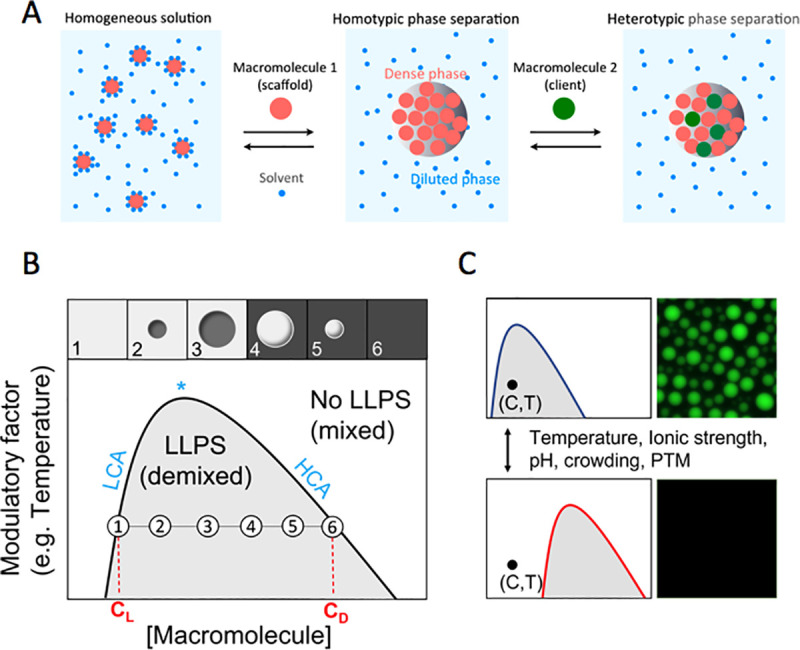
Fig 1
Fig 1. Overview of LLPS, phase diagram, and modulation.
(A) Under certain conditions, a solvated macromolecule (scaffold) undergo homotypic LLPS and concentrate in a distinct liquid compartment (dense phase). One or more additional macromolecules (clients) can partition into the new phase through heterotypic LLPS. (B) A phase diagram describes the phase behavior of a binary (macromolecule and solvent) or multicomponent system (at least 2 macromolecules) as a function of macromolecular concentration or any other physicochemical factor that may modulate its condensation tendency. Here, we present a concentration vs temperature phase diagram for a binary system. A phase boundary (black curve, known as binodal) defines whether the system is in a 1-phase regime (mixed solution) or in a 2-phase regime (demixed solution). All coordinate pairs of concentration and temperature that lie beneath the phase boundary (gray) give rise to LLPS. The phase boundary maximum is the critical point (star), above which a homogeneous solution is seen at any macromolecular concentration. The critical point divides the phase boundary in 2 segments known as low concentration arm (LCA, left) and high concentration arm (HCA, right). The LCA defines the concentration of the diluted or light phase (CL), whereas the HCA defines the concentration of the dense phase (CD). Increasing total concentration in the light phase above the concentration threshold only changes the relative volumes between phases (i.e., droplets become larger at the expense of the diluted phase; see Fig 3). The top panel of (B) illustrates this phenomenon: (1) macromolecule concentration at threshold, no LLPS. At higher concentration, small droplets form (2) growing in size (3) as concentration increases. Eventually, the volume of the dense phase is higher than the diluted phase, so surface tension dictates the formation of diluted droplets surrounded by dense phase (4). After this inversion boundary, increasing concentration decreases the diluted droplets size (5) until a 1-phase regime of dense solution only is achieved (6). (C) Modulatory effectors such as PTMs or pH operate by altering the forces that drive droplet formation, thus changing the phase boundary. All of these modulatory effects may act in favor or against LLPS, depending on the nature of the interactions involved. For instance, addition of a negative charge by phosphorylation has the potential to engage components in electrostatic attractive or repulsive forces. C,T, concentration, temperature; HCA, high concentration arm; LCA, low concentration arm; LLPS, liquid–liquid phase separation; PTM, posttranslational modification.
Fig 2
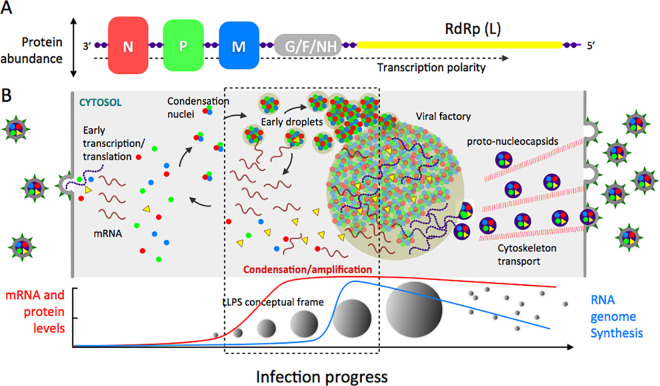
Fig 2. A general integrative model for condensation of VFs based on NSVs.
(A) Simplified depiction of nsNSV genome structure. The viral transcription mechanism ensures a gradient of protein expression, with higher abundance of N, encoded at the 3′ region, and lower abundance of the large polymerase, invariably encoded at the 5′ end of nsNSV genomes. (B) Model depicting the formation of cytosolic VFs along viral infection. The schema stresses the amplification effect on RNA and protein synthesis caused by the self-primed formation of condensates (see main text). Toward the end of the infectious cycle, the immature nucleocapsids (proto-nucleocapsids) protrude from the VF and are transported along the cytoskeleton network to the assembly site [73]. The principle behind LLPS indicate that as the concentration of components increase, a partition into a newer denser phase takes place, where the concentration within the droplets remain constant, and further increase in the concentration of the components in the surrounding milieu cause an increment of the size of the condensates. The condensation event causes an abrupt increase of the effective local concentration of RNA and proteins, the drivers of the LLPS, which results in a substantial amplification of transcription and genome replication in the VF. LLPS, liquid–liquid phase separation; nsNSV, nonsegmented NSV; NSV, negative-stranded virus; RdRp, RNA-dependent RNA polymerase; VF, viral factory.
Fig 3
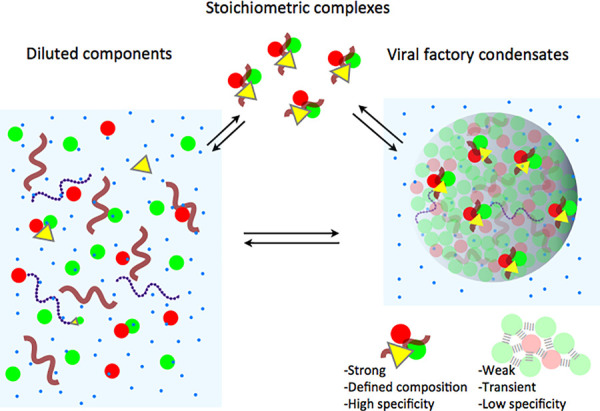
Fig 3. Nature of interactions in a viral condensate.
Complexes of different molecularity between the replication/transcription machinery exist in solution below their respective association constant. Above that level, defined stoichiometric complexes are formed, which are also present within the dense phase, coexisting with excess free components, particularly those acting as scaffold or drivers for LLPS. These complexes are held together by strong and specific interaction. Conversely, the interactions holding the condensate are weak and transient, required for a modulated assembly/disassembly, and display low specificity. These low affinity interactions take place only in the condensate, where concentrations can be a few orders of magnitude higher than those in the diluted cytosolic phase. LLPS, liquid–liquid phase separation.

References

    1. Kim J, Lee H, Lee HG, Seo PJ. Get closer and make hotspots: liquid-liquid phase separation in plants. EMBO Rep. 2021;22(5):e51656. doi: 10.15252/embr.202051656 ; PMCID: PMC8097390. - DOI - PMC - PubMed
    1. Fromm SA, Kamenz J, Noldeke ER, Neu A, Zocher G, Sprangers R. In vitro reconstitution of a cellular phase-transition process that involves the mRNA decapping machinery. Angew Chem Int Ed Engl. 2014;53(28):7354–9. doi: 10.1002/anie.201402885 ; PMCID: PMC4320757. - DOI - PMC - PubMed
    1. Azaldegui CA, Vecchiarelli AG, Biteen JS. The emergence of phase separation as an organizing principle in bacteria. Biophys J. 2021;120(7):1123–38. doi: 10.1016/j.bpj.2020.09.023 ; PMCID: PMC8059088. - DOI - PMC - PubMed
    1. Wheeler RJ, Hyman AA. Controlling compartmentalization by non-membrane-bound organelles. Philos Trans R Soc Lond B Biol Sci. 2018;373(1747):20170193. doi: 10.1098/rstb.2017.0193 ; PMCID: PMC5904305. - DOI - PMC - PubMed
    1. Banani SF, Lee HO, Hyman AA, Rosen MK. Biomolecular condensates: organizers of cellular biochemistry. Nat Rev Mol Cell Biol. 2017;18(5):285–98. doi: 10.1038/nrm.2017.7 ; PMCID: PMC7434221. - DOI - PMC - PubMed

Publication types