. 2021 Oct 14;11(1):20464.
doi: 10.1038/s41598-021-99665-3.

E. coli aggregation and impaired cell division after terahertz irradiation

Affiliations

E. coli aggregation and impaired cell division after terahertz irradiation

Sergey Peltek et al. Sci Rep. .

Abstract

In this study we demonstrated that exposure of Escherichia coli (E. coli) to terahertz (THz) radiation resulted in a change in the activities of the tdcABCDEFGR and matA-F genes (signs of cell aggregation), gene yjjQ (signs of suppression of cell motility), dicABCF, FtsZ, and minCDE genes (signs of suppression of cell division), sfmACDHF genes (signs of adhesin synthesis), yjbEFGH and gfcA genes (signs of cell envelope stabilization). Moreover, THz radiation induced E. coli csg operon genes of amyloid biosynthesis. Electron microscopy revealed that the irradiated bacteria underwent increased aggregation; 20% of them formed bundle-like structures consisting of two to four pili clumped together. This could be the result of changes in the adhesive properties of the pili. We also found aberrations in cell wall structure in the middle part of the bacterial cell; these aberrations impaired the cell at the initial stages of division and resulted in accumulation of long rod-like cells. Overall, THz radiation was shown to have adverse effects on bacterial populations resulting in cells with abnormal morphology.


Conflict of interest statement

The authors declare no competing interests.

Figures
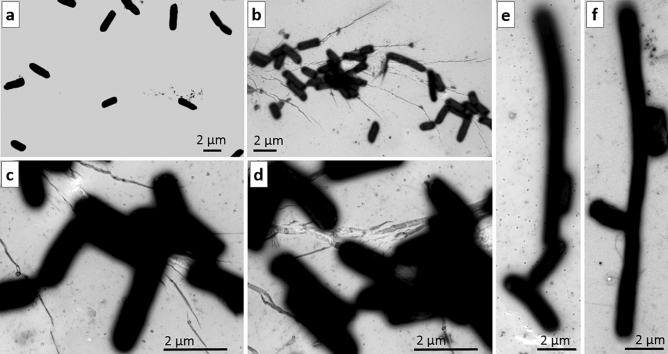
Figure 1
Figure 1
Aggregation of E. coli cells after treatment with THz radiation. (a) Stand-alone bacteria in the unirradiated sample. (b) Agglomeration of aggregated bacteria after the irradiation. (c,d) Magnified parts of panel (b). (b–f) Examples of aggregation of short and elongated (filamentous) bacteria. (b–d) Bacteria aggregate via side surfaces. (e,f) Bacteria aggregate through apical regions. The scale bar is 2 µm. Negative contrast.
Figure 2
Figure 2
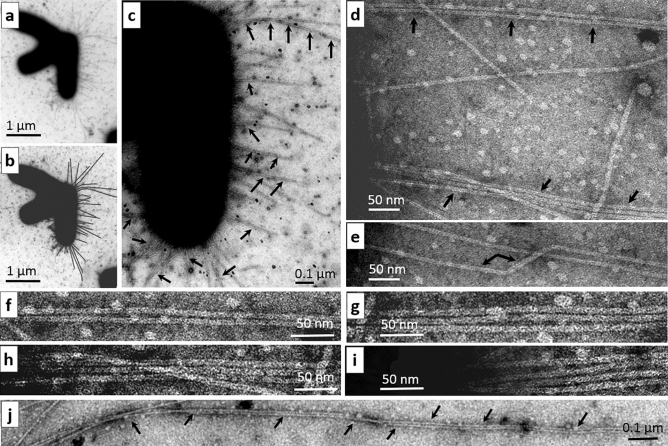
Multiple bundling of type 1 pili on E. coli cells after the THz irradiation. (a) Three aggregated bacterial cells are shown, one of which carries numerous type 1 pili: these pili have a diameter of 7.0–7.5 nm and vary in length from 0.1 to 2 µm, with maximal length in rare case reaching 3 µm. (b) The copy of (a) in which pili are indicated by black lines. (c) A magnified part of (a) with numerous examples of bundled pili (indicated by arrows) at low magnification. (d) A magnified part of (a) in which the arrows indicate two-pilus bundles. (e) Changes in the diameter of a pilus, indicated by interconnected arrows. (f–i) Examples of 2-, 3-, and 4-pilus bundles. (j) Adhesion of two pili throughout their considerable length. The scale bar is 1 µm in (a,b), 0.1 µm in (c,j), and 50 nm in (d–j).
Figure 3
Figure 3
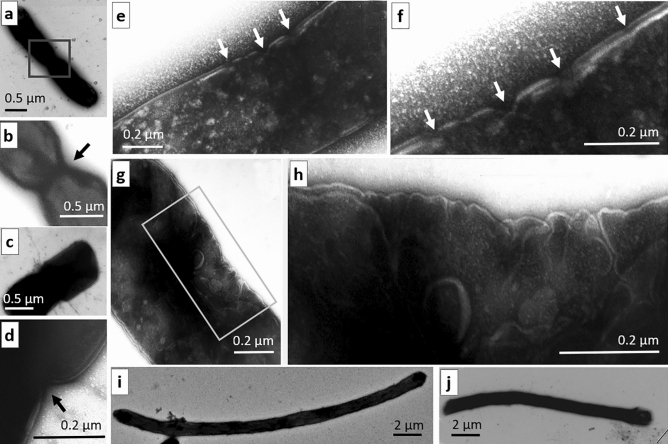
Disrupted structural organization of the envelope of dividing E. coli cells, as detected after exposure to THz radiation. (a–d) Examples of two dividing bacterial cells at low and high magnification with V-shaped invaginations in the envelope (indicated by arrows) in control. (e,f) Multiple V-shaped invaginations and breaches in the envelope of irradiated bacteria at low and high magnification (indicated by arrows). (g,h) Asymmetric unilateral formation of numerous folds in the envelope in the central part of an irradiated cell. The scale bar is 0.5 μm in (a–c); 0.2 μm in (d–h); and 2 μm in (i,j).

References

    1. Dhillon SS, et al. The 2017 terahertz science and technology roadmap. J. Phys. D Appl. Phys. 2017;50:043001. doi: 10.1088/1361-6463/50/4/043001. - DOI
    1. Weightman P. Prospects for the study of biological systems with high power sources of terahertz radiation. Phys. Biol. 2012;9:053001. doi: 10.1088/1478-3975/9/5/053001. - DOI - PubMed
    1. Il’ina IV, Sitnikov DS, Agranat MB. State-of-the-art of studies of the effect of terahertz radiation on living biological systems. High Temp. 2018;56:789–810. doi: 10.1134/s0018151x18050127. - DOI
    1. Cherkasova OP, et al. Effects of terahertz radiation on living cells: A review. Opt. Spectrosc. 2020;128:855–866. doi: 10.1134/S0030400X20060041. - DOI
    1. Demidova EV, et al. Studying the non-thermal effects of terahertz radiation on E. coli/pKatG-GFP biosensor cells. Bioelectromagnetics. 2013;34:15–21. doi: 10.1002/bem.21736. - DOI - PubMed

Publication types

MeSH terms