


Moderate gradient severe aortic stenosis: diagnosis, prognosis and therapy
- PMID: 34650372
- PMCID: PMC8503314
- DOI: 10.1093/eurheartj/suab108
Moderate gradient severe aortic stenosis: diagnosis, prognosis and therapy
Abstract
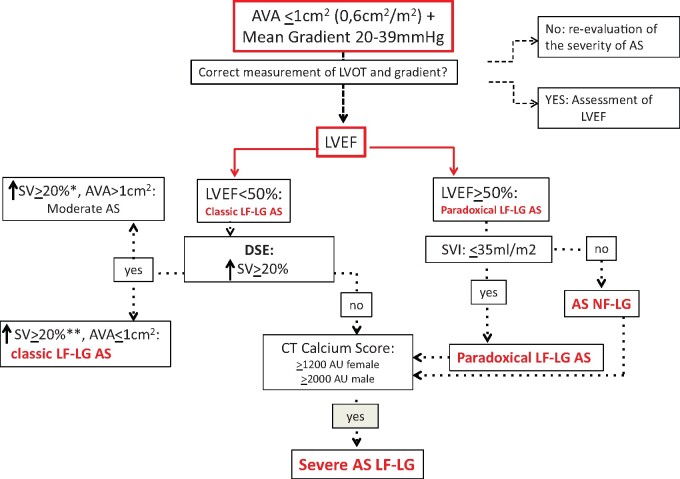
Aortic stenosis (AS) is defined as severe in the presence of: mean gradient ≥40 mmHg, peak aortic velocity ≥4 m/s, and aortic valve area (AVA) ≤1 cm2 (or an indexed AVA ≤0.6 cm2/m2). However, up to 40% of patients have a discrepancy between gradient and AVA, i.e. AVA ≤1 cm2 (indicating severe AS) and a moderate gradient: >20 and <40 mmHg (typical of moderate stenosis). This condition is called 'low-gradient AS' and includes very heterogeneous clinical entities, with different pathophysiological mechanisms. The diagnostic tools needed to discriminate the different low-gradient AS phenotypes include colour-Doppler echocardiography, dobutamine stress echocardiography, computed tomography scan for the definition of the calcium score, and recently magnetic resonance imaging. The prognostic impact of low-gradient AS is heterogeneous. Classical low-flow low-gradient AS [reduced left ventricular ejection fraction (LVEF)] has the worst prognosis, followed by paradoxical low-flow low-gradient AS (preserved LVEF). Conversely, normal-flow low-gradient AS is associated with a better prognosis. The indications of the guidelines recommend surgical or percutaneous treatment, depending on the risk and comorbidities of the individual patient, both for patients with classic low-flow low-gradient AS and for those with paradoxical low-flow low-gradient AS.
Keywords: Aortic valve replacement; Calcium score; Low-flow low-gradient; Severe aortic stenosis; TAVI.
Published on behalf of the European Society of Cardiology. © The Author(s) 2021.
Figures
References
-
- Otto CM, Nishimura RA, Bonow RO, Carabello BA, Erwin JP 3rd, Gentile F, Jneid H, Krieger EV, Mack M, McLeod C, O'Gara PT, Rigolin VH, Sundt TM 3rd, Thompson A, Toly C.. 2020 ACC/AHA Guideline for the management of patients with valvular heart disease: executive summary: a report of the American College of Cardiology/American Heart Association Joint Committee on Clinical Practice Guidelines. Circulation 2021;143:e35–e71. - PubMed
-
- Baumgartner H, Falk V, Bax JJ, De Bonis M, Hamm C, Holm PJ, Iung B, Lancellotti P, Lansac E, Rodriguez Muñoz D, Rosenhek R, Sjögren J, Tornos Mas P, Vahanian A, Walther T, Wendler O, Windecker S, Zamorano JL; ESC Scientific Document Group. 2017 ESC/EACTS Guidelines for the management of valvular heart disease. Eur Heart J 2017;38:2739–2791. - PubMed
-
- Hachicha Z, Dumesnil JG, Bogaty P, Pibarot P.. Paradoxical low-flow, low-gradient severe aortic stenosis despite preserved ejection fraction is associated with higher afterload and reduced survival. Circulation 2007;115:2856–2864. - PubMed
-
- Clavel MA, Burwash IG, Pibarot P.. Cardiac imaging for assessing low-gradient severe aortic stenosis. JACC Cardiovasc Imaging 2017;10:185–202. - PubMed
-
- Eleid MF, Goel K, Murad MH, Erwin PJ, Suri RM, Greason KL, Nishimura RA, Rihal CS, Holmes DR.. Meta-analysis of the prognostic impact of stroke volume, gradient, and ejection fraction after transcatheter aortic valve implantation. Am J Cardiol 2015;116:989–994. - PubMed
LinkOut - more resources
Full Text Sources
Research Materials