


Rewards of Compassion: Dispositional Compassion Predicts Lower Job Strain and Effort-Reward Imbalance Over a 11-Year Follow-Up
- PMID: 34650487
- PMCID: PMC8505888
- DOI: 10.3389/fpsyg.2021.730188
Rewards of Compassion: Dispositional Compassion Predicts Lower Job Strain and Effort-Reward Imbalance Over a 11-Year Follow-Up
Abstract
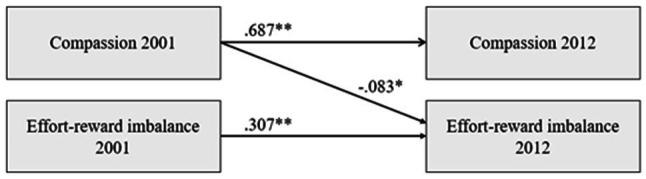
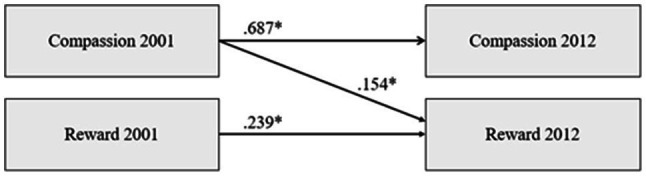
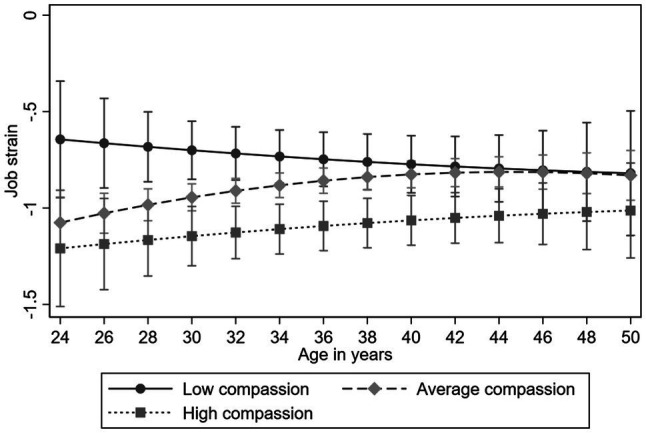
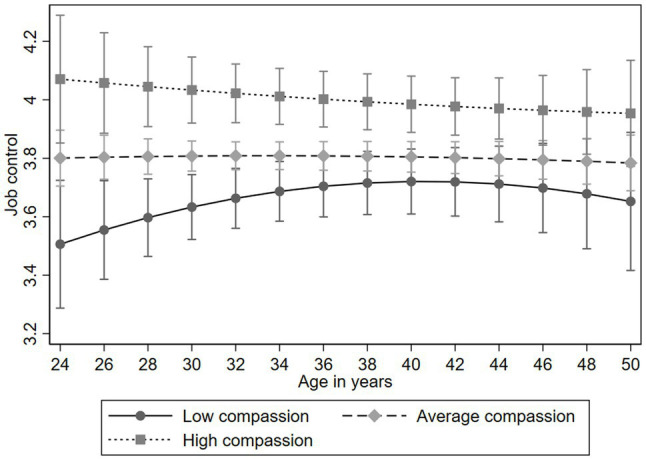
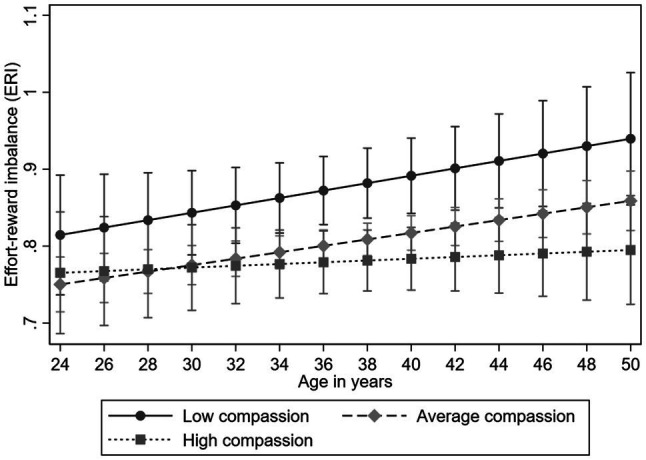
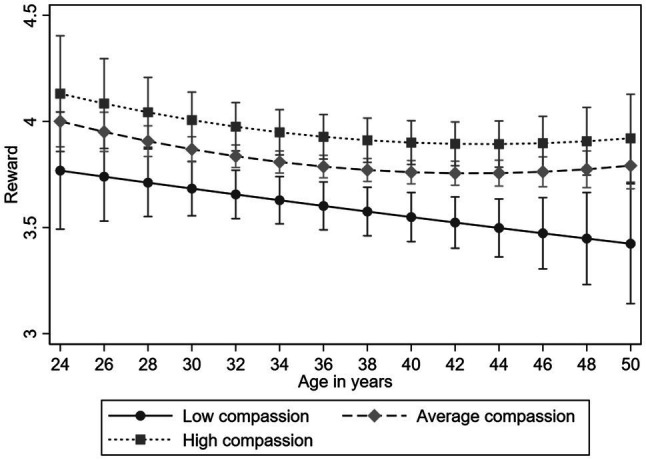
Dispositional compassion has been shown to predict higher well-being and to be associated with lower perceived stress and higher social support. Thus, compassion may be a potential individual factor protecting from job strain. The current study examines (i) whether dispositional compassion predicts job strain and effort-reward imbalance (ERI) or does the predictive relationship run from job strain and ERI to dispositional compassion and (ii) the effect of dispositional compassion on the developmental trajectory of job strain and ERI over a 11-year follow-up. We used data from the Young Finns study (n=723) between 2001 and 2012. The direction of the predictive relationships was analyzed with cross-lagged panel models. Compassion's effect on the trajectories of job strain, ERI, and their components was examined with multilevel models. First, the cross-lagged panel models demonstrated there was no evidence for the predictive pathways between compassion and job strain or its components. However, the predictive pathways from high dispositional compassion to low ERI and high rewards had better fit to the data than the predictive pathways in the opposite direction. In addition, multilevel models showed that high compassion predicted various job characteristics from early adulthood to middle age (lower job strain and higher job control as well as lower ERI and higher reward). Compassion did not predict job demand/effort. The findings were obtained independently of age, gender, and socioeconomic factors in childhood and adulthood. These findings indicate that compassion may be beneficial in work context. Further, compassion might be useful in the management or prevention of some aspects of strain. Our study provides new insight about the role of compassion in work life.
Keywords: compassion; effort-reward imbalance; job demand control; longitudinal; personality.
Copyright © 2021 Tolonen, Saarinen, Keltikangas-Järvinen, Siira, Kähönen and Hintsanen.
Conflict of interest statement
The authors declare that the research was conducted in the absence of any commercial or financial relationships that could be construed as a potential conflict of interest.
Figures
Similar articles
-
Negative emotionality, activity, and sociability temperaments predicting long-term job strain and effort-reward imbalance: a 15-year prospective follow-up study.J Psychosom Res. 2011 Aug;71(2):90-6. doi: 10.1016/j.jpsychores.2011.02.012. Epub 2011 Apr 6. J Psychosom Res. 2011. PMID: 21767689
-
Do dimensions from the Copenhagen Psychosocial Questionnaire predict vitality and mental health over and above the job strain and effort-reward imbalance models?Scand J Public Health. 2010 Feb;38(3 Suppl):59-68. doi: 10.1177/1403494809353436. Scand J Public Health. 2010. PMID: 21172772
-
Overcommitment as a predictor of effort-reward imbalance: evidence from an 8-year follow-up study.Scand J Work Environ Health. 2016 Jul 1;42(4):309-19. doi: 10.5271/sjweh.3575. Epub 2016 Jun 3. Scand J Work Environ Health. 2016. PMID: 27258720
-
Job strain, effort-reward imbalance and employee well-being: a large-scale cross-sectional study.Soc Sci Med. 2000 May;50(9):1317-27. doi: 10.1016/s0277-9536(99)00388-3. Soc Sci Med. 2000. PMID: 10728851 Review.
-
Job strain and effort-reward imbalance as risk factors for type 2 diabetes mellitus: A systematic review and meta-analysis of prospective studies.Scand J Work Environ Health. 2022 Jan 1;48(1):5-20. doi: 10.5271/sjweh.3987. Epub 2021 Sep 28. Scand J Work Environ Health. 2022. PMID: 34582561 Free PMC article.
Cited by
-
Health workers' conceptualisationand experiences of common mental symptoms and work-related psychosocial stressors in Central and Southern Ethiopian regions: a qualitative study.BMJ Open. 2025 Feb 26;15(2):e087811. doi: 10.1136/bmjopen-2024-087811. BMJ Open. 2025. PMID: 40010807 Free PMC article.
-
Exploring the link between work-related psychosocial factors and professional quality of life among ethiopian healthcare workers: Insights from structural equation modelling analyses.PLoS One. 2025 Mar 26;20(3):e0319870. doi: 10.1371/journal.pone.0319870. eCollection 2025. PLoS One. 2025. PMID: 40138351 Free PMC article.
References
-
- Abelson J. L., Erickson T. M., Mayer S. W., Crocker J., Briggs H., Lopez-Duran N. L., et al. . (2014). Brief cognitive intervention can modulate neuroendocrine stress responses to the trier social stress test: buffering effects of a compassionate goal orientation. Psychoneuroendocrinology 44, 60–70. doi: 10.1016/j.psyneuen.2014.02.016, PMID: - DOI - PMC - PubMed
-
- Berings D., De Fruyt F., Bouwen R. (2004). Work values and personality traits as predictors of enterprising and social vocational interests. Pers. Individ. Differ. 36, 349–364. doi: 10.1016/S0191-8869(03)00101-6 - DOI
-
- Brito-Pons G., Campos D., Cebolla A. (2018). Implicit or explicit compassion? Effects of compassion cultivation training and comparison with mindfulness-based stress reduction. Mindfulness 9, 1494–1508. doi: 10.1007/s12671-018-0898-z - DOI
LinkOut - more resources
Full Text Sources
