


Serum lactate concentration on admission to hospital predicts the postoperative mortality of elderly patients with hip fractures 30 days after surgery
- PMID: 34650704
- PMCID: PMC8507077
Serum lactate concentration on admission to hospital predicts the postoperative mortality of elderly patients with hip fractures 30 days after surgery
Abstract
Purpose: To determine whether serum lactate concentration on admission to hospital is a predictor for 30-day and 1-year mortality for patients who underwent hip-surgery.
Methods: Data from elderly patients with hip fractures admitted to our hospital (Jan 2012-Dec 2016) were reviewed. The lactate concentration on admission was assessed using a cut-off value of 2.0 mmol/L and then a new cut-off value was determined by maximizing the Youden index. Multivariate logistic regression was employed to verify whether a higher lactate concentration compared with the cutoff value was an independent risk factor for postoperative mortality after 30 days or at 1 year.
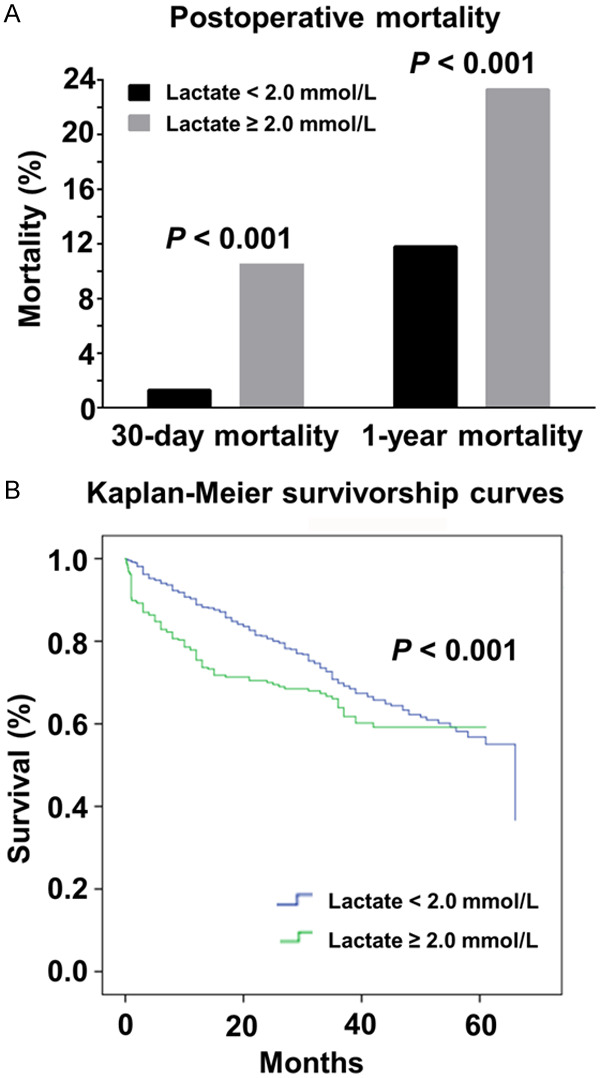
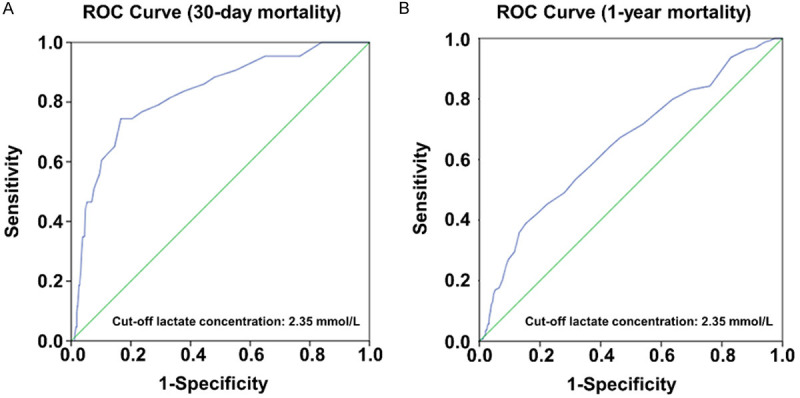
Results: A total of 1,004 patients were enrolled. There were differences in the incidence of postoperative complications (28.6% vs. 21.9%, P=0.022), length of stay (13.56±8.66 vs. 12.47±7.81 days, P=0.047), 30-day mortality (10.8% vs. 1.3%, P<0.001), 1-year mortality (23.3% vs. 11.8%, P<0.001) and survival time (23.92±16.58 vs. 28.81±16.54 months, P<0.001) between the ≥2.0 mmol/L (n=315) and <2 mmol/L (n=689) groups. Serum lactate concentration was a good predictor of 30-day mortality (AUC=0.829, P<0.001) with a cutoff value of lactate =2.35 mmol/L (sensitivity =0.744, specificity =0.834). Multivariate analysis revealed that a serum lactate concentration ≥2.35 mmol/L at admission was an independent risk factor for 30-day (OR=9.93, P<0.001) and 1-year (OR=2.23, P<0.001) mortality.
Conclusion: The admission lactate concentration (≥2.35 mmol/L) following hip fracture derived by this study was a significant predictor of mortality 30 days after surgery, which might help physicians to stratify the risk for these patients.
Keywords: 30-day mortality; Hip fracture; elderly; lactate concentration; predictor.
AJTR Copyright © 2021.
Conflict of interest statement
None.
Figures
References
-
- Mayordomo-Cava J, Abásolo L, Montero-Fernandez N, Ortiz-Alonso J, Vidán-Astiz M, Serra-Rexach JA. Hip fracture in nonagenarians: characteristics and factors related to 30-day mortality in 1177 patients. J Arthroplasty. 2020;35:1186–1193. - PubMed
-
- Johnell O, Kanis JA. An estimate of the worldwide prevalence, mortality and disability associated with hip fracture. Osteoporos Int. 2006;17:1726–33. - PubMed
-
- Menéndez-Colino R, Alarcon T, Gotor P, Queipo R, Ramírez-Martín R, Otero A, González-Montalvo JI. Baseline and pre-operative 1-year mortality risk factors in a cohort of 509 hip fracture patients consecutively admitted to a co-managed orthogeriatric unit (FONDA Cohort) Injury. 2018;49:656–661. - PubMed
-
- Karres J, Kieviet N, Eerenberg JP, Vrouenraets BC. Predicting early mortality after hip fracture surgery: the hip fracture estimator of mortality Amsterdam. J Orthop Trauma. 2018;32:27–33. - PubMed
LinkOut - more resources
Full Text Sources
Research Materials